
The spin over “the greenest road ever built in the UK” continues: National Highways has gained headlines by claiming to be using zero-emission construction machinery on the project, but this is mainly HVO, which is definitely not zero-emission at any point.
The project’s latest piece of propaganda, based on its 2025–26 Sustainability Report, claims:
Lower Thames Crossing begins one of world’s largest deployments of zero-emissions construction machinery
Work began in early 2026 and is being carried out only using electric, HVO and hydrogen powered equipment and machinery
HVO (Hydrotreated Vegetable Oil) can be used as a drop‑in replacement for diesel in most diesel engines without modification.
But these engines do still emit greenhouse gases and therefore cannot be described as zero emission.
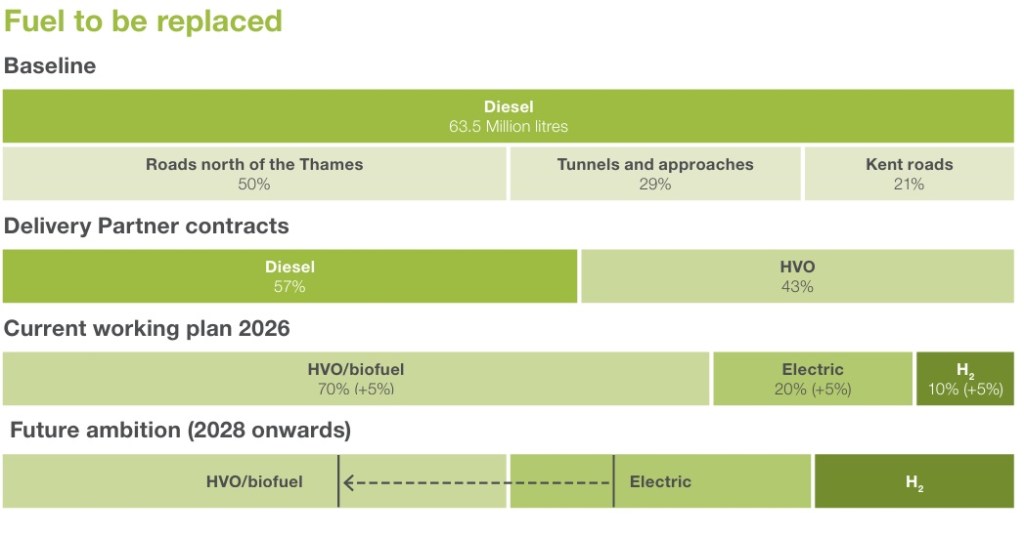
As the graphic below suggests, HVO/biofuel is expected to be 70% of the fuel used in 2026.
To add to the spin, the report itself says:
We have started replacing around 60 million litres of diesel with alternative fuels of electricity, green hydrogen, hydrotreated vegetable oil (HVO) and biofuel.
No, you aren’t replacing anything. If you didn’t build the scheme, you wouldn’t need 63.5 million litres of diesel or a “replacement”.
In any case, the tosh about “the greenest road ever built in the UK” ignores the huge carbon emissions from actually using it.
And is anyone else wondering why so much work is being done on a project that isn’t due to have a full business case until 2028 and whose outline business case is allegedly “in draft”?


Leave a comment