
National Highways has no plans to upgrade CCTV on its smart motorway network, despite an express statement in the Road investment Strategy (RIS3) that the government expects it to do so.
The government-owned company has been forced to disclose its planned spending on smart motorway technology and on maintenance of its network, ahead of possible cuts to fund increased defence spending.
The disclosure follows a Freedom of Information Act request by smart motorway campaigner Claire Mercer, who successfully challenged the company’s claim that it did not hold the information that she requested because the government was consulting on proposals to reduce capital funding by £428m over the first four years of the current RIS.
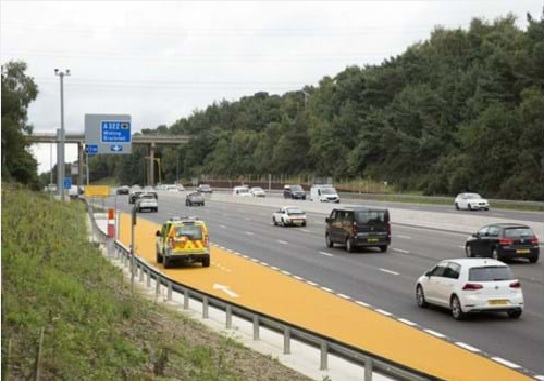
Mercer pointed out that the company had already allocated spending, even if it might subsequently be cut.
The company conceded in a review that its original response “was not compliant with the Freedom of Information Act”.
It then disclosed that, while it had no plans to add new or retrofitted technology to smart motorways during RIS3, it was planning to spend an estimated £309m on roadside technology renewals for smart motorways, with £46m being spent on CCTV renewals.
It explained that this was to replace existing technology such as CCTV, message signs, signals and emergency telephones “where needed due to their age or obsolescence”, but would not cover any increased capability, other than what might be covered in the latest specification “e.g. CCTV renewals may result in better picture quality”.

This means that the company’s plans are directly in contraction to a statement in the RIS document that:
we expect National Highways to continue to invest in the technology needed to help increase public confidence when driving on smart motorways,
like upgrading CCTV cameras to detect incidents that could have an impact on the safety of users or their journey times.
The refusal to upgrade CCTV means that the company does not plan to increase coverage, leaving operators dependent in many areas on tilt, pan and zoom cameras that need to be manually aimed and may well be pointing the wrong way when an incident occurs.
With stopped vehicle detection aiming to spot only four in five stopped vehicles, National Highways did trial an AI-based alternative that would use CCTV imagery. While such a system was found to be a possibility it was limited by poor CCTV coverage and was not taken forward.
The company also disclosed that its estimated maintenance budget in 2026/27 for the strategic road network (SRN) as a whole was “around £300m”. This figure for a financial year that is now halfway through, is from resource spending and not subject to cuts to capital.
It explained that this covered “a wide range of activities undertaken across a variety of assets [which] includes planned, cyclic maintenance to keep assets in a suitable condition such as emptying drainage gullies or electrical testing of roadside technology assets, as well as reactive maintenance to repair assets when defects occur, such as potholes, damaged road barrier, or flooding [and] our severe weather service to grit/salt the roads during winter and periods of extreme weather”.
Although the RIS 3 document refers to “increased levels of maintenance and renewals funding”, which “will enable stronger focus on planned and preventative maintenance”, this year’s planned maintenance spending appears broadly in line with previous years.
National Highways stressed that “the [budgetary] review is ongoing and as such National Highways does not know the revised budget at this time”.
The disclosure will however provide a baseline by which the extent of any cuts can be judged when the company publishes its delayed Strategic Business Plan and Delivery Plan.


Leave a comment