The Department for Transport (DfT) has finally issued the review of its decision to bury the outline business case (OBC) for the Lower Thames Crossing, with its claim that the document is “in draft” collapsing but the document still being buried.
And I would know, because the information tribunal case that provides the definitive authority that proves the DfT has got it wrong has my name on it, literally.
By way of a reminder, Rebecca Lush of Transport Action Network asked for the OBC after learning that it was used as the basis for a decision last year to take funding for the scheme beyond £3bn.
Despite this, the DfT claimed that the document was “draft” and “has not been finalised”, thereby falling under the Exception at Regulation 12(4)(d) of the Environmental Information Regulations.
Lush asked for a review in June and the DfT strung the case out for three months.
Despite upholding the original decision (to release none of the document), the DfT reviewer made clear that:
Having viewed the OBC I can see that it is dated 3rd October 2025 and is marked final version. It is therefore not an unfinished document.
So the original claims were wholly bogus. But the DfT took another tack. In a section of the review letter that does not make grammatical sense, it stated:
The spin over “the greenest road ever built in the UK” continues: National Highways has gained headlines by claiming to be using zero-emission construction machinery on the project, but this is mainly HVO, which is definitely not zero-emission at any point.
Lower Thames Crossing begins one of world’s largest deployments of zero-emissions construction machinery
Work began in early 2026 and is being carried out only using electric, HVO and hydrogen powered equipment and machinery
HVO (Hydrotreated Vegetable Oil) can be used as a drop‑in replacement for diesel in most diesel engines without modification.
But these engines do still emit greenhouse gases and therefore cannot be described as zero emission.
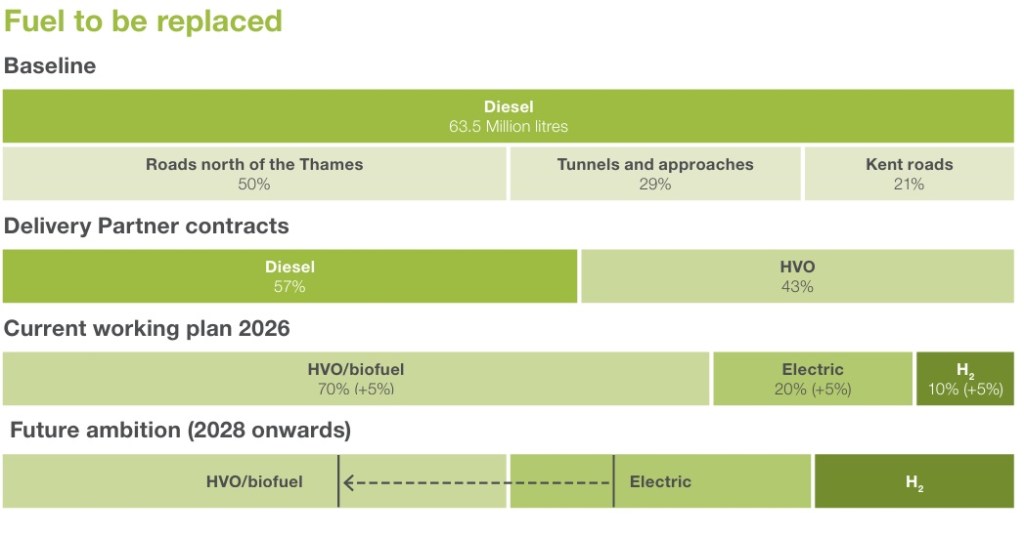
As the graphic below suggests, HVO/biofuel is expected to be 70% of the fuel used in 2026.
To add to the spin, the report itself says:
We have started replacing around 60 million litres of diesel with alternative fuels of electricity, green hydrogen, hydrotreated vegetable oil (HVO) and biofuel.
No, you aren’t replacing anything. If you didn’t build the scheme, you wouldn’t need 63.5 million litres of diesel or a “replacement”.
In any case, the tosh about “the greenest road ever built in the UK” ignores the huge carbon emissions from actually using it.
And is anyone else wondering why so much work is being done on a project that isn’t due to have a full business case until 2028 and whose outline business case is allegedly “in draft”?
Still on the subject of Heidi Alexander’s speech to the Labour conference, it has been pointed out to me that she also made no reference to any of the major road schemes that the government is officially taking forward, such as the A66 scheme or the Lower Thames Crossing.
Has the government gone cold on road building?
Here are the transport secretary’s references to roads in a speech that had a lot to say about the railways:
Roads riddled with potholes
Record investment in roads maintenance, Conference. The first Road Safety Strategy in over a decade.
Our newest Minister, Justin Madders, who is gripping the problem of driving test wait times and overseeing our investment in roads.
Given that the first reference to investment in roads is specifically to maintenance, it might be reasonable to assume that the second one is also and that the absence of reference to road building suggests that ministers are less keen on it than they were.
…Alexander told the News Agents podcast that Heathrow’s expansion was a “very significant infrastructure project” that should be weighed up against the country’s climate obligations and its impact on locals.
The comments represent a striking departure from the full-throated support that the Keir Starmer government gave the runway, which former Chancellor Rachel Reeves singled out as a key pillar in her bid to boost economic growth.
Having said that, the Independent reports Treasury minister James Murray as giving the scheme full-throated support, in spite of Andy Burnham’s refusal to do so:
But I think we recognise that having that third runway is really important for jobs, it’s really important to get that investment into Heathrow and it’s actually really important for the whole country because that investment in making Heathrow stronger, making our country stronger, making sure that we boost trade and making sure we get more jobs right across the country is really important for our future.
I’ve been looking at the Final stage Impact Assessment of the Highways (Financing) Bill published by the Lower Thames Crossing (LTC) team at the Department for Transport (DfT), which obviously tries to big up the legislation, but also flags a few pretty obvious risks.
The LTC appears in the assessment as an example of how the mechanism of a Regulated Asset Base (RAB) model might get private money to build highways infrastructure in exchange for (toll) revenue and how some highways infrastructure might be handed over to a private entity.
The section on Risks, unintended consequences and assumptions sets out a few things that might go wrong, all quite likely and very good reasons not to deploy the model.
The section on Risk of higher road user charges sets out the basic model:
Under the RAB model, the regulated company (RegCo) is entitled to recover efficiently incurred capital and operational expenditures associated with the asset. In addition, the framework can allow for the RegCo to recover costs that would not typically arise under conventional public delivery, such as private financing costs, transaction and administration costs, and, depending on the licence and transaction, certain tax costs. These costs would be recovered by Road User Charges (RUCs) and associated revenue mechanisms.
So already there are additional costs, with the obvious consequence:
As a result, there is a risk that charges could be higher, or structured differently, than those that might be set under a public delivery model.
But its ok because:
Regulatory oversight can provide cost incentives, prevent excessive charges, and ensure that RUCs remain proportionate over the life of the scheme.
Note that the mitigation imports the word PR “ensure”, albeit attached to can, which makes it meaningless as a statement of certainty.
There is also the risk of Private sector inefficiencies:
Contrary to (my) expectations, the Government has now published the Highways (Financing) Bill, which provides for even more public assets to be privatised, destroying Andy Burnham’s promise to be “relentless” in giving people “ownership and control”.
I had thought that a very recent statement that the Bill would be published “when Parliamentary time allows” meant that it would not be appearing any time soon – or why make such a statement about a bill in the King’s Speech, but the Bill was in fact introduced to the House of Commons and given its First Reading yesterday with Second Reading on 15 October.
Aside from setting up the private funding mechanism for building the Lower Thames Crossing, the Bill will facilitate the transfer of the Dartford Crossings – and their revenue – to the same private entity.
The Highways (Financing) Bill (“the Bill”) establishes a statutory framework to enable private sector investment to construct, operate, maintain and improve new and existing strategic road infrastructure through a Regulated Asset Base (“RAB”) model and for private companies to act as a Highway Authority for that infrastructure.
And, somewhat mealy-mouthed:
The main provisions, needed to establish the RAB model, will:
[…]
provide transfer schemes to allow property, rights and liabilities to be transferred between the Secretary of State strategic highways companies, licence holders and other appropriate persons in connection with the licensing regime established by the Act.
Make no mistake: this is privatisation. And the notes make explicitly clear that the Government believes that giving away a public asset and its rights to collect tolls is “needed to establish the RAB model”.
This means they don’t think they can get private finance to build the LTC without a huge amount of public funding being diverted from the DfT to a private body.
The government I lead will be relentless in giving people and places what they were promised 10 years ago, ownership and control.
Not so relentless after all. It seems that Burnham is as happy to seen public assets privatised as Starmer and Reeves were.
The obvious contradiction, the earlier failure to set a date for the Bill, and the qualification “at this stage” made me think that a rethink was being carried out. I was, it seems, very wrong.
In fact, the DfT’s recent response is almost word-for-word what roads minister Simon Lightwood said in February.
As a former PM once said, “nothing has changed”. Privatisation remains Labour policy.
One response to “No rethink: Burnham backs privatisation”
[…] another piece of climate-wrecking and unconvincingly justified transport infrastructure (the LTC), it turned out that ministers are (for now) going full steam […]
A response from the Department for Transport on the question of whether it is really going to privatise a major public asset as part of its plan for the Lower Thames Crossing (LTC) suggests that the penny has dropped that it is incompatible with Andy Burnham’s promise to give people more “ownership and control”.
Officials have suddenly slipped the phrase “at this stage” into what otherwise appears to be a doubling down on the choice of the Regulated Asset Base (RAB) model, under which ownership and operations of the Dartford Crossings would transfer to a new regulated private sector entity.
I’m still awaiting a response from the Department for Transport as to whether it is still sold on the privatisation model for the Lower Thames Crossing (LTC), which delay may itself be significant, but in the meantime I have noticed something that brings the delay to the required legislation into sharper focus.
Setting out “the Department for Transport’s legislative agenda for the second Parliamentary session, as set out in the King’s Speech”, Alexander wrote:
The department will also be introducing two new pieces of legislation in the next session.
[…]
Furthermore, our Highways (Financing) Bill will enable a new financing approach to fund large-scale road schemes, supporting the UK Government’s commitment to deliver a modern transport network that helps people get where they need more easily and safely.
will be brought forward when Parliamentary time allows
that’s a significant backtracking, suggesting either incompetence or a rethink.
Meanwhile, an “independent” review of the Office of Road and Rail (ORR) looks at the expectation that it will be the regulator for the entity that will build and operate the LTC.
As the question of whether the case for the £10bn Lower Thames Crossing (LTC) has been properly made continues to rumble on, the possibility arises that the project may have stalled under a new prime minister who has committed giving people “ownership and control”.
Firstly, I have had a response from the Department for Transport (DfT) to my request for an explanation as to how the outline business case (OBC) can be “in draft” despite the document having been approved nearly a year ago as the basis for a decision to commit a large chunk of public money.
The DfT seems to be sticking to its line – the basis for its refusal to disclose the document – without actually saying that the OBC is still in draft. It is full of fudges:
the next iteration of the business case
The business case remains a draft working document
was not the finalised outline business case
this project remains at Outline Business Case stage
None of this states that the OBC is in draft (or was in draft at the time Rebecca Lush of Transport Action Network asked to see it).
For good measure, the DfT says that publishing an unspecified draft document now:
could present an incomplete or misleading position, including material still subject to validation, decisions and sensitivities linked to future procurement and investment activity
So if this is the document that went to the department’s investment committee last October, a decision to increase public spending to £3.1bn was taken on the basis of “material still subject to validation”.
The DfT must know that it can’t have it both ways on this.
Alongside the news that the Department for Transport (DfT) has resorted to gaslighting to hide the outline business case for the Lower Thames Crossing (LTC), a new article in an academic journal tells the same story – that the case for the £10bn+ project is largely confected – in a different way.
examines the Lower Thames Crossing in discursive terms, seeking to understand the multiple socially-constructed realities associated with the project.
Here “discursive” means an approach that looks at a policy as a product of discourse – something created by language, narratives and social meaning, and in this case
specifically the dominance of the views and evidence given by National Highways as the project promoter.
Foucauldian discourse analysis, as used here:
allows projects to be understood beyond their supposedly ‘objective’ justification, to incorporate elements of subjectivity. This concerns how particular ways of thinking, talking and doing make projects appear to be rational, necessary and legitimate.
This Foucauldian stuff is way too clever for me, but the article very much strikes a chord when it talks about how transport policy, including under Labour, is mainly sloganeering:
For example, narratives are given that “traffic delays stifle progress”, “motorways and trunk roads are the economic arteries of our country”, “highway investment will resolve congestion” and “kickstart economic growth” (Department for Transport, 2025a, p.4). The planning system is even put forward as blocking project delivery, requiring more ‘efficient’ project implementation (HM Treasury, 2025).
The government seems to have dug itself into a very big hole in an attempt to bury the outline business case (OBC) for the Lower Thames Crossing, a document that was the basis for a decision to take total public funding for the “privately-funded” tunnel to £3.1bn.
A new report from the National Infrastructure and Service Transformation Authority (NISTA) has shown how the Department for Transport is playing fast and loose with public money over the Lower Thames Crossing (LTC) – and basically lying to avoid releasing the mega-project’s business case.





Leave a Reply