Transport Insights

The transport stories you won't see in the industry-friendly media

Author

Chris Ames

Tag: greenwashing

  • A shining example of churnalism

    A story on Your Harlow about transport secretary Heidi Alexander contains both one of the most egregious examples of churnalism that you will ever see and some pretty clear evidence that Alexander is determined to greenwash aviation expansion.

    The paper reports:

    LONDON Stansted this week welcomed The Secretary of State for Transport Heidi Alexander MP, who saw first-hand how the airport’s transformation programme will boost the role it plays driving trade, investment and tourism for London and the East of England.

    If that looks like it’s been copied and pasted from a press release, that’s because the whole article has. The London Stansted release begins:

    LONDON Stansted this week welcomed The Secretary of State for Transport Heidi Alexander MP, who saw first-hand how the airport’s transformation programme will boost the role it plays driving trade, investment and tourism for London and the East of England.

    Let’s look at one of those boosts – tourism. Given that Stansted is heavily orientated towards low-cost leisure travel and many passengers are UK residents taking holidays abroad, most of this tourism is Brits spending money abroad rather than foreign visitors spending money in Britain’
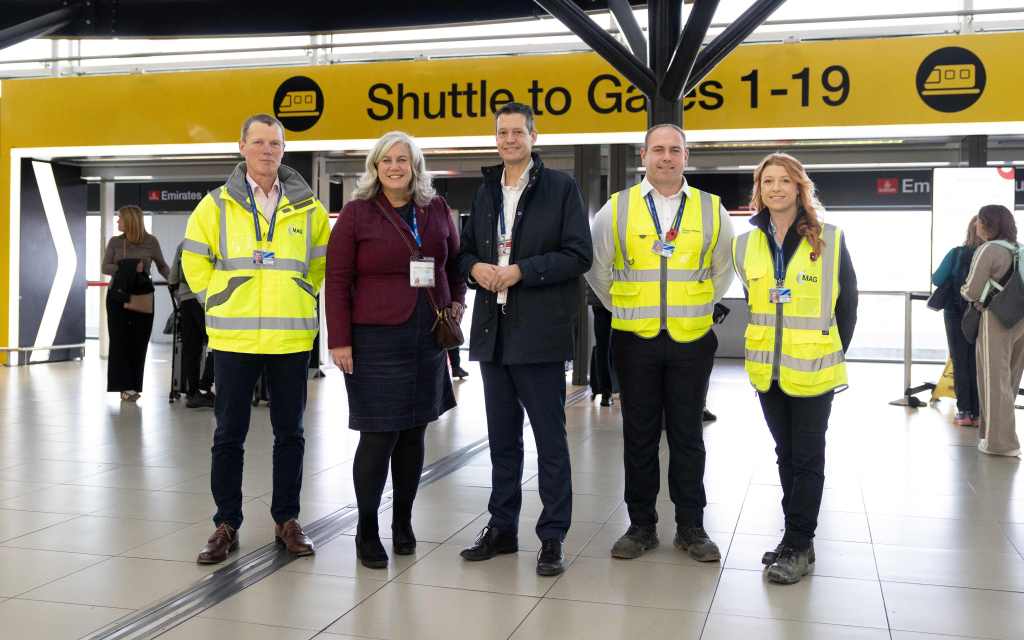
    Alongside this, Alexander’s greenwashing is off the scale. Funnily enough, both the press release and the newspaper report say:

    Stansted has welcomed a record-breaking number of passengers this year, and saw it achieve its busiest ever flying day this summer with over 700 aircraft movements…

    The visit concluded at the airport’s new on-site solar farm, the only one of its kind at a London airport, which became operation in September this year and is now helping power the airport and supports Stansted’s commitment to achieve net zero carbon emissions from its direct airport operations by no later than 2038.

    Obviously, Alexander isn’t going to let the fact that emissions savings on airport operation are a drop in the ocean compared with those from flights. She is reported to have said:

    We support airport expansion where it balances economic growth with climate, noise and air quality obligations. I’m pleased to see Stansted’s plans to grow passenger numbers responsibly – boosting connectivity, jobs and growth across the East of England, while meeting environmental commitments.

    Stansted’s new solar farm is a shining example of how airports can cut their carbon footprint and reduce emissions as they grow. This comes as we invest £43 million to boost innovation that makes the sector even greener.

    As Labour has clearly realised, why tackle climate change when you can greenwash it?

    One response to “A shining example of churnalism”

    1. clearlyteenage2e6308de03 avatar
      clearlyteenage2e6308de03

      It seems a terrible shame that over two decades after both Tories and Labour realised we had to reduce traffic and our carbon emissions anything is done to increase CO2. Now we know we are close to runaway global heating it is a chronic neglect of duty not to do everything we can to reduce and not increase carbon.

      This is even more of a shame as Heidi Alexander is ex London Government which for the UK has proved outstandingly successful in reducing traffic CO2 and air pollution.

      Like

    Leave a Reply

  • HVO is not zero emission

    The spin over “the greenest road ever built in the UK” continues: National Highways has gained headlines by claiming to be using zero-emission construction machinery on the project, but this is mainly HVO, which is definitely not zero-emission at any point.

    The project’s latest piece of propaganda, based on its 2025–26 Sustainability Report, claims:

    Lower Thames Crossing begins one of world’s largest deployments of zero-emissions construction machinery

    Work began in early 2026 and is being carried out only using electric, HVO and hydrogen powered equipment and machinery

    HVO (Hydrotreated Vegetable Oil) can be used as a drop‑in replacement for diesel in most diesel engines without modification.

    But these engines do still emit greenhouse gases and therefore cannot be described as zero emission.

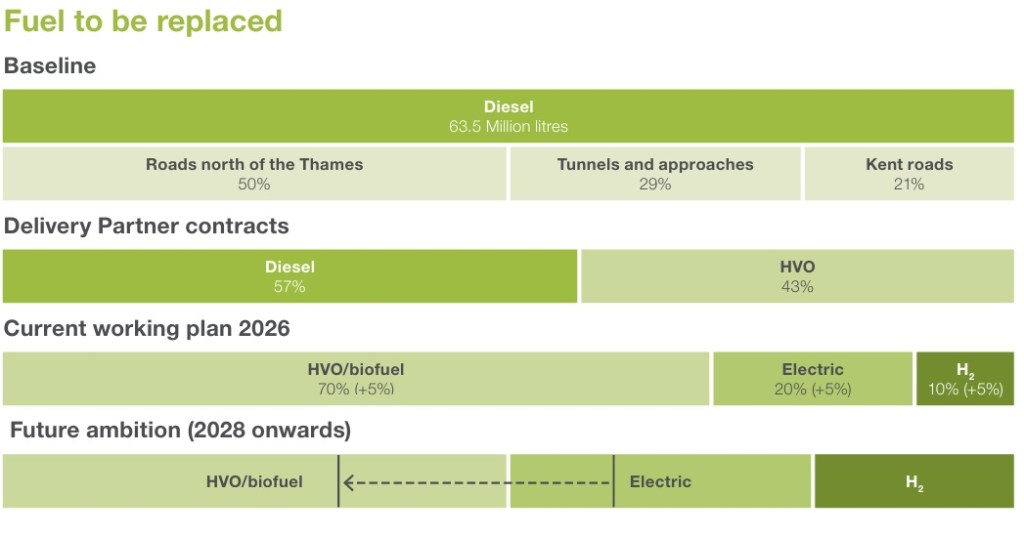
    As the graphic below suggests, HVO/biofuel is expected to be 70% of the fuel used in 2026.

    To add to the spin, the report itself says:

    We have started replacing around 60 million litres of diesel with alternative fuels of electricity, green hydrogen, hydrotreated vegetable oil (HVO) and biofuel.

    No, you aren’t replacing anything. If you didn’t build the scheme, you wouldn’t need 63.5 million litres of diesel or a “replacement”.

    In any case, the tosh about “the greenest road ever built in the UK” ignores the huge carbon emissions from actually using it.

    And is anyone else wondering why so much work is being done on a project that isn’t due to have a full business case until 2028 and whose outline business case is allegedly “in draft”?

  • Greenwashing the improbable

    The government has continued to signal its determination to expand aviation in a climate emergency, even as another analysis casts doubt on plans to expand Heathrow airport.

    The Times reports:

    Heathrow’s plan for a third runway is impossible to deliver on time, and the project is likely to run into complications including the relocation of several angling lakes, ministers have been told.

    A report by the American construction firm Bechtel…

    … concluded that Heathrow’s third runway would be possible at the earliest by 2040 — five years after the intended delivery date.

    The problem is the scale of works to be done even before construction can begin:

    (more…)

  • A cast iron non denial

    National Highways has published a response to the Sunday Times story this week that said the £11bn Lower Thames Crossing (LTC) is “poised to be built with foreign steel”, but I’m not sure whether its a carelessly worded rebuttal or a carefully worded non denial.

    The gist of the Sunday Times story is that UK-based steel manufacturers are not able, and will not be able, to produce the “low embodied carbon steel” that the government-owned company has promised to use as part of its greenwashing.

    Industry sources say this will exclude domestic manufacturers from the tender and force ministers to approve the provision of steel from abroad that meets the UK’s green targets. 

    Clearly the alternative to sourcing steel from abroad is to drop the “low embodied carbon steel” pledge.

    There is also a question of *when* as the tunnel is nowhere near being built but:

    Tata Steel is in the process of building an electric arc furnace on the site of Britain’s biggest blast furnace steelworks in Port Talbot, south Wales. It is understood that the furnace will not be up and running to tender for the multimillion-pound Lower Thames Crossing contract.

    The National Highways webpage starts off by saying the Sunday Times claim that the LTC is set to be built with foreign steel “is not the case”, adding:

    No procurement process for steel is currently under way.

    Our Delivery Partners have carried out early market engagement simply to understand existing capability ahead of launching procurements later this year. This engagement shows that the UK steel sector can meet between 85% and 90% of the project’s requirements, reflecting both the capability and ambition of British manufacturers.

    (more…)
  • National Highways digs holes in Thames Tunnel carbon pledges

    National Highways has continued its greenwashing of the Lower Thames Crossing but its pledge to wish away emissions from the construction of the unaffordable scheme is full of holes.

    Last week the company claimed in a press release:

    The project aims to cut its construction carbon footprint by 70% by aggressively targeting carbon as it refines the design of the new road and adopting new materials and methods of construction as they emerge. It has also made a legal commitment to responsibly offset any remaining carbon emissions using best practice, and only in the early 2030s once efforts to reduce it during construction are exhausted.

    I have written extensively about how the government-owned company invented a purely notional figure for construction carbon emissions, which it now says it will cut by 70%. One part of this scam was to imagine that the project might not use ground-granulated blast furnace slag – a widely used lower carbon cement substitute – and then to claim a saving from deciding to use it after all.  

    I also reported that, although National Highways claims to have carbon limits built into its contracts with the companies that will build the tunnel, it will not disclose what penalties will result from non-compliance, raising concerns that contractors may find it cheaper to pay the penalties.

    National Highways has banned contractors from using offsetting to meet these targets but its Carbon and Energy Management Plan for the scheme does away with any claim that the targets represent any kind of a cut. It refers to “an upper limit for the use of carbon in construction, based on industry practice”, which implicitly admits that the original figure was using poor practice.

    (more…)

  • Puttng lipstick on a pig

    Transport Action Network (TAN) has posted another of its National Highways Watch pieces, with significant input from me, and it has been almost simultaneously vindicated by comments in the draft Third Road Investment Strategy (RIS 3).

    The piece Highway robbery – abusing Designated Funds compares National Highways’ use of designated funds, pictorially at least, to putting lipstick on a pig – i.e. prettifying large and potentially environmentally destructive road building schemes with greenwashing.

    TAN has discovered that National Highways is syphoning off money from a dedicated fund for environmental and safety improvements (called ‘Designated Funds’1) to use it as sweeteners or greenwashing for new roadbuilding schemes. National Highways is also raiding the “ringfenced” funding to pay for mitigation that should come out of the scheme budgets.

    The piece highlights a number of alleged misuses of designated funds, including “sweetening the Lower Thames Crossing”:

    A document on “Benefits and Outcomes” submitted as part of the scheme’s planning application mentions “Designated Funds” 25 times, and claims that “Over £30 million of designated funds have been allocated to Lower Thames Crossing”, despite having to make clear that these benefits technically “fall outside of the remit of the DCO [planning application]”.

    (more…)
  • National Highways steps up the greenwashing

    There’s another closure of the A3 this weekend as part of National Highways’ seemingly interminable M25 Junction 10 scheme.

    I’ve written a lot about the disruption caused by the works and once again the closure, this time between the junction and Send to the south, has diversions that involve using the M25 and a longer diversion for vehicles and drivers that are not permitted to use the motorway.

    But what’s most egregious about this is the astonishingly blatant greenwashing. According to the BBC:

    A National Highways spokesperson said: “We are restoring heathland and upgrading the junction with the A3 Wisley Interchange to reduce congestion, improve safety and create more reliable journeys.

    “We thank drivers and the local community for their patience and ask anyone travelling during these times to plan their journeys carefully.”

    National Highways is cutting down a lot of trees as part of a road widening scheme that will encourage more traffic and worsen climate change. Some of the land currently covered by trees will indeed be returned to heathland but to present this as the primary reason for the scheme is outrageous.

    And there is of course the usual trick, which rail companies also do during disruption, of transferring responsibility to the public by asking them to plan or check their journeys.

    Leave a Reply