
Two articles from me in the latest edition of Local Transport Today pick up on pledges that the Department for Transport (DfT) has failed to honour in the new Road Investment Strategy (RIS) – on both smart motorway safety and toxic road runoff.
Campaigners have slammed the DfT after it quietly dropped a commitment to consider adding more emergency areas (EAs) on smart motorways under the new RIS, leaving the network short of the spacing standard recommended by MPs in a landmark report.
The story notes that in its November 2021 report on smart motorways, the Commons Transport Committee recommended that the DfT and National Highways should retrofit EAs to existing all lane running (ALR) motorways to make them a maximum of 1,500 metres apart, decreasing to every 1,000 metres (0.75 miles) where physically possible.
In its response, the DfT said it “agrees in principle with this recommendation” and committed £390m over RIS 2 to retrofit over 150 additional EAs to ALRs by 2025.
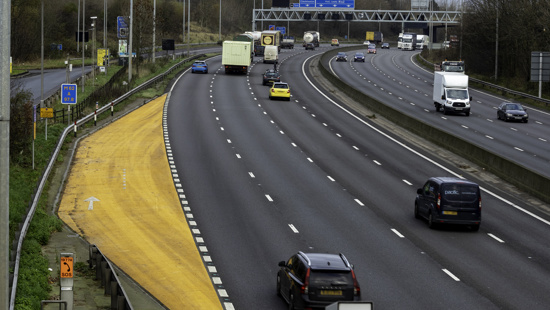
And, in an implicit recognition that the extra 150 EAs would not bring the whole network into compliance with the standard recommended by MPs, the DfT also said: “A decision on whether to retrofit across the remainder of ALR smart motorways will be considered as part of the formulation of the third Road Investment Strategy, based on evidence of safety benefits.”
The story notes that I had approached the DfT and National Highways for comment, but had not received a response at the time of publication. I still haven’t.
Similarly, neither replied in relation to this story on toxic road runoff:
National Highways’ longstanding pledge to mitigate “high priority” water outfalls on its network by 2030 is mired in confusion after its regulator questioned whether it could be achieved following a doubling of costs and the new RIS appeared to backtrack on the pledge.
The story notes that company’s 2030 Water Quality Plan set that year as the target to first confirm and then mitigate sites on the strategic road network where there was a high risk of toxic runoff polluting watercourses and the wider environment.
While this was subject to funding during RIS 3, last September National Highways’ then chief executive Nick Harris told MPs that it that it expected to be “funded to do all 250” of the “high-risk” outflows that were expected to be confirmed and that in October, the company published a document setting out 182 confirmed high-risk locations in tranches representing “when we expect to deliver improvements work at each location, subject to funding and delivery constraints, with all to be delivered “before 2030”.
A month later the Office of Rail and Road’s (ORR) advice on National Highways’ draft strategic business plan noted that estimated costs had more than doubled to between £900,000 and £1.2m per asset, meaning that National Highways expected to deliver 110 and 130 mitigations from the allocated budget, leaving between 75 and 95 assets carried over under RIS 4. The regulator noted that National Highways had “previously proposed and committed” to mitigating 250 assets and said it should work with the DfT “to manage expectations where it has previously committed publicly to deliver a bigger programme and the reasons this is no longer feasible”.
The new RIS includes a commitment to mitigate a total of 190 – 250 high risk water outfalls / soakaways, implicitly by 2031, “reviewing a deliverability plan by the end of 2027/28”. It adds: “This range includes those outfalls and soakaways mitigated during Road Period 2 and 2025/26”.
So it’s entirely unclear whether there is more money or whether the DfT and National Highways are simply misleading the public about what can be done. Either way, the 2030 deadline has slipped by at least a year.
 Transport Insights
Leave a comment