National Highways has suggested that work to improve the safety of smart motorways might be cut as part of a raid on its funding to pay for increased defence spending.
The coded admission comes in response to a freedom of information (FOI) request from smart motorway campaigner Claire Mercer, which sought to find out how much the company was planning to spend on the network under the third Road Investment Strategy (RIS 3), which began in April and runs until 2031.
It’s worth starting with the part of RIS 3 that Mercer cited:
Over the third road period, we expect National Highways to continue to invest in the technology needed to help increase public confidence when driving on smart motorways, like upgrading CCTV cameras to detect incidents that could have an impact on the safety of users or their journey times.
There are a lot of weasel words here, including “invest” and “to help increase public confidence”, with the latter reflecting a refusal to admit openly that safety on smart motorways could be objectively better.
If CCTV is to be upgraded, rather than simply renewed and replaced when life-expired, that could be an investment, but upgrading cameras “to detect incidents” misrepresents what they are used for, which is to allow operatives to view incidents, including those that have been flagged by other technology.
But, assuming that there were plans to improve technology under RIS3, these are now under threat. After extensive requests for clarification, National Highways responded:
You might think that to have to go back and fix one emergency area (EA) on a stretch of motorway is unfortunate and two would be careless, but what would Oscar Wilde say about remedial works to four EAs on the same stretch?
A parliamentary question from (Baroness) Caroline Pidgeon has accidentally revealed that National Highways’ National Emergency Area Retrofit (NEAR) programme has not been formally completed, because works are neededto strengthen embankments adjacent to four new emergency areas on the M1.
It was all going so well, with the NEAR programme appearing to have been delivered on time and on budget.
… what is the final cost of the installation of new emergency areas on smart motorways; and what is the break down of costs for each relevant motorway.
Transport minister (Lord) Peter Hendy replied:
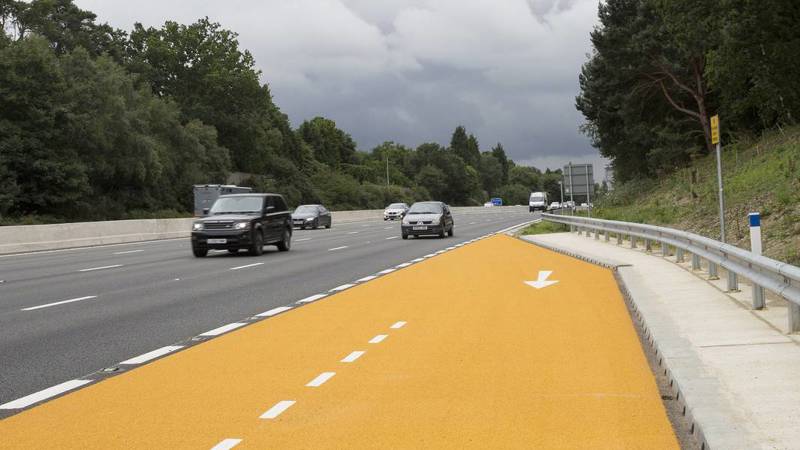
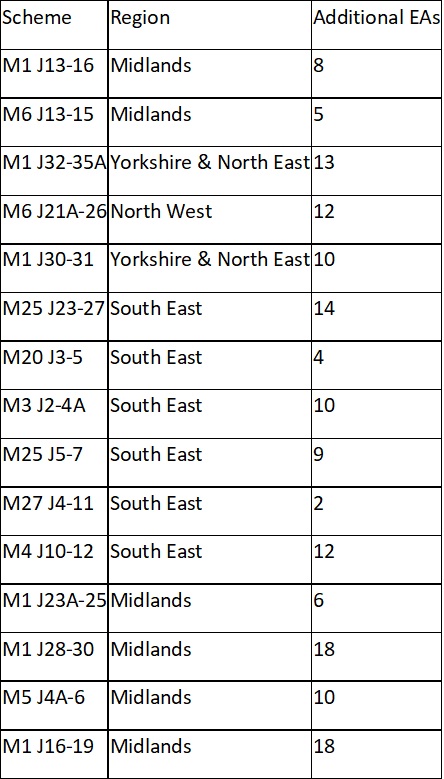
National Highways committed to add over 150 new emergency areas on existing All Lane Running smart motorways by the end of March 2025, prioritising locations where these would provide the greatest benefit and could be delivered within the £390 million budget. The table below sets out the number of additional emergency areas delivered on each relevant motorway section.
On average, across the programme, an emergency area costs approximately £2.6 million to construct (pending final accounts). Individual emergency areas have varying design requirements, including topography, requirement for supporting structures, drainage, and technology, which mean they can cost less or more than the expected average to construct.
National Highways has recently commenced work on the M1 between junctions 16 and 19 to undertake remedial works to strengthen embankments adjacent to four new emergency areas. These works are expected to be completed by August 2026. As a result, programme close-out activities have been extended and final costs for the National Emergency Area Retrofit programme are now expected to be available in Spring 2027, subject to final accounting and internal governance.
The roads minister has again resisted scrutiny over the provision of emergency areas on smart motorways, implicitly admitting that they do not meet the spacing standard to which the previous government said it agreed in principle.
As I have reported, the government has broken a pledge to consider adding further emergency areas under the new road investment strategy.
But, faced with parliamentary questions over current spacing levels, Simon Lightwood has continued to obfuscate, relying on a definition of “places to stop in an emergency” that includes locations other than designated emergency areas.
what is the current average distance between dedicated emergency refuge areas, excluding slip roads and junctions, on All Lane Running Smart Motorways.
Lightwood replied:
My previous answer on 27 April 2026 set out that the average distance between places to stop in an emergency is now less than a mile (around 0.9 miles). Design standard GD301 sets out the new spacing standard (around 3/4 mile where feasible and 1 mile maximum) and defines what a place of relative safety is. The document can be found at: GD 301 – Smart motorways.
This obstructive and disingenuous answer not only evades the point about dedicated emergency areas but includes a crass non sequitur switch between the definitions of “places to stop in an emergency” and “a place of relative safety”.
The point remains that neither definition is what the last government signed up to in principle in 2022 following a recommendation from the Transport Committee:
The Department and National Highways should retrofit emergency refuge areas to existing all-lane running motorways to make them a maximum of 1,500 metres apart, decreasing to every 1,000 metres (0.75 miles) where physically possible.
Roads minister Simon Lightwood is clearly determined never to give a straight answer to a straight question, particularly when it comes to the lack of safety of smart motorways, and his latest evasion is to sidestep an MP’s question on emergency refuge areas.
Transport minister Simon Lightwood has published a response to a fellow Labour MP’s written parliamentary question about emergency (refuge) areas on smart motorways but, as part of an ongoing and determined effort to avoid scrutiny, has made no attempt to answer the question.
As I noted on Monday, a question put down by Sarah Champion MP followed up on my revelation that the new Road Investment Strategy said nothing about adding new emergency areas to meet the spacing standard to which the government agreed in 2022:
To ask the Secretary of State for Transport, with reference to the Third Report of the Transport Committee of Session 2021–22, Rollout and safety of smart motorways, HC26, what steps her Department is taking to ensure that emergency refuges on All Lane Running Smart Motorways are spaced no more than 1,500m apart, and no more than 1,000m apart where possible.
Following my stories pointing out that ministers had quietly dropped a pledge to consider adding more emergency refuge areas on smart motorways to comply with a 2021 recommendation from MPs, one MP has put down a written parliamentary question on the issue.
with reference to the Third Report of the Transport Committee of Session 2021–22, Rollout and safety of smart motorways, HC26, what steps her Department is taking to ensure that emergency refuges on All Lane Running Smart Motorways are spaced no more than 1,500m apart, and no more than 1,000m apart where possible.
As I wrote here, this was a recommendation from the Transport Committee (albeit that it referred to “emergency refuge areas”) and the Department for Transport said in its response:
The Government agrees in principle with this recommendation as we recognise that the installation of EAs at closer spacing is valued by drivers and road safety organisations.
It announced the £390m over the rest of the second Road Investment Strategy to for a retrofit programme that would see over 150 additional EAs being added to all lane running smart motorways by 2025.
In recognition of the fact that this would not achieve the recommended standard, it added:
A decision on whether to retrofit across the remainder of ALR smart motorways will be considered as part of the formulation of the third Road Investment Strategy, based on evidence of safety benefits.
This last bit (considering the issue) does not appear to have happened. It certainly isn’t being done.
Champion’s “named day” question should in theory have been answered last week but is still awaiting a response.
One response to “Awaiting answers on smart motorway safety”
clearlyteenage2e6308de03
Did the country really need most of the (un)Smart motorways at all? Do they contribute to carbon reduction? Might they encourage more peak hour car use especially near our big cities where we are trying to encourage sustainable transport use? Do they make it harder for emergency vehicles to reach incidences or accidents?
If somebody (who – I ask?) thinks they might help reduce traffic congestion at certain times (on past evidence – possibly for a couple of years only) we must surely go back to opening the hard shoulder only on limited occasions to reduce congestion. At such times average and peak driving speeds need rigorous enforcement to say 40mph. That should save the really serious accidents and probably be an optimum speed for capacity anyway.
There is no real case for higher speeds except for the truly daft economic appraisal system used by DfT and abused by National Highways in the promotion of their expensive schemes.
Two articles from me in the latest edition of Local Transport Today pick up on pledges that the Department for Transport (DfT) has failed to honour in the new Road Investment Strategy (RIS) – on both smart motorway safety and toxic road runoff.
Campaigners have slammed the DfT after it quietly dropped a commitment to consider adding more emergency areas (EAs) on smart motorways under the new RIS, leaving the network short of the spacing standard recommended by MPs in a landmark report.
The story notes that in its November 2021 report on smart motorways, the Commons Transport Committee recommended that the DfT and National Highways should retrofit EAs to existing all lane running (ALR) motorways to make them a maximum of 1,500 metres apart, decreasing to every 1,000 metres (0.75 miles) where physically possible.
In its response, the DfT said it “agrees in principle with this recommendation” and committed £390m over RIS 2 to retrofit over 150 additional EAs to ALRs by 2025.
And, in an implicit recognition that the extra 150 EAs would not bring the whole network into compliance with the standard recommended by MPs, the DfT also said: “A decision on whether to retrofit across the remainder of ALR smart motorways will be considered as part of the formulation of the third Road Investment Strategy, based on evidence of safety benefits.”
The story notes that I had approached the DfT and National Highways for comment, but had not received a response at the time of publication. I still haven’t.
National Highways’ longstanding pledge to mitigate “high priority” water outfalls on its network by 2030 is mired in confusion after its regulator questioned whether it could be achieved following a doubling of costs and the new RIS appeared to backtrack on the pledge.
The story notes that company’s 2030 Water Quality Plan set that year as the target to first confirm and then mitigate sites on the strategic road network where there was a high risk of toxic runoff polluting watercourses and the wider environment.
While this was subject to funding during RIS 3, last September National Highways’ then chief executive Nick Harris told MPs that it that it expected to be “funded to do all 250” of the “high-risk” outflows that were expected to be confirmed and that in October, the company published a document setting out 182 confirmed high-risk locations in tranches representing “when we expect to deliver improvements work at each location, subject to funding and delivery constraints, with all to be delivered “before 2030”.
A month later the Office of Rail and Road’s (ORR) advice on National Highways’ draft strategic business plan noted that estimated costs had more than doubled to between £900,000 and £1.2m per asset, meaning that National Highways expected to deliver 110 and 130 mitigations from the allocated budget, leaving between 75 and 95 assets carried over under RIS 4. The regulator noted that National Highways had “previously proposed and committed” to mitigating 250 assets and said it should work with the DfT “to manage expectations where it has previously committed publicly to deliver a bigger programme and the reasons this is no longer feasible”.
The new RIS includes a commitment to mitigate a total of 190 – 250 high risk water outfalls / soakaways, implicitly by 2031, “reviewing a deliverability plan by the end of 2027/28”. It adds: “This range includes those outfalls and soakaways mitigated during Road Period 2 and 2025/26”.
So it’s entirely unclear whether there is more money or whether the DfT and National Highways are simply misleading the public about what can be done. Either way, the 2030 deadline has slipped by at least a year.
Transport Action Network (TAN) has published its analysis of the 16 evaluation reports on smart motorway schemes that the government finally allowed National Highways to publish this month, concluding that as expected, they showed that almost all had been costly failures.
Instead of delivering a predicted £10 billion of economic benefits, they delivered under £2bn, which is less than they cost to build. And that’s not counting the £900 million spent on retrofitting additional emergency laybys and upgrading technology.
TAN notes that Post Opening Project Evaluation (POPE) studies are produced after a new scheme is built to assess whether it worked in terms of relieving congestion, improving safety, whether the environmental mitigation worked, and overall whether they provided value for money for taxpayers.
It focuses on the 11 schemes with five-year studies and the most reliable data, finding that only two came anywhere near delivering their claimed benefits.
The other nine were an economic disaster, costing the economy over £400m on (lack of) time savings, when National Highways had predicted over £7 billion of benefits. This is before counting the cost of building these nine ‘smart’ motorways, which comes in at a staggering £1.6 billion. This doesn’t include the £900 million that has been spent on retrofitting more emergency refuges and upgrading the technology across all ‘smart’ motorways. That means that these nine ‘smart’ motorways have cost the economy well over £2 billion.
Looking across all 11 schemes, the economy lost over £500 million, showing how bad these motorways are financially, before any consideration of safety.
Barry O’Sullivan has been found guilty of causing the death of Pulvinder Dhillon by careless driving on a smart motorway section of the M4 in 2022 but the verdict in no way lets National Highways off the hook and it is unarguable that the crash would not have happened if the “smart” technology had done its job.
A jury sat through the trial and heard the evidence – plus the judge’s summing up – and decided that O’Sullivan was guilty so I won’t argue with them.
But in this case it has always been possible to argue both that O’Sullivan was culpable despite National Highways’ shocking failings and that National Highways failed abysmally despite O’Sullivan’s culpability.
I first wrote about the crash soon after it happened and was told by a senior National Highways official that the stopped vehicle detection (SVD) technology had worked as far as possible, except that a fault with the wider system meant that alerts were not posted on gantries.
The M4 [incident] was a particular issue with some of our back office systems that were offline at the time – we’ve now corrected the system so that can’t happen. The scheme was still in operational acceptance so, as tragic as it was, this was a shortcoming of a system that [hadn’t yet] been handed into business as usual.
What I didn’t know then was that this was the fifth day of this fault and that National Highways had failed to effect what turned out to be quite a quick fix because the fault was wrongly categorised.
As the trial of Barry O’Sullivan for allegedly causing the death of Pulvinder Dhillon by careless driving approaches its conclusion, the story gets worse for National Highways, whatever the verdict.
An unresolved technical failure on the M4 smart motorway network meant alerts for broken-down vehicles were not properly communicated in the days leading up to a fatal collision, a court has heard.
The technical malfunction on March 2 2022 was flagged by the system and automatically generated tickets, but they were assigned to the wrong National Highways team and with an incorrect priority level of “7-day resolution”, the court was further told.
This meant the alert system had been malfunctioning for five days when Barry O’Sullivan, 45, crashed his grey Ford Transit Connect into the back of a Nissan Micra that had come to a halt in the fast lane of the motorway on March 7 2022.





Leave a comment