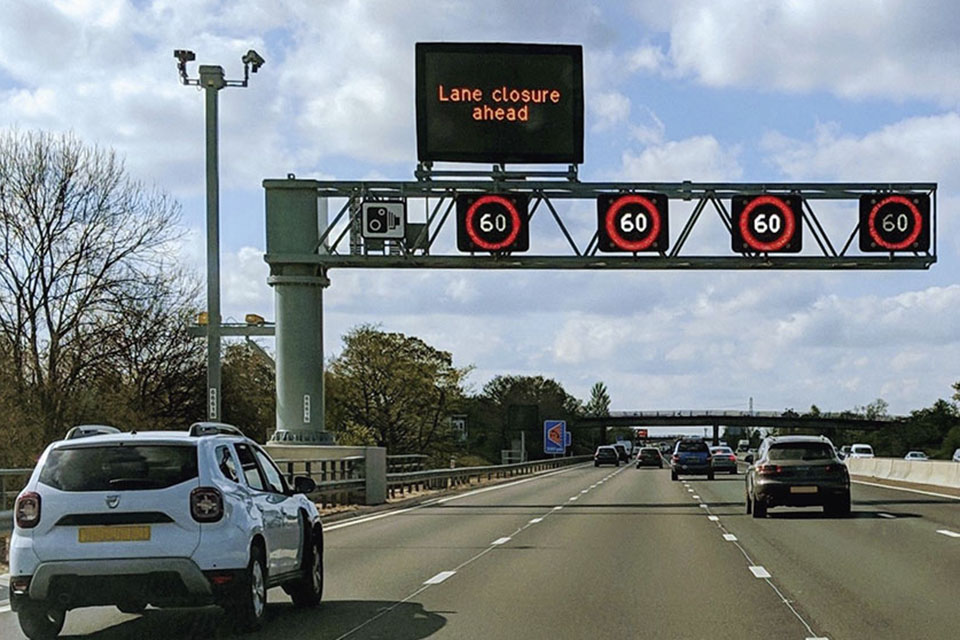
National Highways has suggested that work to improve the safety of smart motorways might be cut as part of a raid on its funding to pay for increased defence spending.
The coded admission comes in response to a freedom of information (FOI) request from smart motorway campaigner Claire Mercer, which sought to find out how much the company was planning to spend on the network under the third Road Investment Strategy (RIS 3), which began in April and runs until 2031.
It’s worth starting with the part of RIS 3 that Mercer cited:
Over the third road period, we expect National Highways to continue to invest in the technology needed to help increase public confidence when driving on smart motorways, like upgrading CCTV cameras to detect incidents that could have an impact on the safety of users or their journey times.
There are a lot of weasel words here, including “invest” and “to help increase public confidence”, with the latter reflecting a refusal to admit openly that safety on smart motorways could be objectively better.
If CCTV is to be upgraded, rather than simply renewed and replaced when life-expired, that could be an investment, but upgrading cameras “to detect incidents” misrepresents what they are used for, which is to allow operatives to view incidents, including those that have been flagged by other technology.
But, assuming that there were plans to improve technology under RIS3, these are now under threat. After extensive requests for clarification, National Highways responded:
The fallout over the shelving of two road schemes in the East Midlands to pay for “defence” continues, with a piece in the Times from regional mayor Claire Ward, in which she points out with some justification that the decision has simultaneously trashed the concepts of a road investment strategy (RIS) and devolution.
It’s a good opening, albeit one that starts with a version of a cliché:
A day is a long time in politics. But it shouldn’t be. Last Monday, Andy Burnham set out his vision for government, which put devolution at the heart of an empowered Britain. Less than 24 hours later, while Sir Keir Starmer delivered his speech on defence, I was on the phone with his office, being informed that the East Midlands would be losing nearly £1 billion of investment across two major road schemes.
While the RIS is a national strategy and regional mayors do not have to be consulted, it is the logic of devolution that mayors will have increasing say (and possibly control) over spending decisions in their area.
Ward also says:
To start putting that right — including by granting the funding for our two road schemes — only to cancel them three months later, says to regions like mine: “You do not matter.”
Something has got garbled in the editing here but the gist of it – that it’s grossly undermining to change your mind three months after publishing a strategy that literally plans “investment” in roads – is bang on.
I think some of Ward’s other arguments about how these two road schemes are essential to defence manufacturing are quite weak but she’s entitled to feel let down by the government that represents the same party as her and talks a good game on devolution.
The BBC has a very poor, and quite late, report on the decision to cancel the A120 Braintree to Marks Tey dualling scheme, with no consideration of whether continuous road building is a good idea in a climate emergency, or even the only solution to a poor safety record.
The cancellation of the scheme emerged when the Road Investment Strategy was published in March and it was removed from the pipeline of future works.
Ministers say the project is no longer affordable, but some of those who live, work and travel on the trunk road are angered by the decision and fear for its future sustainability.
Having admitted that it may only be “some” people who are angered by the decision, the BBC then devotes its article exclusively to those views.
The road does appear to have an appalling safety record, approximately one fatality a year this century but:
Average speed cameras were installed between Braintree and Marks Tey in 2025 and a new 50mph (80km/h) limit was enforced for most of the route.
While it’s too early to tell what the impact of this might be, there will be statistics. But the BBC doesn’t need statistics, when it has subjective claims to rely on:
The Department for Transport has released a written version of what it called Debrief Drop In Sessions that took place just after the Road Investment Strategy was released last month, including a sort of explanation as to why National Highways will be expected to do so little to improve safety.
It follows comments by a senior National Highways official last month, in which he admitted that the company had not bothered with its target for the last (2020-25) RIS, because it depended on matters outside its control.
As I have pointed out, what is described in the RIS as a “KPI Target” is not a target at all, but a requirement that it at least try to meet a level of casualty reduction:
National Highways must demonstrate it has done all it reasonably can to achieve a 7.5% reduction in the number of people killed or seriously injured (KSI) on the SRN by the end of 2031, based on the 2022-24 baseline.
It’s worth pointing out that transport secretary Heidi Alexander misrepresented this in her introduction to RIS 3, where she referred to:
setting National Highways a target to achieve a 7.5% reduction
One stakeholder at a Debrief Drop-in asked:
Why is the safety target so unambitious, given previously the target was for zero harm by 2040?
The answer goes back to the idea that National Highways can only control what it can control:
Following my stories pointing out that ministers had quietly dropped a pledge to consider adding more emergency refuge areas on smart motorways to comply with a 2021 recommendation from MPs, one MP has put down a written parliamentary question on the issue.
with reference to the Third Report of the Transport Committee of Session 2021–22, Rollout and safety of smart motorways, HC26, what steps her Department is taking to ensure that emergency refuges on All Lane Running Smart Motorways are spaced no more than 1,500m apart, and no more than 1,000m apart where possible.
As I wrote here, this was a recommendation from the Transport Committee (albeit that it referred to “emergency refuge areas”) and the Department for Transport said in its response:
The Government agrees in principle with this recommendation as we recognise that the installation of EAs at closer spacing is valued by drivers and road safety organisations.
It announced the £390m over the rest of the second Road Investment Strategy to for a retrofit programme that would see over 150 additional EAs being added to all lane running smart motorways by 2025.
In recognition of the fact that this would not achieve the recommended standard, it added:
A decision on whether to retrofit across the remainder of ALR smart motorways will be considered as part of the formulation of the third Road Investment Strategy, based on evidence of safety benefits.
This last bit (considering the issue) does not appear to have happened. It certainly isn’t being done.
Champion’s “named day” question should in theory have been answered last week but is still awaiting a response.
One response to “Awaiting answers on smart motorway safety”
clearlyteenage2e6308de03
Did the country really need most of the (un)Smart motorways at all? Do they contribute to carbon reduction? Might they encourage more peak hour car use especially near our big cities where we are trying to encourage sustainable transport use? Do they make it harder for emergency vehicles to reach incidences or accidents?
If somebody (who – I ask?) thinks they might help reduce traffic congestion at certain times (on past evidence – possibly for a couple of years only) we must surely go back to opening the hard shoulder only on limited occasions to reduce congestion. At such times average and peak driving speeds need rigorous enforcement to say 40mph. That should save the really serious accidents and probably be an optimum speed for capacity anyway.
There is no real case for higher speeds except for the truly daft economic appraisal system used by DfT and abused by National Highways in the promotion of their expensive schemes.
Roads minister Simon Lightwood, who was complicit in hiding the smart motorway evaluation reports and seems to have gone into politics to hide things from the public, has blanked a question from an MP about safety spending under the new road investment strategy (RIS).
Asked by Helen Morgan how much money is committed to the Safety National Programme and Small Schemes National Programme elements of the RIS, Lightwood said:
RIS3 included for the first time a set of four National Programmes, which are a new way for National Highways to deliver defined outputs that support RIS3 objectives, where these are not funded in other programmes. Details of the funding for each National Programme will be confirmed in National Highways’ Delivery Plan for 2026-31, which is expected to be published in the summer.
It’s worth unpicking this to see how evasive Lightwood is being. The RIS, written by his department, is literally a strategy for spending on the strategic road network. Its purpose is to give National Highways a budget and tell it, Parliament and the public how it should be spent.
Lightwood knows how much is in the budget for the Safety and Small Schemes National Programmes but is simply choosing to hide this.
Two articles from me in the latest edition of Local Transport Today pick up on pledges that the Department for Transport (DfT) has failed to honour in the new Road Investment Strategy (RIS) – on both smart motorway safety and toxic road runoff.
Campaigners have slammed the DfT after it quietly dropped a commitment to consider adding more emergency areas (EAs) on smart motorways under the new RIS, leaving the network short of the spacing standard recommended by MPs in a landmark report.
The story notes that in its November 2021 report on smart motorways, the Commons Transport Committee recommended that the DfT and National Highways should retrofit EAs to existing all lane running (ALR) motorways to make them a maximum of 1,500 metres apart, decreasing to every 1,000 metres (0.75 miles) where physically possible.
In its response, the DfT said it “agrees in principle with this recommendation” and committed £390m over RIS 2 to retrofit over 150 additional EAs to ALRs by 2025.
And, in an implicit recognition that the extra 150 EAs would not bring the whole network into compliance with the standard recommended by MPs, the DfT also said: “A decision on whether to retrofit across the remainder of ALR smart motorways will be considered as part of the formulation of the third Road Investment Strategy, based on evidence of safety benefits.”
The story notes that I had approached the DfT and National Highways for comment, but had not received a response at the time of publication. I still haven’t.
National Highways’ longstanding pledge to mitigate “high priority” water outfalls on its network by 2030 is mired in confusion after its regulator questioned whether it could be achieved following a doubling of costs and the new RIS appeared to backtrack on the pledge.
The story notes that company’s 2030 Water Quality Plan set that year as the target to first confirm and then mitigate sites on the strategic road network where there was a high risk of toxic runoff polluting watercourses and the wider environment.
While this was subject to funding during RIS 3, last September National Highways’ then chief executive Nick Harris told MPs that it that it expected to be “funded to do all 250” of the “high-risk” outflows that were expected to be confirmed and that in October, the company published a document setting out 182 confirmed high-risk locations in tranches representing “when we expect to deliver improvements work at each location, subject to funding and delivery constraints, with all to be delivered “before 2030”.
A month later the Office of Rail and Road’s (ORR) advice on National Highways’ draft strategic business plan noted that estimated costs had more than doubled to between £900,000 and £1.2m per asset, meaning that National Highways expected to deliver 110 and 130 mitigations from the allocated budget, leaving between 75 and 95 assets carried over under RIS 4. The regulator noted that National Highways had “previously proposed and committed” to mitigating 250 assets and said it should work with the DfT “to manage expectations where it has previously committed publicly to deliver a bigger programme and the reasons this is no longer feasible”.
The new RIS includes a commitment to mitigate a total of 190 – 250 high risk water outfalls / soakaways, implicitly by 2031, “reviewing a deliverability plan by the end of 2027/28”. It adds: “This range includes those outfalls and soakaways mitigated during Road Period 2 and 2025/26”.
So it’s entirely unclear whether there is more money or whether the DfT and National Highways are simply misleading the public about what can be done. Either way, the 2030 deadline has slipped by at least a year.
Returning to the theme of the schemes in the third Road Investment Strategy (RIS 3) that will carry both construction activity and costs into the next RIS, getting more expensive the longer they are delayed, the A66 Northern Trans-Pennine is now set to cost over £2bn.
What makes this example even more farcical is that the scheme was part of Boris Johnson’s 2020 Project Speed to, well, speed up infrastructure schemes, and was given special funding for this purpose.
Now, the Office of Rail and Road’s (ORR) advice on National Highways’ draft strategic business plan reveals that the total costs of the 16 enhancement schemes in the draft strategic business plan (SBP) are around £600m higher than previous estimate.
This difference is predominantly from the A66 Northern Trans-Pennine scheme, where the outturn cost in the draft SBP compared was £540m above the most recent forecast.
Assuming that the most recent forecast was £1.5bn, that puts the scheme at well over £2bn. I don’t really like saying that something has breached an imaginary barrier but in this case I use the word ironically, to point out that the costs of these schemes just seem to escalate without any constraints.
In the absence of detail on enhancement schemes in the new Road Investment Strategy (RIS), the Office of Rail and Road’s (ORR) advice on National Highways’ draft strategic business plan gives a good indication of what is likely to happen.
We know from the RIS that there is £3.8bn for enhancement schemes, not counting the cash for the Lower Thames Crossing, but what emerges from the ORR report is just how much of this will go on schemes that are already in construction and how much of the new schemes will fall into the post-2031 RIS 4.
The report reveals that:
National Highways’ proposed portfolio of existing enhancements in its draft SBP is made up of 16 schemes, 11 of which are currently in construction.
In addition, only two of the new schemes are due to be completed during the RIS 3 period, also known as Roads Period 3, or RP3.
And two of the schemes are not due to start until the last two years of the five-year period, with the A38 Derby Junctions starting in 2029-30 and the A46 Newark Bypass in 2030-31.
As the ORR notes, National Highways enhancements frequently fall into a vicious circle of delays and cost increases, followed by delays because the costs have to be spread out:
Depending on decisions elsewhere in the plan, it might be necessary to defer the start of these projects to improve affordability. However, such deferrals would further increase total outturn costs as seen during RP2.
Documents published by National Highways’ regulator show how the company tried to avoid being held to account during the new Road Investment Strategy (RIS 3) for its continued failure to meet casualty reduction targets and how little it is likely to do by way of dedicated safety work.
If the proposed spending levels in the draft strategic business plan (SBP) have been carried through to the RIS itself, dedicated spending on safety over five years will be (significantly) less than the cost of one major enhancement scheme, such as the £600m A38 Derby Junctions scheme.
The ORR reported that National Highways’ draft SBP proposed a spend of £342m in its safety National Programme and £122m in its safety Designated Fund, totalling £464m.
This describes in quite scathing terms what the £464m looks like out of a budget totalling £25bn:
The commitment of less than 2% of the RIS3 Statement of Funds Available to specific safety activities is difficult to reconcile with safety being the number one priority for the organisation.
Comparison between the ORR’s account of the SBP and the RIS itself reveals that a proposal for the National Programme to deliver safety interventions on 18 priority corridors with current poor safety performance and a low International Road Assessment Programme (iRAP) star rating has been carried forward – suggesting that the funding levels will be very close to what was proposed.
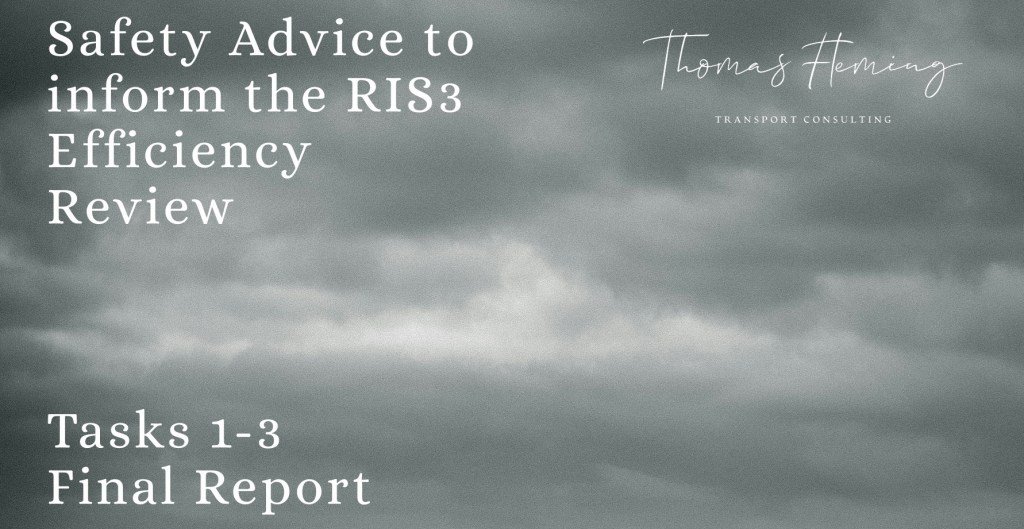
In terms for casualty reduction, the Thomas Fleming analysis reveals that the National Programmes and Designated Funds combined were forecast to achieve a reduction of just 85 killed and seriously injured (KSI) casualties per year by the end of the RIS. It calculated that this would represent a cut of just 2.7% relative to the 2005-2009 baseline against which previous RIS targets were calculated.
It highlighted “significant disparities” between the scale of this reduction and the long-term trajectory required to achieve zero deaths and serious injuries on the strategic network by 2050 – a target date that National Highways has already put back by 10 years.






Leave a comment