Transport Insights

The transport stories you won't see in the industry-friendly media

Author

Chris Ames
  • Another empty pledge from the DfT

    Another Department for Transport (DfT) announcement throws random and unsubstantiated numbers at a problem in a successful attempt to get headlines from gullible journalists.

    The DfT press release First-time buyers to benefit from 40,000 new homes on brownfield railway land already contains a small quibble in the sub-headline:

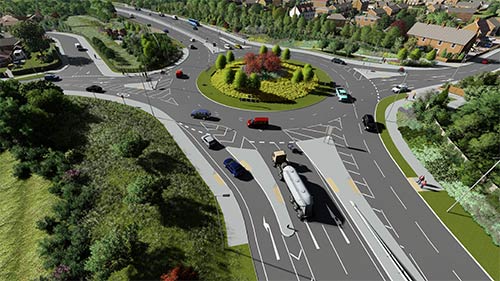
    Neighbourhoods in Manchester, Newcastle, Nottingham and Cambridge will be transformed with homes, green spaces, shops and hotels.

    And of course many of these railway properties will be more suitable for shops and hotels, which may also be more economically viable.

    Here’s the plan:

    Previously, London and Continental Railways Ltd and Network Rail’s Property Team operated independently, each managing different aspects of surplus rail land across the UK.

    This fragmented approach often led to inefficiencies, duplicated efforts and missed opportunities for strategic development.

    Now, Platform4 will bring these 2 functions, skills and capabilities together in a unified structure to deliver 40,000 homes over the coming decade by disposing of surplus rail land, attracting private investment and accelerating community regeneration. By working together, instead of separately, Platform4 is expected to generate an additional £227 million by delivering at greater pace and scale.

    The press release provides no evidence that these numbers are realistic and it is noticeable that the figure of 40,000 new homes (over 10 years) is not only unsubstantiated – and presented elsewhere as an “up to” – but also does not say how many of these homes are additional to what would have happened under the existing structure.
    (more…)

  • National Highways lied to ORR over shelved A1 scheme

    I have had two responses from the Office of Road and Rail (ORR) to my questions about what it was told about the secret decision in late 2021/early 2022 to shelve the A1 Morpeth to Ellingham scheme and the story gets murkier and shabbier.

    By way of a recap, both National Highways and the ORR falsely told the public and Parliament in July 2022 that construction of the scheme would start in 2022-23.

    The ORR has confirmed that it was given information that should have stopped it making this false claim:

    In February 2022 we were informed that A1 Morpeth to Ellingham was “deprioritised in SR21”.  However, the scheme remained committed under RIS2 until a formal change had been agreed by the Secretary of State for Transport, as legislated under the Infrastructure Act 2015. 

    The National Audit Office (NAO) said in November 2022 not only that the scheme had been deprioritised but that it had had its funding withdrawn in February and still had no funding in nine months later. But the ORR hasn’t yet confirmed – or denied – that it was told this key point.

    I asked it (again) why it said in its annual assessment of National Highways 2021-22 that the scheme would go ahead in 2022-23, which is incompatible with the scheme being “deprioritised”.

    It said:

    Our annual assessment of National Highways’ performance for 2021-22 reported the formally committed position National Highways agreed with government. The project remained in the company’s portfolio, with start of works and open for traffic commitment dates, that we reported were at risk. We also reported that the company still forecast spend against the project.

    The revelation that National Highways did not just keep the deprioritised and defunded scheme in its portfolio but gave it completely false start of works and open for traffic “commitment” dates goes to the heart of this scandal.

    It means that no delivery plan from the company can ever be taken at face value again – and that the ORR, which has had to take action against National Highways for a breach of its licence obligations to supply accurate information – *should* never trust the company again.

    (more…)

  • Zero emission – or hot air?

    It looks like the government’s approach to funding zero emission buses is copying its approach to electric vehicle chargers – talk a good game without actually promising anything.

    When the Department for Transport issues a press release that says:

    Government ministers and metro mayors commit to greener transport and greater job opportunities across the regions

    the vague language totally undercuts the claim of a commitment, and indeed there is no commitment.

    The non-story is that the fifth meeting of the UK Bus Manufacturing Expert Panel:

    focussed on the future pipeline of zero-emission bus orders, in order to give UK manufacturers the long-term certainty needed to invest and grow.

    Apparently there were

    plans advanced to ensure a 10-year pipeline of zero-emission bus orders.

    (more…)

  • New Dawn Fades

    There’s an interesting revelation in the Guardian’s story abut hundreds of civil servants being transferred from the Department for Transport (DfT) to the state-owned rail operator, as part of the creation of Great British Railways (GBR):

    sources indicated that GBR would now probably not be up and running until 2028

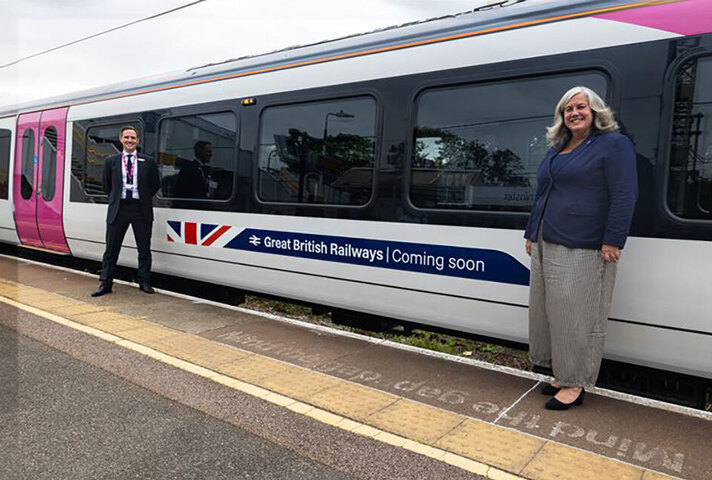
    I noted a couple of weeks back that, although the DfT’s webpage implies a start date of 2027, the absence of a date from a recent press release was saying that GBR was “coming soon”, was conspicuous.

    In April, the DfT described the return to public hands of as South Western Railway as a “new dawn for rail”, but the state-owned firm has just quietly announced cuts to services.

    As has been observed, there was no fanfare about this deterioration. Heidi Alexander certainly didn’t stand in front of an SWR train to publicise it.

    Leave a comment

  • There was never enough money

    New Civil Engineer reports that City of York Council has agreed to phase the delivery of its Outer Ring Road project as the anticipated cost has jumped by almost £100m to £164m.

    This has been on the cards for some time and in February Cllr Katie Lomas, the council’s finance executive member, told the Local Democracy Reporting Service that:

    it’s been clear for some time there was never enough money allocated to deliver it.

    On that basis, it’s worth recapping the history of the scheme, going back to 2018, when Tory transport secretary Chris “failing” Grayling announced that it would be one of the first schemes in the major road network, although his department had not yet revealed the actual network.

    The huge rise in the cost of the scheme – and therefore the huge funding gap – has been known about for a while, leading to the decision to phase delivery of the scheme and the scheme. I’ve written a few times that government funding for these schemes leaves councils well short of what they cost these days.

    But the fact that the council was still working on the full business case for the scheme  didn’t stop the Department for Transport claiming earlier this month that it was one of 28 local road schemes that had been “given the green light“.

    Leave a comment

  • DfT confirms funding withdrawn from A1 scheme

    I have a further explanation from the Department for Transport (DfT) on why it doesn’t think that National Highways and the Office or Rail and Road (ORR) misled the public and Parliament when they said the A1 Morpeth to Ellingham scheme would start construction in 2022-23, despite being deprioritised and its funding withdrawn.

    It isn’t really much of an explanation and appears to depend on conflating the suggestion that these bodies should have said the scheme was cancelled (it wasn’t; I didn’t) with what I actually said, which is that they should not have actively pretended it was going ahead within a specific timeframe, when it wasn’t.

    I think the top line is that:

    The claims National Highways and the Office of Rail and Road misled the public are untrue, as the positions they set out were in accordance with the status of ministerial decisions on the projects at the time.

    This depends on pretending that schemes going ahead soon and not (yet) being cancelled is the same thing. In addition: 

    A Spending Review funding allocation is not the same as a project decision; the latter requires specific approval by a Transport Minister. 

    The DfT also says that the scheme remained in the RIS portfolio [which] is reflected in the language used by the National Audit Office (NAO) report in September 2022 and the subsequent National Highways delivery plan.

    It is absolutely true that the scheme remained without funding in the portfolio awaiting a final decision on whether to proceed, as the NAO revealed and as I reported.

    But again, the DfT is trying to pretend that being in the portfolio without funding awaiting a final decision on whether to proceed is compatible with what National Highways said and the ORR also reported, which is that it was going ahead *that year*.

    (more…)
  • National Highways and ORR misled public and Parliament over A1 scheme

    Looking back at what was said in 2022 about the secret decision to shelve the A1 Morpeth to Ellingham scheme, it is quite clear that both National Highways and its regulator misled the public, and both organisations have conspicuously failed to deny that they did so.

    I have previously noted that the Tory government’s decision to withdraw all funding from the scheme after the 2021 Spending Review is cited in a leaked report obtained by the Newcastle Chronicle.

    However, the National Audit Office’s (NAO) November 2022 report cites the scheme as one of two that had been shelved earlier that year:

    In February 2022, DfT formally notified National Highways that two projects on the watchlist had been deprioritised as an outcome of the 2021 Spending Review. These two projects remained in the portfolio awaiting a final decision on whether to proceed but their funding has been removed.

    So to be absolutely clear, between February and November 2022 the A1 Morpeth to Ellingham scheme had no funding.

    Let’s look then at National Highways’ Delivery Plan 2022-2023, which was published pretty well in the middle of that period. Under “Our activities during 2022-23”; it states:

    We will start work on two schemes [including] A1 Morpeth to Ellingham which will upgrade multiple sections of the A1 to dual carriageway to provide continuous high quality dual carriageway from Newcastle to Ellingham, north of Alnwick.

    A pretty unambiguous pledge to start work on a scheme that had no funding and unarguably a direct lie but National Highways has not responded to my request for explanation or comment.

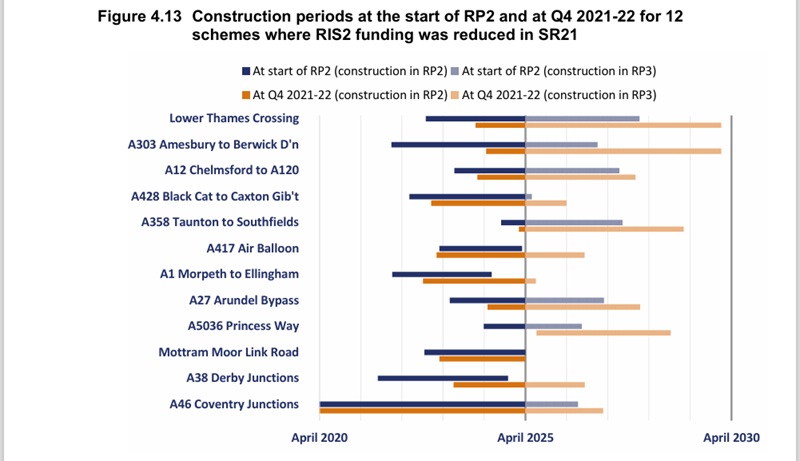
    Similarly the Office of Rail and Road’s (ORR) Annual Assessment of National Highways’ performance April 2021 to March 2022, “Presented to Parliament pursuant to section 10(8) of the Infrastructure Act 2015” and “Ordered by the House of Commons to be printed on 14 July 2022” lists the scheme as one of “12 schemes where RIS2 funding was reduced in SR21”.

    So already the public and Parliament are being misled by the ORR’s description of the scheme as having had its funding “reduced”, rather than outright withdrawn.

    To make matters worse, the ORR then presented Parliament with a graphic (above) showing the construction period for the scheme beginning in 2022-23.

    It then falsely claimed that the scheme was “currently forecasting spend of £255m against a RP2 baseline of £39m”. The scheme was not currently forecasting any spend as it was unfunded.

    (more…)

  • National Highways underpasses the buck

    Transport secretary Heidi Alexander’s request for more information about National Highways’ £340m M60/M62/M66 Simister Island project as she considers its planning application has generated some media coverage and an interesting snippet about how the company spends our money.

    At the heart of the issue is a dispute about what, if anything, the scheme will do to improve the Haweswater underpass, which goes under the motorway and provides a form of access for local people.

    Here’s the question that Alexander asked after ministers said they would throw money at the scheme.

    The Secretary of State is aware that, during the examination, the Applicant indicated that it was exploring designated funding to support some improvements to the Haweswater underpass.

    The Secretary of State requests an update from the Applicant on whether a bid has been made for that designated funding, and if so, any update as to whether that bid has been successful.

    Bear in mind that then the applicant (National Highways) talks about making a “bid” for designated funding, it is claiming to make a bid to itself.

    Anyway, here is its answer:

    The Applicant confirms that a bid for Designated Funding to carry out improvements to the Haweswater Underpass will be made to seek to secure its delivery in the financial year 2026/27 as all funds have now been allocated for the 2025/26 financial year. The Applicant would reiterate that there is no guarantee that funding will be made available, and the improvements are outside the scope of the Scheme.

    So National Highways is happy to spend £340m on a scheme to increase road capacity but is going to pass the begging bowl to itself to improve access for locals. And when it says there is no guarantee that funding will be made available, it is something of an understatement.

    (more…)
  • ORR determined to hide the truth about A1 scheme cancellation

    I have a response – of sorts – from the Office of Rail of Road (ORR) on the question of what it knew about the secret decision to shelve the A1 Morpeth to Ellingham scheme. It’s a response that shows the regulator to be unable or unwilling to be straight with the public.

    To recap, last week the Newcastle Chronicle reported, based on a leaked Department for Transport report, that:

    …during the 2021 Spending Review the funding for the scheme was “withdrawn” and the plan was “deprioritised”. The report adds: “The funding decision was not made public, but we instructed National Highways to cease work on the scheme.”

    Rather than answer my question about what and when it was told about the decision to shelve the scheme during a time when its dashboard continued to show it as a live scheme, the regulator told me:

    “ORR’s enhancements reporting showed the delays for some enhancement schemes, including the A1 Morpeth to Ellingham scheme. The detail of ongoing governmental policy decisions is not something that ORR can include in regulatory reporting of National Highways’ performance.”

    Dismissing the shelving of a scheme and the withdrawal of funding as part of ongoing governmental policy decisions is as worrying as it is disingenuous.

    Is the ORR telling us that live National Highways enhancement schemes listed in a road investment strategy that is intended to provide certainty are quietly shelved all the time while it pretends that they are merely “delayed”?

    If this is true and the ORR is constantly hiding such developments from the public, it is even more pointless as a regulator than I thought it was.

    I have reminded the ORR of my original question, which it can only delay answering because of the Freedom of Information Act.

    Leave a comment

  • How National Highways planned to fail on safety

    Returning to the subject of National Highways’ pledge to carry out 43 “additional” actions during 2024-25 to improve its failing safety record, a raft of recent documents from the company and its regulator suggest that it *might* have spent more money on the issue, but there remains no confirmation on either point.

    To recap, according to the Office of Rail and Road (ORR), National Highways’ enhanced safety plan, which both bodies have continued to hide from the public, was said to have included 43 additional actions for the year: 24 road safety schemes, eight communications campaigns, and 11 ‘working with others’ actions. Only 33 were delivered during the year and almost all of the undelivered actions were road safety schemes.

    Both organisations said these actions, in a plan delivered in March 2024, were “additional” to the company’s 2024-25 delivery plan, which was published a year later and did not list specific actions.

    I calculated that during the first four years of the second (2020-25) roads period, National Highways had spent £105.8m from its Safety and Congestion designated fund, leaving around £34m to be spent of the £140m five-year budget against a projected “investment” of £27m in the delivery plan.

    In its Annual Report and Accounts for the year, the company, claimed to have “invested” £41.3m in around 160 projects improving safety or congestion. When added to the existing spend, this corresponds with the £147m “spend” in the ORR’s “efficiency and finance” report for RIS 2, although the ORR may have included cost of schemes that have not been completed.

    So National Highways *may* have spent more over the year than it claimed *as the year ended* to have intended to spend and appears to have overshot its RIS 2 budget of £140m.

    Its annual report says that with cuts for designated funds, there was “an exercise to prioritise those schemes contributing to corporate and legislative targets and commitments”. This appears to have led to a boost to the Safety and Congestion fund via by a raid on the Users and Communities fund and National Highways *may* have focused the Safety and Congestion fund more on safety and congestion.

    But there is no real evidence that this happened and National Highways has never said how many of its Safety and Congestion fund were safety and how many were congestion.

    (more…)

Subscribe

Subscribe to get our the latest stories in your inbox.