Transport Insights

The transport stories you won't see in the industry-friendly media

Author

Chris Ames
  • Lightwood makes light of speed camera snafu

    Roads minister Simon Lightwood has claimed that drivers who break the law “can expect to be punished”, despite confirming that tens of thousands of drivers have got away with speeding offences because of National Highways’ latest technology failure on smart motorways.

    In written parliamentary statement, Lightwood confirmed, but sought to play down, the fact that an “anomaly” over the settings on variable speed limit enforcement cameras occurred approximately 2,650 times over four years, leading to a similar number of wrongful prosecutions.

    But that’s only half the story. As Lightwood told MPs:

    Independently, the National Police Chiefs’ Council took action to instruct all affected police forces to cancel wider prosecutions related to infringements in progress, regardless of whether they were impacted by this issue. As a result, tens of thousands of people’s speed awareness courses are being cancelled, and thousands of historic fixed penalty notices and criminal justice prosecutions are being discontinued.

    Lightwood also explained why his department had covered the problem up for around three months, without explicitly stating that it had done so:

    Throughout this process, I have been clear with all partners that we must ensure our road network remains safe. We therefore took the decision, following a safety assessment from National Highways, not to undermine public confidence in enforcement and risk impacting driver behaviour before we had a solution to this issue approved and ready to roll out.

    He ended his statement with an assertion that the facts have proven to be wholly untrue.

    Compliance with the law is being enforced in a variety of ways across our roads, as has always been the case. If you break the law, you can expect to be punished.

    As I commented yesterday, if tens of thousands of drivers breaking the law cannot be prosecuted because smart motorway technology is, once again, not up to the job, that is a major safety issue.

  • Facts won’t be fixed on Thames tunnel till 2028

    Transport Action Network (TAN) has seized upon the confirmation that the Lower Thames Crossing will not open until 2034, but even this date is said not to be realistic and the mega-project is not even due to have a full business case (FBC) until 2028.

    The delay to the FBC means that Labour will continue to throw money (£3bn) at the project before working out whether it is worth doing and the rest of us will be kept in the dark.

    TAN has pointed to the appointment letter naming Kate Cohen as the Senior Responsible Owner (SRO) for the project:

    You are required to undertake this role until the end of the project planned for 2034, or until the responsibility is transferred. 

    In fact, the National Infrastructure and Service Transformation Authority’s annual report 2024-25 states:

    Compared to financial year 23/24-Q4, the project’s end-date at 24/25-Q4 remained at 20/04/2034.

    […]

    This baseline is no longer viable after a second Written Ministerial Statement was issued on the 4 October 2024 extending the Development Consent Order Decision date until 23 May 2025 in order to allow more time for the application to be considered further, including as part of the spending review [Development Consent Order Consent granted 25 March 2025]. The project is currently working on the impact to the Open for Traffic following the second Written Ministerial Statement.

    No-one seems to have told Matt Palmer, executive director of the Lower Thames Crossing, about 2034. In this recent press release about a non-existent piece of tunnelling kit, he said:

    The search for our giant tunnel boring machine is now on, putting us on track to open the Lower Thames Crossing in the early 2030s. 

    (more…)

  • National Highways races to play down speed camera cock-up

    The revelation that thousands of drivers have been wrongly prosecuted because speed cameras on smart motorways and elsewhere had the wrong settings is a major embarrassment for National Highways, which is why it is, typically, trying to play it down.

    I’m not sure it will boost confidence that the issue has only been admitted by the government-owned company and the Department for Transport (DfT) after a so-called fix has been put in place, but here is the headline on the National Highways press release:

    Fix being rolled out after variable speed camera anomaly

    As the Daily Mail points out:

    The scandal will yet again raise concerns about the safety of smart motorways, which are stretches of road where variable speed camera technology is used to manage traffic flow and reduce congestion.

    It’s fair enough to point out that too rigid enforcement doesn’t put anyone at risk but the story feeds into the general problem that, as the draft of the third Road Investment Strategy put it:

    National Highways should not be over-reliant on technology, for example drawing on insights from the use of cameras and stopped vehicle detection when considering driver safety and welfare.

    This is code for saying that the technology on smart motorways isn’t up to the job.

    (more…)
  • DfT adds insult to death and injury on smart motorways

    There’s a good write-up in the (Sheffield) Star of the current situation over the release of the 14 evaluation reports on smart motorways that ministers are sitting on, with the Department for Transport’s (DfT) excuses not fooling anyone.

    It features Claire Mercer’s reaction to the DfT being unable to say that there is anything other than a  made-up “assurance” process to justify the ongoing suppression of the Post Opening Project Evaluations (POPEs).

    The reality, as National Highways told me, is that ministers have to agree a “comms handling plan” before telling us how (un)safe the projects are.

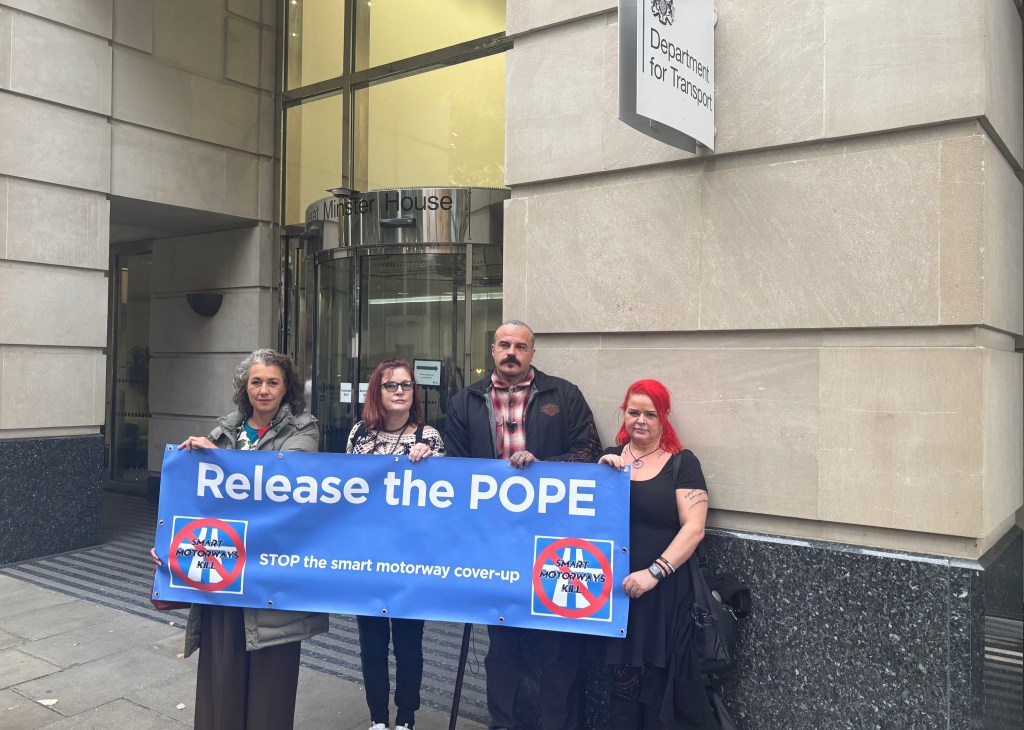
    Speaking to The Star, Claire – founder of the Smart Motorways Kill Campaign – scolded the DfT and said she believes the “only reason” for the delays can be that roads minister Simon Lightwood is “merely preparing to spin what are likely to be very negative findings.”

    The Star does include Mercer’s allegation that Lightwood lied to her by falsely claiming that an assurance process is “ongoing”:

    (more…)
  • Look over there, Greenwood says as active travel funding falls

    With Labour cutting funding for active travel and being coy about whether its forthcoming cycling and walking investment strategy (CWIS3) will include meaningful targets, transport minister Lilian Greenwood has gone in for the diversionary tactic of reheating the culture wars.

    On Sunday The Guardian reported pressure from campaigners for CWIS3 to include targets beyond the feeble – and clearly unmeasurable – aspiration to make walking, wheeling and cycling “easy, safe, and accessible for everyone” by 2035.

    On Wednesday, Greenwood answered – or rather failed to answer – a question from shadow transport secretary Richard Holden on:

    (more…)

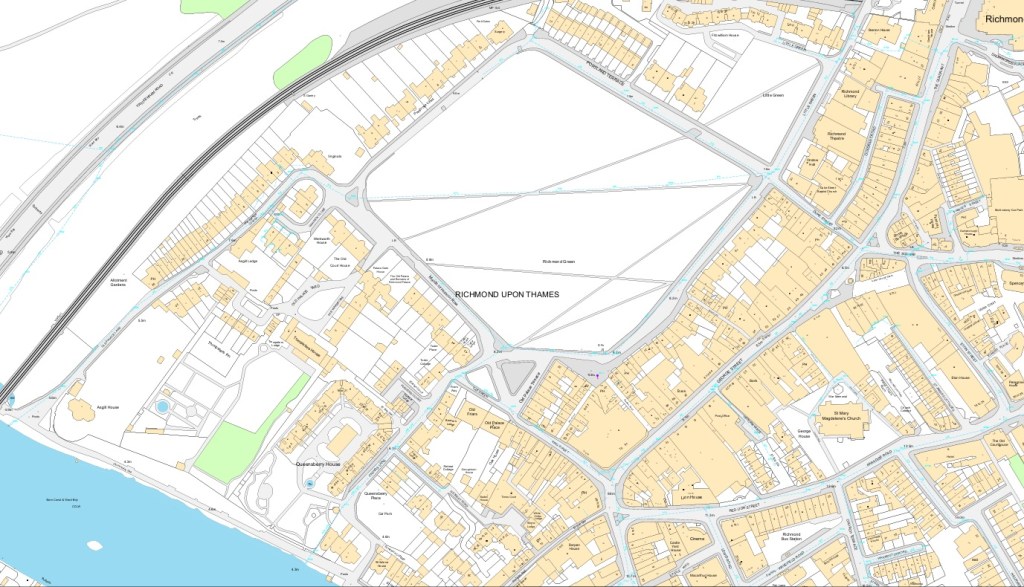
  • Richmond Council doubles down on disregard for law

    Clearly aware that it does not have a leg to stand on after wrongly asserting that a resident had broken the law by pouring a small amount of coffee down a road gully, Richmond Council has now thrown away all pretence that it abides by the Freedom of Information Act (FOIA).

    To recap, the council fined Burcu Yesilyurt for an alleged offence under Section 33 of the Environmental Protection Act 1990 and then rescinded the fine on the grounds that the offence she had committed was “a minor contravention which the recipient agreed not to repeat”.

    But, as I and others have pointed out, the offence of disposing of waste in a way likely to pollute land or water would depend on where the gully leads to and – if a sewer that discharges into the environment – the amount of coffee relative to the toxic road runoff that the gully is designed to deal with.

    Thames Water told me that the gully does go into a surface water only sewer – rather hand a combined sewer – which means that Richmond Council is itself seriously polluting the waterway (the Thames) that it claims to be protecting.

    I asked the council under FOIA:

    where does the gully into which the coffee was poured discharge? (i.e. into a combined sewer system or the Thames)

    what mitigation is in place to protect Richmond’s waterways from the [toxic] runoff via gullies on the street in question?

    what assessment has it made of the relative scale and composition of the coffee tipped into the gully relative to day to day runoff to satisfy itself that such a contravention occurred?

    The answers to these questions would show whether the Council was (ever) entitled to allege that Ms Yesilyurt had committed an offence and whether it has been entirely hypocritical because it is itself a major polluter, which we already know.

    But the council made no attempt to state whether it had the information requested, let alone provide it; instead it sent me a narrative response that looks very much like a PR statement:

    (more…)
  • Potholes: who benefits?

    I have just caught up with Panorama’s programme on The Pothole Problem, which aired earlier this week and does very much dig beneath the surface of the issue, as you would hope.

    Having worked briefly with Richard Bilton and colleagues on last year’s programme about smart motorways, I am not surprised that this new programme went beyond the headlines, as well as making a technical issue accessible and relatable.

    While obviously highlighting the safety and other problems that potholes and poor road condition in general can cause, the programme correctly identified the obsession with filling them in as the main issue.

    (more…)
  • DfT looks to AMES for robust analysis

    The latest (December) issue of highways magazine includes my first piece for the publication as a freelance since I left in March – and it’s a good one

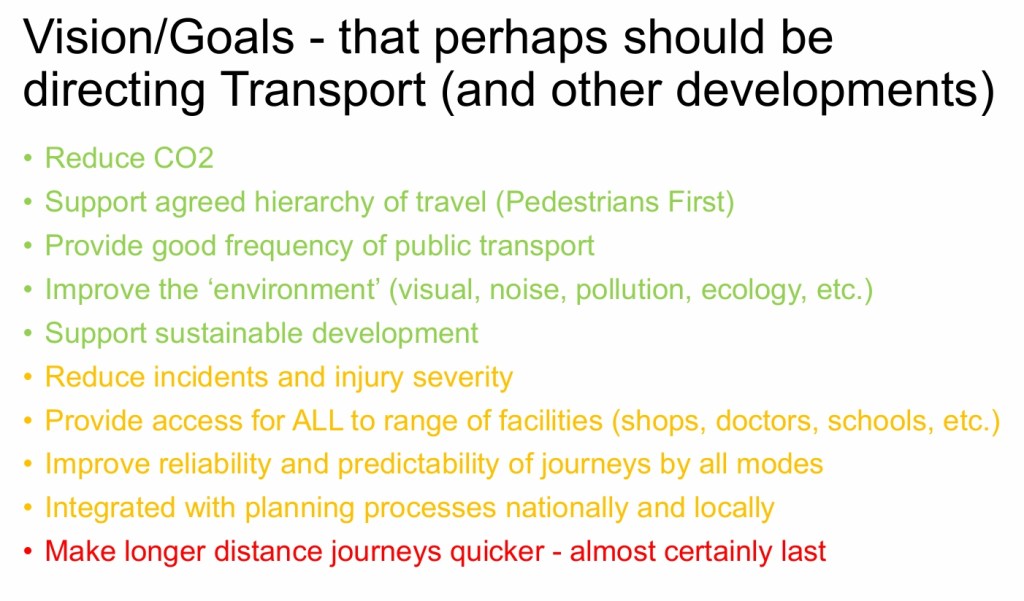
    The article features an interview with “two stalwarts of transport planning who recently told a prestigious European conference that the way we choose which transport projects to spend money on needs to change”.

    The two are John Elliott and Derek Turner CBE, who between them have 100 years working experience, including as leading lights of the Local Authority Technical Advisers Group.

    The conference was the European Transport Conference in Antwerp and their paper was titled: “Time for Transport Planning to Reflect Real Priorities based on Facts?”

    Anyone who knows either of them will know that the answer from their point of view is very much yes.

    Unfortunately, the edit of the article loses my very funny joke based on the fact that the Department for Transport’s forthcoming Appraisal, Modelling and Evaluation Strategy is called AMES for short.

    If you haven’t done it already, you can sign up for free access to the digital issue of the magazine.

  • Minister lied to me, smart motorway widow says

    Claire Mercer of Smart Motorways Kill has also concluded that the claim that the Department for Transport (DfT) is still “assuring” 14 smart motorway evaluation reports going back three years is a fiction – and that roads minister Simon Lightwood lied to her about this.

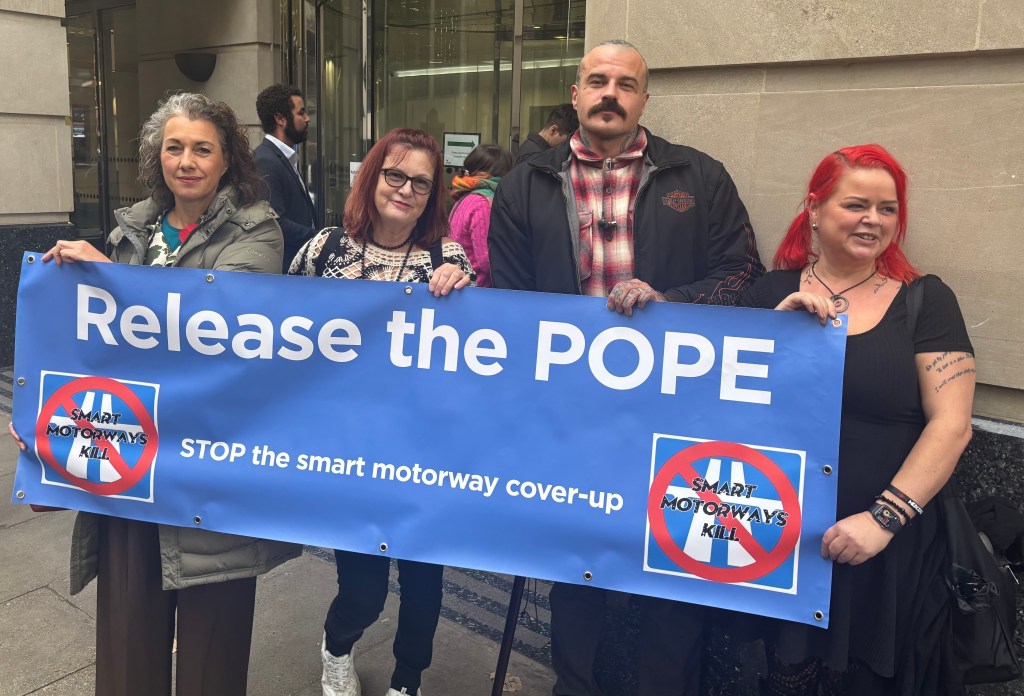
    Mercer, whose husband Jason was killed, along with Alexandru Murgeanu, on a smart motorway stretch of the M1 in 2019, co-organised the protest outside the DfT last month calling for the Post Opening Project Evaluation (POPE) reports to be released.

    Lightwood wrote to her at that time to defend the suppression of the reports, saying:

    …it is right that we take the time to fully assure findings. This process is ongoing

    As I wrote on Monday, when challenged over the “process” by Mercer’s MP, Sarah Champion, Lightwood resorted to claiming that a “wider assurance”, rather than the formal assurance for each scheme was happening. This is clearly a fiction.

    Mercer’s solicitors, Irwin Mitchell, also wrote to the DfT to challenge the process. It told them that the reports:

    are currently completing the final governance and approval stages

    adding:

    it is right that the department take the time to fully understand and assure findings prior to publication

    Again, the pretence that a formal assurance process is happening has evaporated.

    Mercer has seen through this and has not forgotten what Lightwood told her. She said:

    (more…)
  • MPs back backwater buses boost

    The Commons Transport Committee has welcomed the news that government funding to local authorities for bus services will take into account how rural an area is for the first time

    Although the committee described the news as an “announcement” by the Department for Transport, it was a little bit buried in a larger announcement last week of the consolidation of various existing bus funding streams into capital and revenue Local Authority Bus Grant (LABG) totalling nearly £3bn over four years.

    The webpage for LABG revenue allocations: 2026 to 2029 states:

    The individual revenue allocations were determined using a revised 2025 to 2026 formula that considered the needs of each local transport authority, taking into account population size, levels of deprivation, bus service provision and rurality. 

    The committee raised the issue of rural buses in its Buses connecting communities report, published in August.

    Chair Ruth Cadbury said: 

    (more…)

Subscribe

Subscribe to get our the latest stories in your inbox.