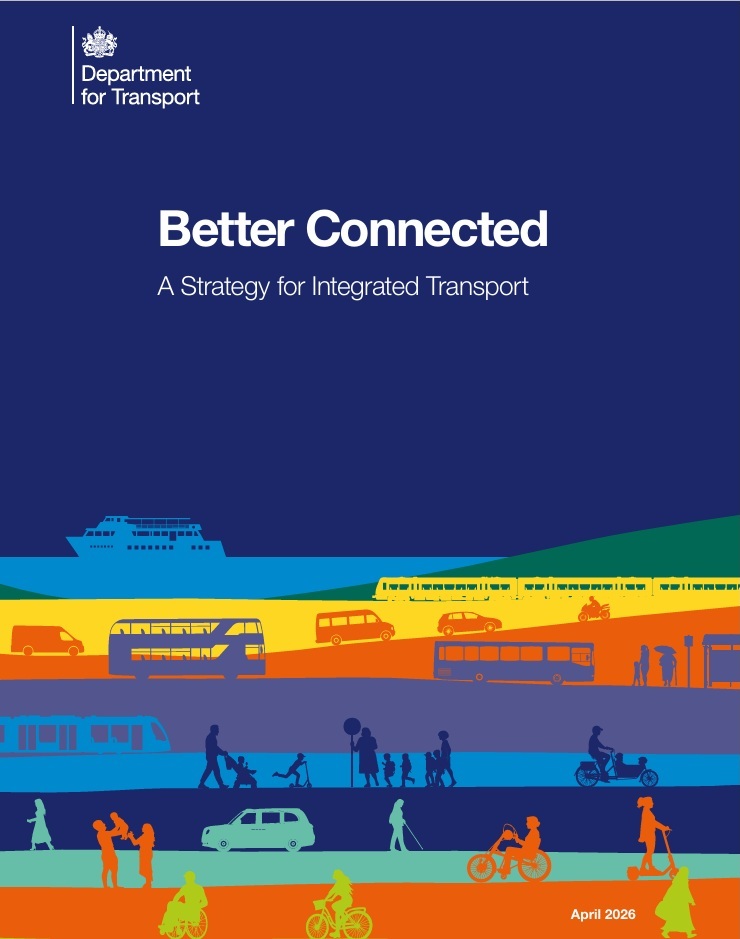
The Department for Transport (DfT) has published its Strategy for Integrated Transport, called Better Connected, and to say it is a disappointment would be an understatement.
It’s little more than a collection of existing policies, wishful thinking and platitudes, with a few new policies thrown in but no indication of any integration or strategy.
And gimmicks – there are a few gimmicks that attempt to grab headlines, although that doesn’t seem to have happened so far as the gimmicks are nowhere near headline-grabbing enough to achieve that.
It’s hard to believe the DfT spend nearly a year and a half coming up with this tosh:
Better Connected is this government’s vision for domestic transport in England. That vision is simple – for transport to work well for people, for it to be safe, reliable, affordable and accessible so they can get on in life and make the journeys they need to easily.
To call a list of four basic asks a “vision” takes some nerve and really sets the tone for the document.
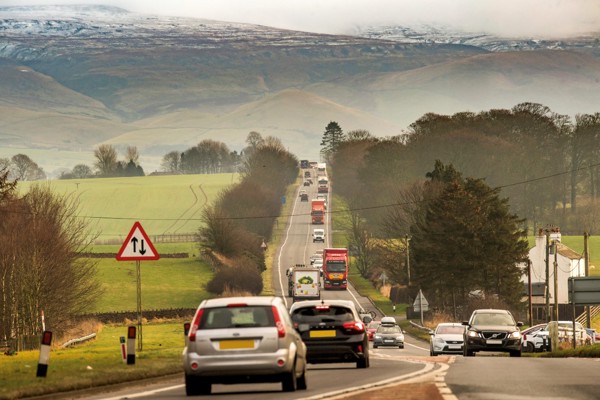
Returning to the theme of the schemes in the third Road Investment Strategy (RIS 3) that will carry both construction activity and costs into the next RIS, getting more expensive the longer they are delayed, the A66 Northern Trans-Pennine is now set to cost over £2bn.
What makes this example even more farcical is that the scheme was part of Boris Johnson’s 2020 Project Speed to, well, speed up infrastructure schemes, and was given special funding for this purpose.
Now, the Office of Rail and Road’s (ORR) advice on National Highways’ draft strategic business plan reveals that the total costs of the 16 enhancement schemes in the draft strategic business plan (SBP) are around £600m higher than previous estimate.
This difference is predominantly from the A66 Northern Trans-Pennine scheme, where the outturn cost in the draft SBP compared was £540m above the most recent forecast.
Assuming that the most recent forecast was £1.5bn, that puts the scheme at well over £2bn. I don’t really like saying that something has breached an imaginary barrier but in this case I use the word ironically, to point out that the costs of these schemes just seem to escalate without any constraints.
In the absence of detail on enhancement schemes in the new Road Investment Strategy (RIS), the Office of Rail and Road’s (ORR) advice on National Highways’ draft strategic business plan gives a good indication of what is likely to happen.
We know from the RIS that there is £3.8bn for enhancement schemes, not counting the cash for the Lower Thames Crossing, but what emerges from the ORR report is just how much of this will go on schemes that are already in construction and how much of the new schemes will fall into the post-2031 RIS 4.
The report reveals that:
National Highways’ proposed portfolio of existing enhancements in its draft SBP is made up of 16 schemes, 11 of which are currently in construction.
In addition, only two of the new schemes are due to be completed during the RIS 3 period, also known as Roads Period 3, or RP3.
And two of the schemes are not due to start until the last two years of the five-year period, with the A38 Derby Junctions starting in 2029-30 and the A46 Newark Bypass in 2030-31.
As the ORR notes, National Highways enhancements frequently fall into a vicious circle of delays and cost increases, followed by delays because the costs have to be spread out:
Depending on decisions elsewhere in the plan, it might be necessary to defer the start of these projects to improve affordability. However, such deferrals would further increase total outturn costs as seen during RP2.
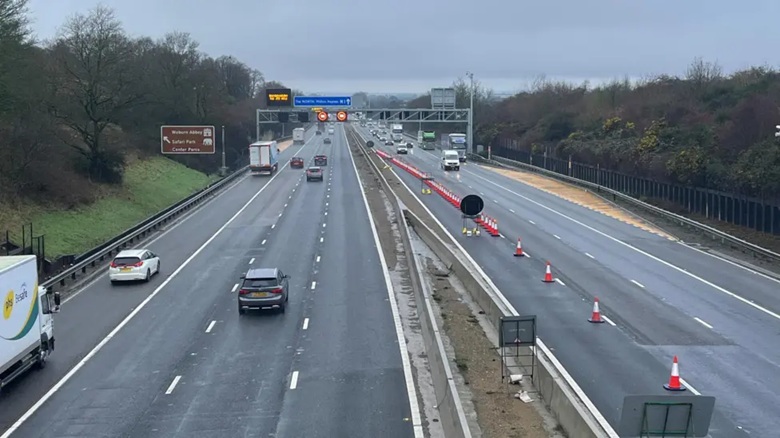
Returning to the mysterious “drainage defect” that undermined the stability of the new concrete central barriers on a stretch of the M1 in Bedfordshire, the BBC reported in quick succession that the defect was “still not fixed” and then that work “is due to begin”.
National Highways said the drainage defect, which had emerged in mid January between junctions 12 and 13 but which they were trying to get to the bottom of, had weakened the supports for what are obviously very heavy barriers.
they had been able to remove the lane closures early last week “due to the improving weather” but did not say when the “drainage defect” would be repaired.
That article quotes me as saying that it looked like National Highways was taking advantage of the drier period:
[But] it seems unlikely that it would be able to carry out significant work to repair any damaged drainage without reinstating lane closures to create a sufficiently wide and safe working environment.
Documents published by National Highways’ regulator show how the company tried to avoid being held to account during the new Road Investment Strategy (RIS 3) for its continued failure to meet casualty reduction targets and how little it is likely to do by way of dedicated safety work.
If the proposed spending levels in the draft strategic business plan (SBP) have been carried through to the RIS itself, dedicated spending on safety over five years will be (significantly) less than the cost of one major enhancement scheme, such as the £600m A38 Derby Junctions scheme.
The ORR reported that National Highways’ draft SBP proposed a spend of £342m in its safety National Programme and £122m in its safety Designated Fund, totalling £464m.
This describes in quite scathing terms what the £464m looks like out of a budget totalling £25bn:
The commitment of less than 2% of the RIS3 Statement of Funds Available to specific safety activities is difficult to reconcile with safety being the number one priority for the organisation.
Comparison between the ORR’s account of the SBP and the RIS itself reveals that a proposal for the National Programme to deliver safety interventions on 18 priority corridors with current poor safety performance and a low International Road Assessment Programme (iRAP) star rating has been carried forward – suggesting that the funding levels will be very close to what was proposed.
In terms for casualty reduction, the Thomas Fleming analysis reveals that the National Programmes and Designated Funds combined were forecast to achieve a reduction of just 85 killed and seriously injured (KSI) casualties per year by the end of the RIS. It calculated that this would represent a cut of just 2.7% relative to the 2005-2009 baseline against which previous RIS targets were calculated.
It highlighted “significant disparities” between the scale of this reduction and the long-term trajectory required to achieve zero deaths and serious injuries on the strategic network by 2050 – a target date that National Highways has already put back by 10 years.
Ministers are due to publish the long-awaited Integrated National Transport Strategy, now to be called a “Better Connected transport plan” on Thursday, it has emerged.
On Thursday, the government will unveil its Better Connected transport plan, which aims to improve travel across the country.
This was confirmed by Danny Williams, who is both director for Integrated National Transport Strategy at the Department for Transport (DfT) and CEO at Active Travel England.
In a in a LinkedIn post referencing the story, he wrote:
On Thursday, the government will unveil its Better Connected transport plan [formerly known at Integrated National Transport Strategy], which aims to improve travel across the country.
Work on the strategy was launched in November 2024 by the then transport secretary, Louise Haigh, who was subsequently and perhaps consequently defenestrated by No 10 and replaced by the more car-friendly Heidi Alexander.
The BBC article appears to serve as an appetiser for the new plan and quotes Alexander as saying that the results of a trial of the NPP app prove “how much people value a simpler, more straightforward way to pay”.
Williams describes his work on the now downgraded strategy, as:
Developed and soon to publish disruptive national strategy that will make a tangible difference to people’s experience of transport, with an emphasis on empowering local decision-making, driving outcomes including a national public transport ticketing system, a new national approach to roads, alignment of transport and new housing, and opportunities including for EVs and Avs
Which is funny, because the BBC reports:
Ministers are now set to impose statutory guidance to accelerate take-up, with the aim of doubling the number of participating councils.
As the farce over the West Yorkshire Mass Transit shows, ministers only believe in empowering local decision-making when it provides the outcomes they want.
Ministers have announced a further 16 local authority road schemes that survived the review initiated last year, but the schemes join a long queue with no funding any time soon.
Last year the Department for Transport (DfT) claimed to have green-lit 28 major road network (MRN) or large local major (LLM) schemes, albeit that many were already in construction and others only working on their business cases.
It announced that a further list of (42) schemes were “under consideration”, with transport secretary Heidi Alexander telling MPs that these schemes “now need to be reviewed”.
The previous government left us with an unrealistic and unaffordable programme of schemes which we have had to review in the best interests of local and national taxpayers.
She stressed that:
this represents a government funding commitment of around £1 billion, subject to each scheme securing the necessary business case and other approvals in due course.
The new Road Investment Strategy (RIS) has set a new low for opacity by announcing four “designated funds” without any actual funding committed.
The RIS document, published this morning by the Department for Transport, rehearses the use of designated funds to “go beyond the requirements of National Highways as a network operator” and states:
RIS3 will continue to provide funding for four Designated Funds: Safety; Customer and Communities; Innovation and Research; and Environment. These four funds have been refined from RIS2 to reflect the priorities of RIS3 and its increased focus on safety and environmental objectives.
Each Designated Fund is operated directly by National Highways. National Highways will report to Government about where the money has been spent, and how it has delivered value for money, but the operational decisions about how to invest these funds is delegated to National Highways.
But, despite a reference to “the money” and to “these funds”, nowhere does the document state how much money will be in each of these funds, meaning that each so-called funds currently has neither designated funding nor any actual objectives.
It appears that any actual funding will be announced further down the line.
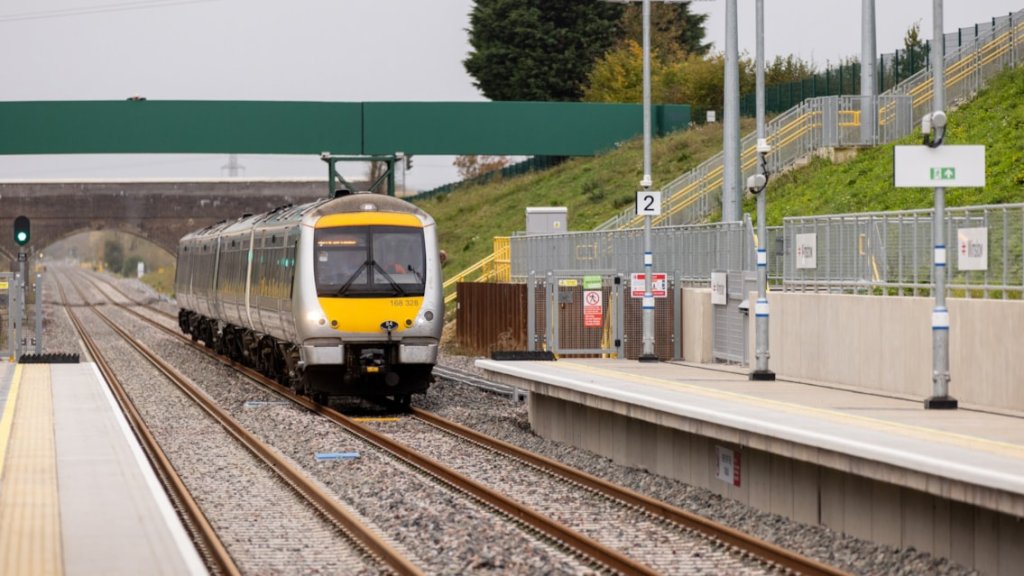
The Department continues to work closely with Chiltern Railways and other partners to confirm a start date for the first EWR services between Oxford and Milton Keynes Central via Winslow. For passenger services to commence, trains will need to have been modified and fully tested, and driver training will need to have been completed. Winslow station also needs to be fully handed over, and future staffing arrangements also remain to be agreed.
We knew all of this already so the only thing that Mather’s non-answer reveals is that he hasn’t a clue.
Unsurprisingly, Heidi Alexander’s announcement that she has “tasked HS2 Ltd to explore options to remove complexity that could cut billions in costs and reduce delays” has fallen flat with people who know what they are talking about.
HS2 was originally commissioned to run at 360km/h, which would have made them the fastest conventional high-speed trains anywhere in the world. However, no railway in the UK, or globally, is currently engineered for 360km/h.
This means that HS2 would have to wait for HS2 tracks to be built before testing any trains – an approach which could increase costs and delay the completion of the project.
There’s an interesting use of language of possibility here, with “would have” suggesting that trains at this speed are not going to happen and “could” admitting that the increase in costs and delay might come to nothing.




 Transport Insights
Leave a comment