
National Highways is set to be given funding and a clear target to tackle toxic water runoff from its roads under a new-style “National Programme” in the forthcoming road investment strategy (RIS 3).
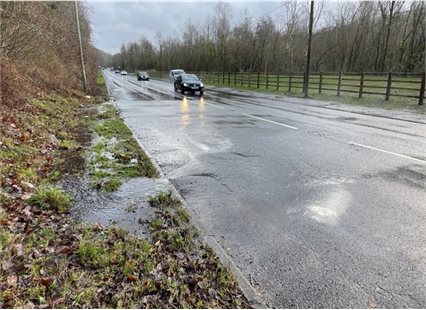
The government-owned company is under pressure to tackle the contaminated water that runs off the strategic road network (SRN) into sensitive waterways in particular.
Last month Parliament’s Environmental Audit Committee (EAC) challenged its chief executive, Nick Harris, on its plans and funding.
He replied without explanation that it expects to be “funded to do all 250” of the “high-risk” outflows on the strategic road network that it has prioritised for mitigation.
It has now emerged that water quality will fall under a National Programme for environmental mitigation, as floated in the draft RIS 3 published in August:
We are considering introducing new National Programmes to deliver defined outputs that support RIS objectives or commitments which are not within other programmes (for example, supporting specific programmes of activity around safety and environmental mitigation).
The company has since published a Preliminary Design Playbook, produced by consultants and setting out measures to mitigate high-risk outflows.
In an interview with New Civil Engineer, Stephen Elderkin, director of environmental sustainability at the government-owned company, said:
Rather than having different design teams coming afresh to each of those locations, given that we’ve now got a national programme, we’ve centralised it.
He added:
We take pollution contained in water running off our network incredibly seriously. It can contain heavy metals, hydrocarbons, tyre crumbs and other particulates and without suitable management of that runoff there is a risk of polluting water bodies where it gets discharged into water so this, this matters. It matters for health and it matters for ecosystems; it’s quite an extensive problem.
Although the playbook is branded as part of what National Highways now calls its 2030 Water Quality Programme, I understand that Mr Elderkin’s words reflect an expectation amongst officials that this will fall under a formal National Programme.
Mr Harris told the EAC:
We’re moving forward on the assumption that it’s all going to be funded.
The draft RIS 3 described how National Programme to deliver environmental mitigation, which could also include biodiversity, would differ from designated funds, which have been criticised for a lack of focus:
These types of projects would have been funded via the Designated Funds in RIS1 and RIS2 but by making them distinct programmes we can more effectively monitor their delivery and outcomes.
A National Programme would also differ from the goal of the current water quality programme as defined by the Playbook:
to develop and implement practical, cost-effective pollution mitigation solutions that deliver environmental benefits within existing funding constraints.
Such a programme would also build on National Highways’ 2030 Water Quality Plan, published in 2023, which sets a target date of 2030 for the mitigation of “high-risk” outflows.
That plan stated that the company would devise “a programme of activities” by the end of 2024-25, but warned:
It should be noted that any identified programme, and associated delivery in Road Period 3 (RP3 2025-2030), is subject to the level of funding agreed as part of the ongoing Road Investment Strategy 3 (RIS 3) negotiations.
With RIS 3 having slipped back a year to begin in April 2026 and run to 2031, it remains to be seen whether National Highways will retain the 2030 target date under a National Programme.
The current official line is that what will be delivered under National Programmes will be confirmed following the publication of RIS 3 but I have approached National Highways for clarification on its plans to tackle runoff in the light of Mr Elderkin’s comments.

 Transport Insights
Leave a reply to Chris Todd Cancel reply