
The draft of the third Road Investment Strategy (RIS 3) published this week suggests that ministers are happy with a smart motorway network where many places to stop in an emergency are officially too far apart, putting drivers at increased risk.
In November 2021, the Transport Select Committee recommended that:
The Department and National Highways should retrofit emergency refuge areas to existing all-lane running motorways to make them a maximum of 1 mile apart, decreasing to every 0.75 miles where physically possible.
The Department (for Transport – DfT) accepted this recommendation in principle and in January 2022 announced that £390m would be spent by the end of March 2025 to retrofit “more than 150 additional emergency areas”, alongside a pause on the construction of new all lane running smart motorways.
The waters were muddied when it emerged that National Highways was counting other places to stop towards the spacing standard, but the company did deliver a promised 151 new emergency areas by the end of March under the National Emergency Area Retrofit (NEAR) programme.
Although this was said to provide “around a 50% increase in places to stop”, neither the DfT nor National Highways ever said how far the programme would go to fill in all the gaps where the spacing was longer than the official standard.
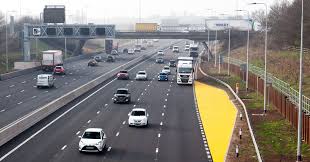
National Highways has told me that it had “prioritised locations where emergency areas could make the most difference and bring benefits to drivers as soon as possible” and suggested that it would like to see a continuation of the programme.
Labour delayed the start of RIS 3 by a year and gave the company an interim settlement for the current year that says nothing about improving safety on smart motorways.
In a section on Smart Motorways, the draft RIS 3 document claims that “substantial investment continues to improve the safety of the existing network” citing “the recent completion of additional Emergency Refuge Areas on the All Lane Running (ALR) smart motorways under the National Emergency Areas Retrofit (NEAR) programme”, which it acknowledges “was finished in March 2025” – a whole year before the new RIS.
There is no commitment to continuing the retrofit of what Labour has now returned to calling “Emergency Refuge Areas”, which leaves National Highways with a spacing standard that it is not funded to deliver.
As I reported earlier this year:
A section of smart motorway where the driver of a stationary vehicle was killed, causing a coroner to raise concerns over the distance between safe places to stop, is not due to have extra emergency refuges retrofitted, it has emerged.
Emma Serrano, area coroner for Staffordshire sent the government-owned company a Regulation 28: Report to Prevent Future Deaths in relation to the death of Kevin O’Reilly, expressing concern over the frequency of emergency areas and that the motorway was ‘not monitored’.
In its response to the coroner, National Highways acknowledged that the stretch of motorway where Mr O’Reilly died did not meet the new standard, but said:
When a new standard is produced, National Highways is not funded to retrofit the Strategic Road Network (SRN) but to apply the new standard in any new works/designs. Currently, there are no plans for the addition of more emergency areas to this section of the M6 motorway.
It seems that Labour is happy to see more deaths on smart motorways where emergency areas to stop are too far apart.
 Transport Insights
Leave a comment