
Returning to the subject of National Highways’ pledge to carry out 43 “additional” actions during 2024-25 to improve its failing safety record, a raft of recent documents from the company and its regulator suggest that it *might* have spent more money on the issue, but there remains no confirmation on either point.
To recap, according to the Office of Rail and Road (ORR), National Highways’ enhanced safety plan, which both bodies have continued to hide from the public, was said to have included 43 additional actions for the year: 24 road safety schemes, eight communications campaigns, and 11 ‘working with others’ actions. Only 33 were delivered during the year and almost all of the undelivered actions were road safety schemes.
Both organisations said these actions, in a plan delivered in March 2024, were “additional” to the company’s 2024-25 delivery plan, which was published a year later and did not list specific actions.
I calculated that during the first four years of the second (2020-25) roads period, National Highways had spent £105.8m from its Safety and Congestion designated fund, leaving around £34m to be spent of the £140m five-year budget against a projected “investment” of £27m in the delivery plan.
In its Annual Report and Accounts for the year, the company, claimed to have “invested” £41.3m in around 160 projects improving safety or congestion. When added to the existing spend, this corresponds with the £147m “spend” in the ORR’s “efficiency and finance” report for RIS 2, although the ORR may have included cost of schemes that have not been completed.
So National Highways *may* have spent more over the year than it claimed *as the year ended* to have intended to spend and appears to have overshot its RIS 2 budget of £140m.
Its annual report says that with cuts for designated funds, there was “an exercise to prioritise those schemes contributing to corporate and legislative targets and commitments”. This appears to have led to a boost to the Safety and Congestion fund via by a raid on the Users and Communities fund and National Highways *may* have focused the Safety and Congestion fund more on safety and congestion.
But there is no real evidence that this happened and National Highways has never said how many of its Safety and Congestion fund were safety and how many were congestion.
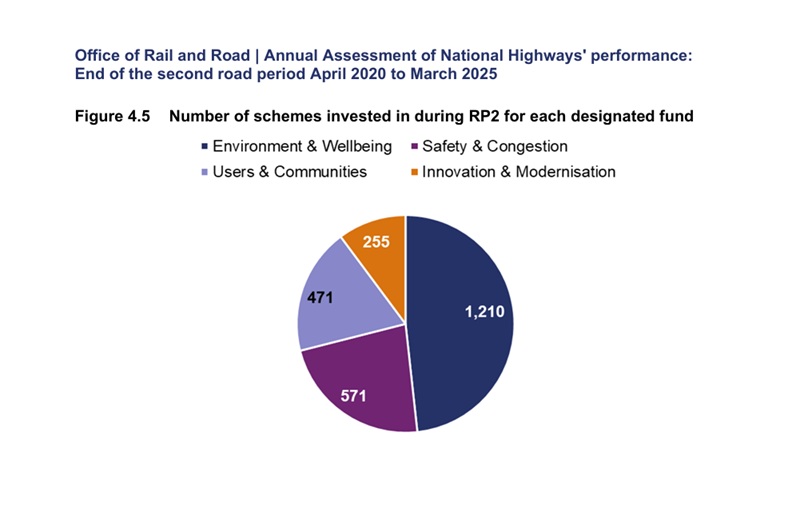
In fact, the company’s designated funds webpage for “Safety” claims that over the five years “we delivered over 570 safety schemes”, while the ORR’s Annual Assessment of National Highways’ performance: End of the second road period April 2020 to March 2025 has a chart showing that the number of schemes under the Safety and Congestion designated fund as a whole was 571 and the ORR told me that just 76 of these were safety schemes.
So National Highways is clearly labelling safety and congestion schemes as safety schemes, which appear to be a small minority of the schemes funded under “Safety and Congestion”.
On the subject of whether National Highways’ extra “Safety and Congestion” spend reflects a plan after the fact to deliver more safety actions in 2024-25, it is also worth recapping that the company had fallen behind on designated fund spending in the first four years.
The ORR “efficiency and finance” report states:
“in year 5 National Highways delivered its highest ever expenditure on DF of £227 million. Positively, this ramp up of activity ensured that the company utilised all of its DF funding in RP2.”
So to some extent, National Highways caught up in year five because of an ongoing underspend, something that looks a lot less impressive than an “enhanced plan”.
I have suggested that at one or more “additional” schemes that were delivered in 2024-25 may have merely been slippage from the previous year, which would double the appearance of increased activity.
And we already know that the company did not deliver what it promised under the “enhanced plan”; perhaps it never intended to. The company’s delivery plan for this year includes safety funding to “complete work undertaken within the second road period” and the five to seven safety designated funds scheme include “from change controlled schemes from 2024-25”.
The ORR’s annual assessment states that “National Highways needs to improve the way in which it captures and reports data on the successful delivery of DF schemes for which funding has been allocated” – another indication that allocating funding for a scheme is not the same as having any intention or ability to deliver it.
In fact, last October National Highways chief executive Nick Harris said that the schemes involved “repurposing money” for schemes that were “not stable and firmed up yet”, adding “we are not sure they are deliverable.”
 Transport Insights
Leave a comment