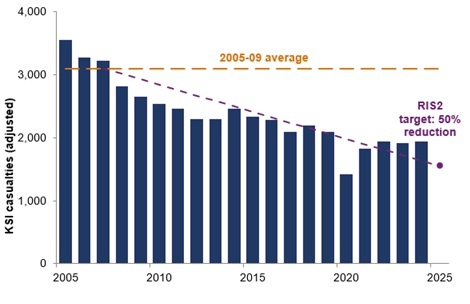
In news that will surprise no one, National Highways missed its casualty target for the 2020-25 Road Investment Strategy (RIS 2) by more than 10 percentage points.
Considering that the target was to achieve a 50% reduction in killed and seriously injured (KSI) casualties in 2025 against a 2005-09 baseline, it means that the company also missed the RIS 1 target of a 40% cut.
But the strategic road network did see an improvement of around 2.8% in KSIs compared to 2024, suggesting that if National Highways had made any effort to reduce casualties earlier in RIS 2 (something it has admitted not doing) there might have been fewer casualties on its network at the end of the period.
According to RRCGB 2025: Road type and environment, published today by the DfT, there were 785 KSI casualties on SRN motorways and 1091 KSIs on SRN A roads – a total of 1,876.

While this is around 2.8% lower than the 1,931 KSIs in 2024, it is only a cut of around 1.5% on the baseline (approximately 3,100), meaning that the total is only 39.5% down overall against the baseline, compared to 38% a year ago.
(more…)