Transport Insights

The transport stories you won't see in the industry-friendly media

Author

Chris Ames

Tag: road safety

  • Back off!

    The AA is again flagging up the dangers (and irritation) of tailgaiting – and it’s right to do so.

    The motoring organisation says that, in to a survey of 12,014 drivers, more than a quarter (27%) named tailgating as the most irritating behaviour carried out by “other drivers”.

    The poll also found that a fifth (19%) of drivers are “hacked off” by middle lane hoggers, while one in six (16%) get annoyed at drivers picking up and using a mobile phone when they are behind the wheel.

    A study carried out by AA Accident Assist in 2023 also highlighted driver frustration over tailgating and in another survey last year more than half (55%) of drivers said it had been getting worse in recent years.

    (more…)

  • Labour demonstrates four wheel drift on road safety

    Meanwhile, in the absence of a roads minister, the minister for local transport has ducked a question about when the government will publish its road safety strategy.

    In response to a parliamentary question from fellow Labour MP Darren Paffey:

    To ask the Secretary of State for Transport, what options her Department is considering to reduce fatalities involving young drivers through the Road Safety Strategy; and when that strategy will be published.

    Lightwood seems to have got mixed up with the difference between “when will the next road safety strategy be published?” and “when was the last road safety strategy published?”.

    Basically, they are thinking about it:

    The Government treats road safety seriously and is committed to reducing the numbers of those killed and injured on our roads. The Road Safety Strategy is under development and will include a broad range of policies. More details will be set out in due course.

    We absolutely recognise that young people are disproportionately victims of tragic incidents on our roads and continue to tackle this through our THINK! campaign. We are considering measures to address this and protect young drivers, as part of our upcoming strategy for road safety – the first in over a decade.

    Labour takes road safety so seriously, it doesn’t have a roads minister.

  • Road deaths continue as Starmer plays musical chairs

    As the BBC reports on the “relentless” toll of deaths on Essex’s roads in 2025, we wait to see what impact the latest game of musical chairs at the Department for Transport (DfT) may have on Labour’s long-promised road safety strategy.

    BBC News, Essex reports that crashes have killed 48 people in the county since the turn of the year, almost matching the 50 total for 2024.

    It’s the beginning of September so we are just over two-thirds of the way into the year.

    Adam Pipe, head of roads policing at Essex Police, cited drug-driving, speed and carelessness as the biggest problems seen on the county’s highways.

    “It is relentless,” Mr Pipe added.

    Twenty-five of the 48 deaths on Essex’s roads in 2025 have been sent to the Crown Prosecution Service to consider charging drivers.

    “These are not, in most cases, an accident – there is a behaviour behind it,” Mr Pipe continued.

    (more…)

  • Smart motorway shortcomings combined in fatal crash

    National Highways’ response to the coroner examining the death of a motorist on a “smart motorway” section of the M6 where the emergency areas are officially too far apart also raises concerning questions about the effectiveness of the technology involved.

    In June 2023, Kevin O’Reilly ran out of petrol on the all lane running M6 northbound approaching Junction 12 and was stationary in lane three when his car was hit by an HGV.

    Emma Serrano, area coroner for Staffordshire sent National Highways a Regulation 28: Report to Prevent Future Deaths in relation to the death of Mr O’Reilly, expressing concern over the frequency of emergency areas and that the motorway was ‘not monitored’.

    I wrote about the issues around emergency area spacing – and what the government isn’t doing about them – earlier today but what National Highways said about the role that stopped vehicle detection (SVD) played is very worrying:

    Having reviewed our CCTV footage after the incident, we determined that Mr O’Reilly’s vehicle was slow moving until approximately 30 seconds before the collision. Once stopped, SVD operated correctly in detecting the vehicle and triggered the automatic “Report of obstruction” message just after the HGV, that collided with Mr O’Reilly’s car, passed the variable message sign. Therefore the HGV driver was not presented with this warning message.

    So, everything worked as it should, but a driver in a stationary vehicle without access to an emergency area (in the absence of a hard shoulder) still lost his life.

    (more…)

  • Don’t look to Labour to fix smart motorways

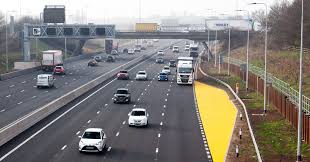
    The draft of the third Road Investment Strategy (RIS 3) published this week suggests that ministers are happy with a smart motorway network where many places to stop in an emergency are officially too far apart, putting drivers at increased risk.

    In November 2021, the Transport Select Committee recommended that:

    The Department and National Highways should retrofit emergency refuge areas to existing all-lane running motorways to make them a maximum of 1 mile apart, decreasing to every 0.75 miles where physically possible.

    The Department (for Transport – DfT) accepted this recommendation in principle and in January 2022 announced that £390m would be spent by the end of March 2025 to retrofit “more than 150 additional emergency areas”, alongside a pause on the construction of new all lane running smart motorways.

    The waters were muddied when it emerged that National Highways was counting other places to stop towards the spacing standard, but the company did deliver a promised 151 new emergency areas by the end of March under the National Emergency Area Retrofit (NEAR) programme.

    Although this was said to provide “around a 50% increase in places to stop”, neither the DfT nor National Highways ever said how far the programme would go to fill in all the gaps where the spacing was longer than the official standard.

    National Highways has told me that it had  “prioritised locations where emergency areas could make the most difference and bring benefits to drivers as soon as possible” and suggested that it would like to see a continuation of the programme.

    Labour delayed the start of RIS 3 by a year and gave the company an interim settlement for the current year that says nothing about improving safety on smart motorways.

    In a section on Smart Motorways, the draft RIS 3 document claims that “substantial investment continues to improve the safety of the existing network” citing “the recent completion of additional Emergency Refuge Areas on the All Lane Running (ALR) smart motorways under the National Emergency Areas Retrofit (NEAR) programme”, which it acknowledges “was finished in March 2025” – a whole year before the new RIS.

    There is no commitment to continuing the retrofit of what Labour has now returned to calling “Emergency Refuge Areas”, which leaves National Highways with a spacing standard that it is not funded to deliver.

    (more…)

  • Official: Smart motorway tech not fit for purpose

    Following on from my piece yesterday about the safety commitments – or lack of them – in the draft 3rd Road Investment Strategy, perhaps the most important comment on the issue comes in a section not about safety but “A technology enabled and enabling network”:

    National Highways should not be over-reliant on technology, for example drawing on insights from the use of cameras and stopped vehicle detection when considering driver safety and welfare.

    For me this is a recognition from government that technology such as stopped vehicle detection (SVD) is not up to the job given to it – keeping people safe when vehicles stop on all lane running “smart motorways” that do not have a hard shoulder.

    It can even be read as a repudiation of “smart motorways” themselves, where the word “smart” was used to imply that their key feature was technology, rather than the removal of the hard shoulder, or at least that the former compensated for the latter.

    (more…)
  • Safety takes a back seat in Labour’s “draft RIS”

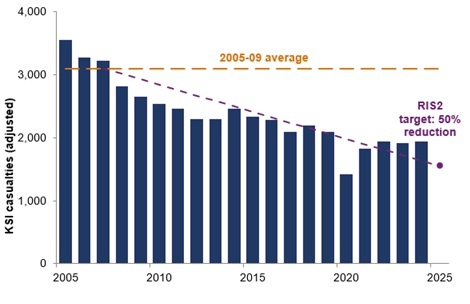
    Ministers have let National Highways off the hook over its continued failings on safety, excusing the company’s failure to meet its 2025 casualty reduction target and allowing it to put its 2040 zero harm pledge back by a whole decade.

    The Department for Transport has published what it is calling a Draft Road Investment Strategy 3, running from April 2026 to March 2031, although the document is billed as a “high-level vision” policy paper and has very little detail.

    The document notes that a consultation on previous papers “revealed that respondents placed the highest importance on improving road safety and environmental outcomes” but offers almost nothing to take these issues forward.

    (more…)
  • Has the DfT put the brakes on the road safety strategy?

    Back on the subject of the (allegedly) forthcoming Road Safety Strategy, I note that this BBC report ends with a comment from the Department for Transport (DfT) that:

    …we will set out the next steps for our strategy for road safety in due course.

    Not only is “in due course” deliberately vague but the DfT is only here referencing the next steps for its strategy in relation to that non-existent deadline.

    For all the spin and expectation that the strategy will be published in the autumn, there have only been two on-the-record statements that the government hopes it will happen this year.

    In April, transport secretary Heidi Alexander told MPs:

    Later this year we hope to publish the first new road safety strategy in 10 years.

    This hope was reiterated in June when roads minister Lilian Greenwood answered a parliamentary question:

    At the Transport Select Committee in April 2025, the Secretary of State set out that we hope to publish the Strategy later this year.

    It may be that the vague timeline given by the DfT is because it wants to make an announcement that will seem like new news rather than something we been expecting, but it could also be a reflection that the timeline is slipping.

    Leave a comment

  • Exclusive: National Highways more than a third short on safety scheme pledge

    I have further detail of National Highways’ failure to deliver the actions it pledged to carry out under its “enhanced safety plan” for 2024-25, with confirmation that it delivered only 15 of a promised 24 road safety schemes, less than two-thirds.

    To recap, National Highways’ enhanced safety plan, which regulator the Office of Rail and Road’s (ORR) demanded that the government-owned company “transparently” produce to improve its failing safety record, but which both bodies have continued to hide from the public, was said to have included 43 additional actions to be delivered during the year.

    These comprised 24 road safety schemes, eight communications campaigns, and 11 “working with others” actions.

    In March, the ORR revealed that the company had only delivered 22 of the 43 actions, including just five safety schemes. In July it revealed that only 33 were delivered during the year, but did not reveal how many of these were safety schemes.

    The regulator has now disclosed to me under the Freedom of Information Act that National Highways delivered just 15 road safety scheme during the year against the target of 24.

    The vast majority of the other types of action were complete – all eight communications campaigns and 10 out of 11 “working with others” actions, with the remaining action said to be dependant on the Roads Policing Review.

    This means that although National Highways delivered three quarters of the actions, it delivered less than two-thirds of the safety schemes it promised.

    What the regulator has never clarified is how it assessed whether these actions, which were said to be “additional” to what the company had already planned for the year were genuinely additional rather than part of existing plans.

    As I pointed out in July, it does seem to have now dropped this claim.

    Leave a comment

  • When is a strategy not a strategy?

    It’s very hard to know what to say about the forthcoming national road safety strategy, bits of which have been fed to the media, except that a few headline-grabbing measures are not, so far, a strategy.

    It is the nature of the way government works these days that big policy documents, labelled strategies, often feature a few crowd-pleasing changes. It doesn’t mean they don’t qualify as strategies, but what matters is how coherently the whole approach fits together.

    The motoring and road safety groups that have commented on what we have so far clearly feel the political need to be supportive of measures that are likely to make a small difference.

    But what is missing so far is anything, such as lower speed limits, that could make a real difference at the cost of alienating some in the right wing media and some voters.

    Many motoring and road safety organisations, and bereaved parents, would also like to see graduated licensing for young drivers but Labour clearly feels that its responsibility to reduce casualties doesn’t extend to areas where it could lose votes.