Transport Insights

The transport stories you won't see in the industry-friendly media

Author

Chris Ames

Tag: road safety

  • Greenwood and Alexander mangle their messages on safety strategy

    Road safety minister Lilian Greenwood appears to want the credit for delivering “the first road safety strategy in a decade”, without actually delivering it – and is causing confusion along the way.

    I joked recently that the boast would soon be extended to 11 years as the Department for Transport fails to produce the strategy.

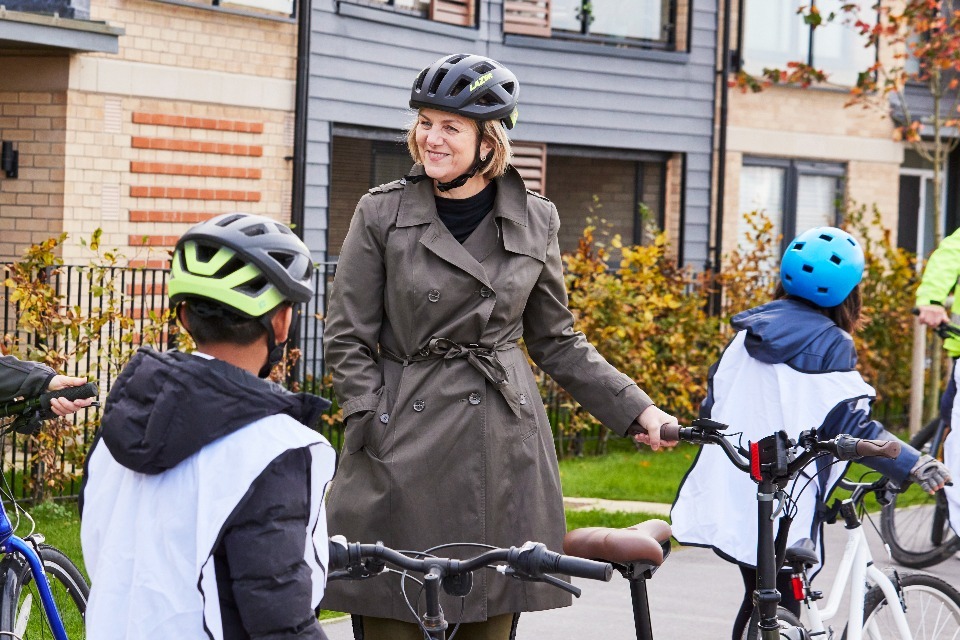
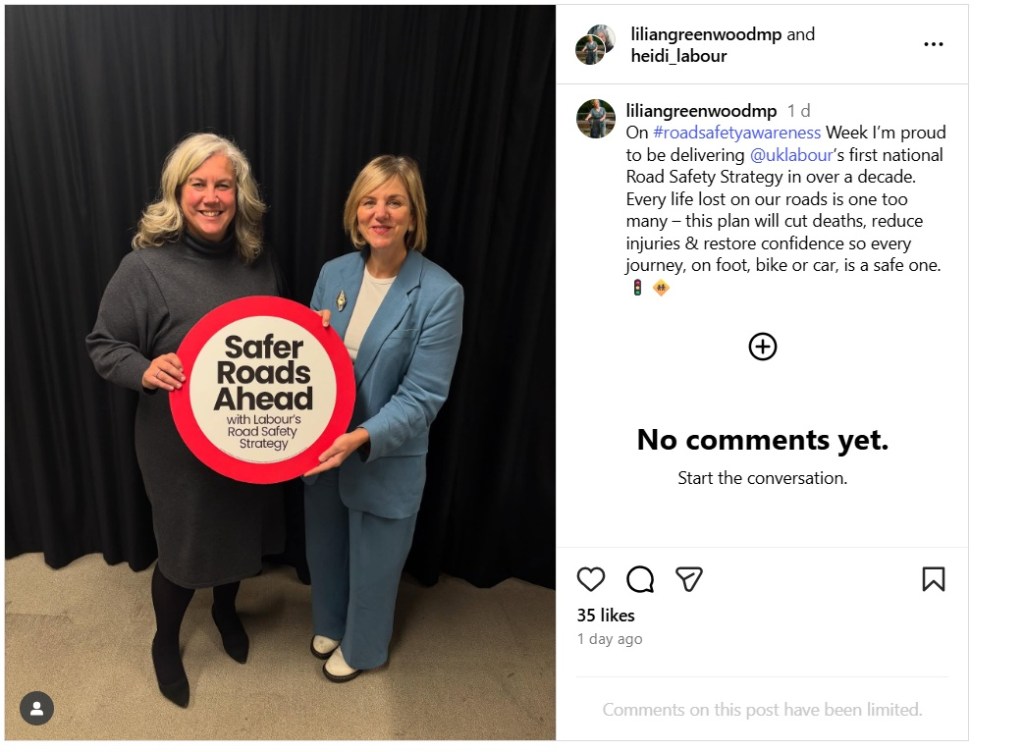
    Now Greenwood has resorted to saying “over a decade”, as in this recent Instagram post, where she is pictured with transport secretary Heid Alexander, proclaiming “safer roads ahead”.

    How much safer? and how far ahead? remain the questions and a the lack of a timetable led to a bit of backtracking on LinkedIn from Jamie Hassall, executive director at the Parliamentary Advisory Council for Transport Safety (PACTS).

    After originally commenting “What great news!”, he admitted: “I should have used a ? rather than a ! I thought this might be the release of the strategy.”

    Anyone looking at this can be forgiven for thinking that the hype from ministers might signal that the strategy is imminent, and indeed it may be.

    If the plan will indeed save lives, the delay is costing them.

    Meanwhile, Greenwood has returned to saying “this year” after going back to the “in due course” formulation.

    In a response this week to a parliamentary question, she wrote:

    Our Road Safety Strategy is under development and will include a broad range of policies. We intend to publish by the end of the year.

    If (still) under development is true, it isn’t imminent.

    What’s that saying about the road to hell?

  • DfT backs away from Road Safety Strategy “this year”

    The Department for Transport (DfT) has confirmed that it is no longer pledging to publish its new Road Safety Strategy this year, despite a very recent pledge from a minister.

    I noticed that in a written parliamentary answer on 27 October, Lilian Greenwood said:

    Our Road Safety Strategy is under development and will include a broad range of policies. We intend to publish by the end of the year.

    But in (multiple) subsequent answers, such as this one just a few days later, she has only said e.g.

    We will set out more details in due course.

    I asked the DfT if it still intends to publish the road safety strategy by the end of the year and a spokesperson told me that “in due course” – i.e. no public target date – is its current line.

    It should be a great embarrassment for ministers. In August “government sources” briefed the Times that the strategy is “due to be published in the autumn”, as well as spinning quite a lot of what might be in it.

    I don’t think transport secretary Heidi Alexander was asked about the timing of the document when appearing before the Transport Committee yesterday, although she did mention that it was on its way.

    Ministers are fond of saying that the new strategy will be “the first for 10 years”.

    At this rate their achievement will be even better, perhaps the first for 11 years.

  • Paralysis at the DfT

    Recent parliamentary answers from transport ministers suggest that Labour is completely stuck on many of key issues it should be addressing.

    In response to a question from fellow Labour MP Darren Paffey about the “planned timetable is for announcing further details on the regulation of private electric scooters, as indicated in the Advanced Manufacturing Sector Plan”, roads minister Simon Lightwood said:

    The Government is committed to pursuing legislative reform for micromobility vehicles when parliamentary time allows.

    We understand the importance of providing a clear legislative timeline and my Department is working with colleagues across government to secure this.

    So another example of when being committed to something doesn’t mean actually doing anything about it. Maybe just extend the trials again?

    Other MPs have been asking what is happening about pavement parking, including Labour MP Damian Egan. Lilian Greenwood is fully aware that it’s an issue that needs to be addressed, but:

    The Government fully understands the serious problems that vehicles parked on the pavement, and other obstacles on the pavement, can cause for pedestrians, especially for people with mobility or sight impairments and disabled people with wheelchairs, prams or pushchairs. To inform next steps, the Department has considered the potential options, assessing the costs and benefits to households and businesses, which includes well-being, social isolation and economic opportunities. This assessment drew on existing evidence, including the 2020 pavement parking consultation. We will announce the next steps and publish our formal response as soon as possible.

    It’s now the fifth anniversary of that pavement parking consultation closing. Neither the Tories nor Labour has had the courage to take it forward.

    And then there is the promised and widely trailed road safety strategy, “the first for ten years”.

    On 27 October, Greenwood told shadow transport secretary Richard Holden:

    Our Road Safety Strategy is under development and will include a broad range of policies. We intend to publish by the end of the year.

    But in subsequent answers, such as this one, she appears to have backed away from this target date, saying:

    More details will be published in due course.

    “In due course” is of course what officials and ministers say when they can’t or don’t want to give a date. I’ve asked the DfT to clarify and transport secretary Heidi Alexander has been in front of the Transport Committee this morning.

    Of course, if Lightwood is to be believed, the department is still carrying out “assurance” of evaluations of smart motorway schemes that National Highways completed in 2022.

    The question is, are they incompetent, or just kicking the tricky stuff into the long grass?

    Leave a comment

  • National Highways explains suppression of POPE reports

    Highways News has, quite rightly, published a response from National Highways on the issue of the suppressed evaluation reports on smart motorways, and it’s one that subtly makes the case for them to be released.

    Last week, I attended an event at the Department for Transport (DfT), which I have revealed to be sitting on a large number of Post Opening Project Evaluation (POPE) reports on smart motorways, which would reveal their record on issues such as safety, value for money and environmental impact.

    The response from National Highways is I think, pretty much what it told me, but very revealing:

    (more…)
  • Councillors want half a billion thrown at poor value scheme

    Councillors in Northumberland are continuing to call on ministers to reinstate a National Highways scheme to dual a section of the A1 that Labour publicly scrapped last year and which was secretly shelved four years ago as poor value for money.

    National Highways had wasted £68m on the scheme by the time it was finally cancelled, with overall scheme costs expected to reach £500m.

    As I have written – at great length – the Tories secretly shelved the scheme following the 2021 Spending Review but ministers, National Highways and the Office of Rail and Road conspired to hide this fact from Parliament and the public.

    But the BBC reports this week that:

    Councillors have made renewed calls to reverse a government decision to widen a “dangerous” single carriageway main road.

    Liberal Democrat councillor Isabel Hunter said the road needed to be dualled as it was getting shut on an “almost a weekly basis” due to accidents.

    Hunter said: “We’re not particularly bothered which party does it, we just want the road dualled.”

    Conservative council leader Glen Sanderson said it was a “fundamental need” to have a “strong spine” between Northumberland and Scotland.

    “The fact that we don’t have that, the fact that we have a dangerous road… and the fact that it has cost people their lives makes it an appalling decision,” he said.

    “The A1 must be dualled, there’s no question about it.”

    (more…)

  • MP joins calls for release of POPEs

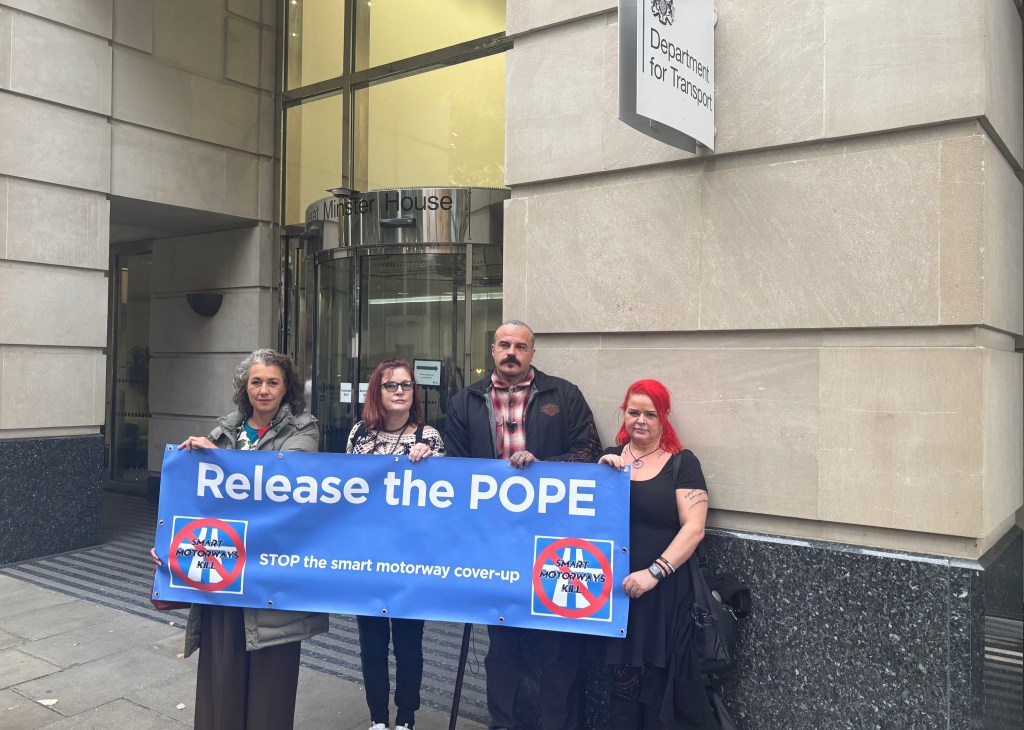
    A Labour MP joined campaigners outside the office of the Department for Transport (DfT) today, calling for suppressed reports on the impact of smart motorway schemes to be released.

    The event was a collaboration between myself and Claire Mercer of the Smart Motorways Kill campaign and aimed to highlight the fact that the DfT is refusing to release a raft of Post Opening Project Evaluation (POPE) reports on smart motorways, which would reveal their record on issues such as safety, value for money and environmental impact.

    It generated a significant amount of attention, with Mercer interviewed by local and national media, telling them that she aimed to “shame” ministers into taking action.

    According to a 2022 report by National Highways’ regulator, the Office of Rail and Road (ORR), nine POPE reports were due to be completed that year alone. It is not known how many have been compiled since.

    Both National Highways and the ORR have blamed ministers for the failure to make the reports public, with the DfT claiming that the reports are still undergoing an “assurance” process.

    Sarah Champion, Member of Parliament for Rotherham, who is Mercer’s MP, also attended the demonstration, at which a banner demanding “Release the Pope” was held up at the entrance to the DfT’s offices.

    (more…)
  • Lightwood backs smart motorway cover-up

    The roads minister has backed the continued suppression of a raft of evaluation reports on the safety and effectiveness of smart motorway schemes, some of which were due for publication three years ago.

    I revealed in September that ministers are sitting on a huge amount of data on the controversial schemes, in the form of multiple post opening project evaluation (POPE) reports, including at least nine that were due for completion in 2022.

    Although the reports were produced by National Highways, the Department for Transport (DfT) called them in and has not allowed them to be published, on the grounds that it is “undertaking its final assurance”.

    An event at the DfT tomorrow will highlight the continuing suppression of the reports and call on ministers to release them in the name of transparency.

    The event is a collaboration between myself and Claire Mercer of the Smart Motorways Kill campaign, who wrote to DfT ministers to invite them to attend.

    She has received a reply from Simon Lightwood, as the minister responsible for the strategic network, who has both declined to attend and backed the patently false claim that the reports are still undergoing assurance. He wrote:

    National Highways does evaluate the economic impact after schemes have been operational for five years and we are committed to transparency, but this is a complex process, and it is right that we take the time to fully assure findings. This process is ongoing, and we will provide an update on publication in due course.

    The phrase “in due course” indicates that Lightwood is not even prepared to say when “an update on publication” will be provided, let alone when – or even if – the reports will actually be published.

    In backing this lie, Lightwood has firmly owned the cover-up of what are looking increasingly like very damaging findings.

    The event will take place at the Department for Transport, 33 Horseferry Rd, London, SW1P 4DR at 12:15pm on Wednesday 5 November.

    Leave a comment

  • DfT to feel the heat over smart motorway cover-up

    I will be taking part in an event at the Department for Transport on Wednesday to highlight the continuing suppression of evaluation reports on the safety and effectiveness of smart motorways and to call on ministers to release them in the name of transparency.

    I revealed in September that ministers are sitting on a huge amount of data on the controversial schemes, in the form of multiple post opening project evaluation (POPE) reports, including at least nine that were due for completion in 2022.

    When the five-years after POPE on the scheme to convert the M1 between junctions 10 and 13 to dynamic hard shoulder was published in September 2021, it revealed that it had cost the economy £200m instead of a projected benefit of £1bn, because it slowed traffic down. It made national news.

    The event is a collaboration between myself and Claire Mercer of the Smart Motorways Kill campaign, who has done most of the work.

    Confirmed attendees at the event include her MP, Sarah Champion, and crash survivor Jack Gallowtree, as well as representatives from road safety and motoring groups.

    Irrespective of what you think about smart motorways, as the official press release puts it:

    The event’s purpose is to shine a spotlight on the years of delay and lack of transparency surrounding these critical reports. Campaigners are urging the DfT and National Highways to release all outstanding POPE evaluations, answer questions, and ensure that lessons are learned to improve future road safety and infrastructure planning.

    Who could argue with that?

    The event will include a demand to “Release the POPE”, a playful reference to the occasions in the past when the pontiff has been captured, including following the 1527 sack of Rome.

    Expected to be a lot more orderly, it will take place at the Department for Transport, 33 Horseferry Rd, London, SW1P 4DR at 12:15pm on Wednesday 5 November.

    There won’t be fireworks, but we hope ministers will feel the heat over the continued cover-up.

  • ORR praises National Highways as casualties increase

    As National Highways’ safety record gets worse, the spin from both the company’s chief executive and its regulator continues.

    The latest government data shows that 1,931 people were killed or seriously injured (KSI) on the strategic road network (SRN) in 2024. This is an increase of 23 people (1%) compared to 2023.

    So the number of KSIs is going up when it is supposed to be going down.

    In a blog post, the Office of Rail and Road (ORR) notes that this is 38% below the (2005-09) baseline against which National Highways is required to achieve a 50% reduction by the end of this year, “which means that National Highways needs to achieve a further reduction of 12 percentage points (381 KSI casualties) if it is to achieve its target”.

    The ORR says:

    The latest figures confirm that it is now almost certain the target will not be met.

    Note that the regulator says the target will not be met, rather than that National Highways will miss the target.

    (more…)
  • Harris blames crash victims for road safety failings

    National Highways’ chief executive has sought to dodge responsibility for the company’s poor progress on road safety, claiming “success” for its limited efforts to reduce casualties through engineering.

    With the company expected to miss its key performance indicator (KPI) for reducing killed and seriously injured (KSIs) casualties during the second (2020-25) road investment strategy (RIS), Nick Harris pointed out that the next RIS does not currently have an equivalent target.

    In an interview for the official podcast of the Highways UK trade show, he said:

    Increasingly on safety though the focus is shifting from that headline KPI to the things we are doing. So there’s a little bit of a shift there.

    The comment also reflects the expectation that the next RIS will give National Highways a National Programme on safety, “supporting specific programmes of activity” and measure it against how much it delivers.

    Harris also sought to blame the victims of collisions:

    (more…)