Transport Insights

The transport stories you won't see in the industry-friendly media

Author

Chris Ames
  • No timetable for East West Rail

    Anyone planning to catch a train in the new-ish East West Rail line should not hold their breath as the only transport minister who is answering parliamentary questions on anything has declined to give a start date for any of its “connection stages”, including one that was scheduled to start this year.

    Layla Moran, LibDem MP for Oxford West and Abingdon, put down a parliamentary question:

    To ask the Secretary of State for Transport, whether she expects the first phase of East-West Rail to open this year; and what her Department’s planned timetable is for the opening of the (a) Bletchley to Bedford and (b) Bedford to Cambridge sections.

    Local transport minister Simon Lightwood’s reply was full of wishful thinking but without any firm timetable:

    The Department is working closely with Chiltern and other partners to confirm a start date for the service. We are looking forward to commencing services as soon as all necessary approvals and infrastructure are in place. Passenger services will commence once train testing and driver training have been completed. As for the second and third connections phases; the Government has committed to accelerating work to deliver EWR services between Oxford-Bedford. The full Oxford-Cambridge service is subject to an application for a Development Consent Order and is planned to commence from the mid-2030s.

    (more…)
  • DfT: National Highways was right to lie about shelved scheme

    The Department for Transport (DfT) has insisted that National Highways was right to put the the A1 Morpeth to Ellingham scheme in an annual delivery plan, despite the scheme being defunded and officially “paused”.

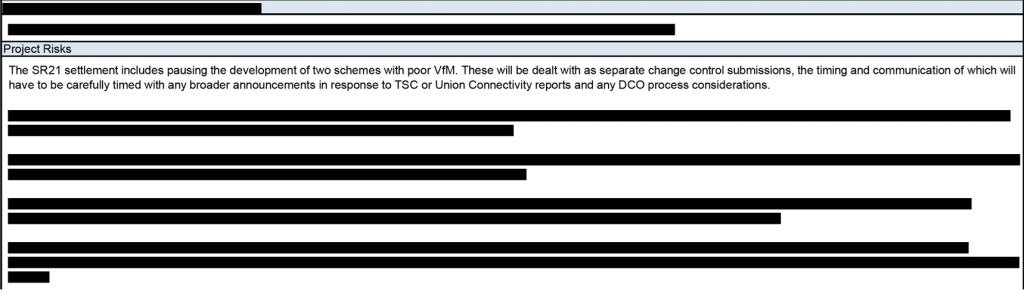
    Rather surprisingly, the department has stated that the formal pausing of the scheme was achieved through a “change control” document previously disclosed to me, despite that document explicitly stating that it would be dealt with a separate change control submissions,

    “the timing and communication of which will have to be carefully timed with any broader announcements in response to TSC or Union Connectivity reports and any DCO process considerations”.

    This quote indicates that National Highways intended to delay putting through the paperwork to hide the fact that the scheme had been secretly shelved, but the DfT has insisted that the document itself, which it approved, constituted “a change control submission to pause the scheme” and that this was approved.

    On this basis, I asked the DfT whether National Highways was correct to include the scheme in its 2022-23 delivery plan and correct to include it in its spending projections.

    (more…)
  • Another HIF scheme stalls as costs soar

    The BBC reports frustration from businesses around Junction 10 of the M5 over delays to the planned redevelopment of the junction, once again showing how the Housing Infrastructure Fund (HIF) is struggling to keep up with rising construction costs.

    A Gloucestershire County Council “third party” scheme currently costing £363m aims to turn the Junction 10 into a conventional “all moves” junction, mainly to facilitate thousands of new homes in the Cheltenham area.

    The cost of the scheme has cost has risen by £70m since 2023, which a council report mainly attributes to delays, particularly in obtaining a development consent order, which transport secretary Heidi Alexander granted in June.

    At that time, the council said that “preparation works will begin this summer to enable the start of scheme construction from spring 2026, with completion anticipated in 2028”, but the council appears to be waiting for a £70m funding gap to be filled.

    A report to the council’s cabinet earlier this month noted that the previous £293m cost was to be met by £212m HIF grant funding “with the remaining £81m to be addressed by Section 106 contributions from developments that were dependent on the junction going ahead”.

    However, the need to underwrite the scheme with £40m in advance of these contributions increased the shortfall to £110m.

    Local councils are to cover £40m, with district councils contributing £20m Community Infrastructure Levy cash and Gloucestershire putting in £20m of its own.

    But this leaves the scheme dependent on a bid from the county to Homes England for a further £70m from HIF.

  • Could Lilian be the future of roads once…more?

    I’m not saying the government is disorganised of makes things up as it goes along, but former “future of roads” minister Lilian Greenwood has returned to the Department for Transport (DfT), just over a week after being moved.

    It appears that she will also be a government whip and her responsibilities at the DfT have not yet been officially confirmed on the department’s website.

    Neither have those of new minister Keir Mather, who appears to have maritime and aviation responsibilities.

    Greenwood’s return brings the department back up to its full complement of four junior ministers under transport secretary Heidi Alexander.

    Bizarre is not a strong enough word for such a turnaround.

    Leave a comment

  • Labour stalls on pavement parking

    A minister has told us all not to hold our breath waiting for the government to follow up on the issue of pavement parking outside London, following a consultation that closed five years ago.

    LibDem Helen Maguire, who happens to be my MP, put down a parliamentary question:

    To ask the Secretary of State for Transport, what her planned timeline is for publishing the new research on the extent and impact of pavement parking.

    Minister for local transport Simon Lightwood once again said that it is still thinking about the issue, fourteen months after coming to power:

    The Department has been considering all the views expressed in response to the 2020 pavement parking consultation and is currently working through the policy options and the appropriate means of delivering them. We will announce the next steps and publish our formal response as soon as possible. The new research announced last week will not delay this; my officials are finalising its terms now. The Department will aim to publish within 12 weeks of agreeing final outputs, per Government Social Research protocols. Local authorities can make use of existing powers to manage pavement parking.

    The last sentence is the key one for me, seeking to play down the importance of any new policy options, but “as soon as possible” is clearly untrue as they are undoubtedly stalling.

    I’ve noted before that the previous roads minister, Lilian Greenwood, promised twice to do something about the issue “very soon” and may have been moved because she appeared to keen to do so.

    The image is from the Tories’ 2020 consultation, which very definitely put forward policy proposals, rather than just asking people what they think in general about the issue.

    Leave a comment

  • Renewable energy fiddle backfires for National Highways

    National Highways’ corporate carbon emissions increased by nearly a fifth over the last year, while emissions from construction and maintenance fell and road user emissions did not fall anything like fast enough to achieve a target of a 55% cut by 2030.

    The company has published an annual update to its Net zero highways 2030 / 2040 / 2050 plan, which sets those three dates as targets for net zero corporate emissions, construction and maintenance emissions and road user emissions respectively.

    Under the plan, progress towards the corporate emissions target gets a large boost from move to “certified renewable electricity”, which means that such electricity does not count towards the company’s target consumption. This is expected to reduce the company’s own emissions by 51% against a 2017-18 baseline but it is not allowed to use this method for its corporate reporting of its emissions, i.e. its annual report, or its KPI target for RIS 2, which it missed.

    Unfortunately, during 2024-25 corporate emissions rose by 18% from 38,388 tCO2e to 45,241 tCO2e. The company said this was largely due to two factors: one motorway service operator ceasing to claim renewable energy certificates, and a data improvement exercise linked to a recalculation of corporate carbon emissions to achieve Science Based Targets Initiative verification.

    (more…)
  • Labour demonstrates four wheel drift on road safety

    Meanwhile, in the absence of a roads minister, the minister for local transport has ducked a question about when the government will publish its road safety strategy.

    In response to a parliamentary question from fellow Labour MP Darren Paffey:

    To ask the Secretary of State for Transport, what options her Department is considering to reduce fatalities involving young drivers through the Road Safety Strategy; and when that strategy will be published.

    Lightwood seems to have got mixed up with the difference between “when will the next road safety strategy be published?” and “when was the last road safety strategy published?”.

    Basically, they are thinking about it:

    The Government treats road safety seriously and is committed to reducing the numbers of those killed and injured on our roads. The Road Safety Strategy is under development and will include a broad range of policies. More details will be set out in due course.

    We absolutely recognise that young people are disproportionately victims of tragic incidents on our roads and continue to tackle this through our THINK! campaign. We are considering measures to address this and protect young drivers, as part of our upcoming strategy for road safety – the first in over a decade.

    Labour takes road safety so seriously, it doesn’t have a roads minister.

  • Dft all at sea as Mather gets maritime gig

    The new transport minister, Keir Mather, appears to have been given the maritime brief, leaving the role of roads minister pretty vacant.

    To mark London International Shipping Week, the Department for Transport has issued a press release with the title More than £1.1 billion investment to boost growth, jobs and skills in UK’s coastal towns and cities.

    And the claim that:

    Funding will help businesses and academia develop real-life technology that reduces carbon emissions from shipping.

    It follows the government’s recent policy of badging decarbonisation spending as aimed at growth, presumably because they are worried what fascist Farage will say and scared of upsetting the even more fascist Trump.

    The press release issued in the name of The Rt Hon Heidi Alexander MP and Keir Mather MP but Mather’s linked profile still does not give him a portfolio.

    Apparently:

    To launch the week, Local Transport Minister, Simon Lightwood, will ring the bell at the London Stock Exchange. The Transport Secretary and Maritime Minister will attend several key events during the week where they will champion UK shipping on the international stage and showcase the UK as a global hub for growth, investment, skills and jobs.

    Mather is not named here as the maritime minister, but a press release from the Transport Select Committee announces that:

    The Transport Committee will question the new Minister for Maritime, Keir Mather MP, as it concludes it inquiry into the Government’s draft revised National Policy Statement for Ports. 

    Let’s hope someone has told Mather what his job is.

    Leave a comment

  • ORR reported fake overspend to MPs

    National Highways’ regulator falsely told Parliament that the company had a projected overspend of nearly a quarter of a billion pounds, but the fictional deficit was almost entirely the result of collusion within government to pretend that a shelved road scheme was still going ahead.

    The revelation raises further concerns about whether the Office of Rail and Road (ORR) sees its role as holding National Highways to account or keeping the company’s secrets from Parliament and the public.

    It is the latest revelation in the scandal that saw both organisations falsely claim in reports presented to Parliament that the A1 Morpeth to Ellingham scheme, which was shelved in February 2022, would go ahead in the 2022-23 financial year.

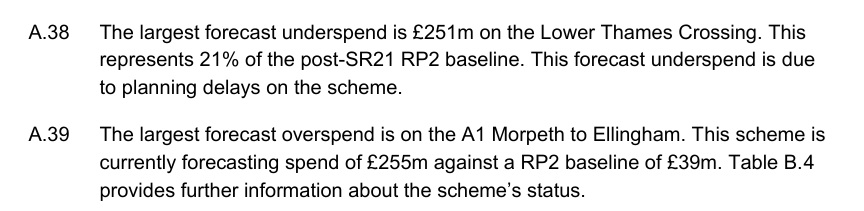
    Not only did the ORR’s annual assessment of National Highways for 2021-22 falsely claim that work on the scheme would start in 2022-23, but it reported that the scheme had a huge overspend (£216m) resulting from “forecasting spend of £255m against a RP2 baseline of £39m”.

    However, this forecast spend was fictitious and the regulator knew it. It knew very well that the funding for the scheme had been withdrawn (apart from sunk development costs) and that National Highways was delaying formally pausing the scheme in order that it could hide from MPs the fact that it had been shelved.

    (more…)

  • MPs slam Labour over cowardice on utilities’ roadworks

    The chair of the Transport Select Committee has hit back at ministers over their response to its recent report on street works, which saw ministers largely reject the committee’s recommendations for fear of upsetting utility companies.

    Committee chair Ruth Cadbury MP did not hold back in her disdain for ministers’ response: 

    The Government’s rejection of all the major recommendations in our report risks making itself simply look unwilling to stand up to utility companies, on behalf of frustrated road users who have to endure unreasonable and often repeated street works delays. 

    Among other recommendations, the committee said the Department for Transport (DfT) should support more local authorities to set up lane rental schemes by allowing them to do so without needing approval from ministers.

    Ministers rejected this call to give up one of their powers, despite the DfT agreeing that the schemes have been effective where used.

    The department suggested that there would be a risk of authorities introducing “poorly targeted schemes” that would increase costs for utility companies. 

    The committee also recommended extending the period for which utility companies are responsible for the road surfaces they have reinstated, from two years after completion to five years, similar to the six years period operating in Scotland. But ministers said they want to see how the Scottish approach plays out. 

    (more…)

Subscribe

Subscribe to get our the latest stories in your inbox.