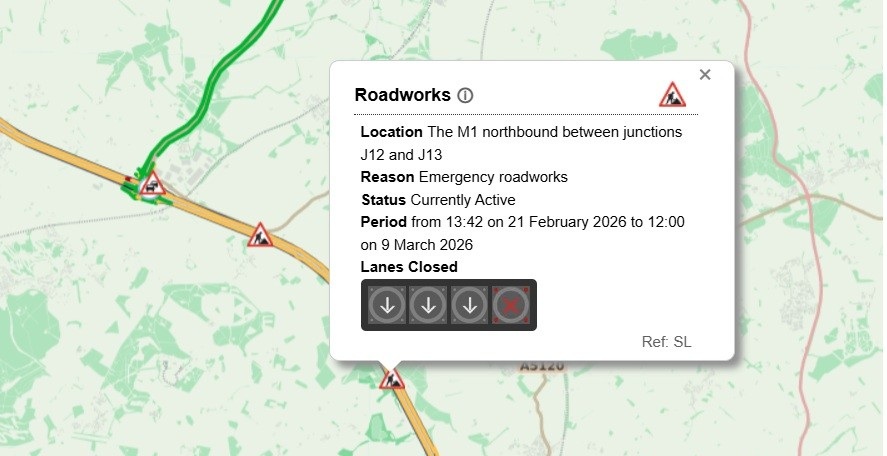
National Highways appears no nearer to fixing the “drainage defect” that is disrupting a stretch of the M1, closing lane three in each direction.
I wrote last week about the problem, which has, according to the government-owned company, weakened barrier supports in the central reservation, but which it is unable to explain.
The BBC reported last week:
Despite several inquiries by the BBC, National Highways has been unable to clarify the exact nature of what they describe as a “drainage defect” or what caused it.
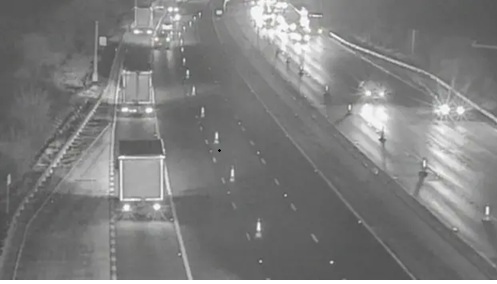
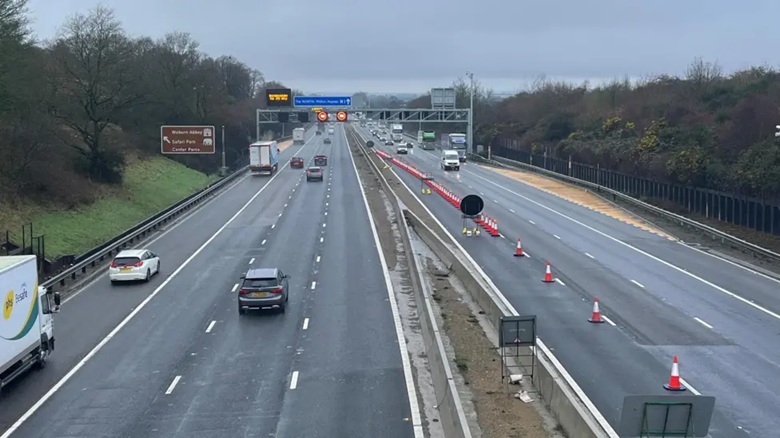
The roadworks, which began on 28 January (pictured), were officially scheduled to finish yesterday but have been extended for another week.
National Highways has not responded to my request for comment, presumably because it does not know what is going on.
As I post this, there are northbound delays, which is unsurprising as the road is currently operating as a three lane motorway with the hard shoulder in use as a running lane and an obvious lack of resilience.
A baffling announcement from the transport secretary has shone a light on her department’s determination to make the facts (or predictions) around carbon emissions fit Labour’s policy of expanding aviation in a climate emergency.
On 19 February I wrote to the judge hearing the above claim in respect of my ongoing duty of candour in those proceedings.
There is no reference before this, or indeed anywhere in the statement, to any claim or proceedings, although Alexander does later make equally baffling references to:
an order of the court from 10 December 2025
and to having
apologised to the court and the parties and submitted a statement from a senior official in the department to explain the error and correct our position.
At no point does she say which court but, unpicking all this, it looks as if the case is the legal challenge to Alexander’s decision to back expansion of Heathrow. You can tell this because she protests that
The world’s first hydrogen double-decker bus fleet has reached the end of the road.
The multi-million pound project in Aberdeen – involving 25 buses – was meant to be the future of clean public transportation, with the city billed as the global hub for hydrogen-powered buses.
But the zero emissions vehicles are now being ditched, along with the ambition that 700 jobs could be created.
The council announced on Thursday evening that it was to drop its hydrogen double-decker bus fleet in favour of electric vehicles following a meeting of its urgent business committee.
It is unfortunate that it hasn’t worked, despite the (too?) high hopes.
A lot of this boils down to money. Much, much more green electricity is required to produce the hydrogen required to move a vehicle a given distance than is required to move a battery electric vehicle the same distance. Obviously, the more electricity you use, the more you have to pay – which means, in a nutshell, hydrogen vehicles cost a lot more to fuel and run than electric vehicles. And ultimately, money talks, which explains why battery electric technology is leaving hydrogen behind as the technology of choice when it comes to decarbonising vehicles likes buses.
It’s a sign of how desperate the government is for good news that today the Department for Transport (DfT) has issued a press release in which the prime minister claims that not putting up rail fares “will put more money in working people’s pockets”.
It is indeed good news that fares have not gone up at the beginning of this month and if the DfT says this is the first freeze for 30 years, I am happy to believe them, although they seem to be happier pointing to increases under the Tories than last year’s increase.
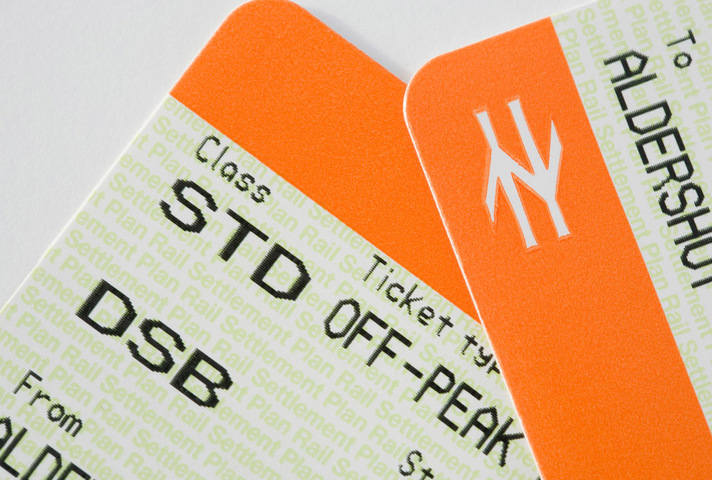
British rail tickets for Standard off-peak travel day return for disabled. Image shot 11/2008. Exact date unknown.
Here’s what Keir Starmer is claimed to have said:
This freeze – the first since the 90s – will put more money in working people’s pockets. By keeping costs down we are making journeys more affordable for millions of people – putting train travel back into the service of passengers, not profits.
I’m not sure how not charging people more is actively putting money in their pockets and of course the government takes the revenue risk on rail fares under National Rail Contracts.
Meanwhile, the DfT says:
With transport costs making up 14% of household spending, this cost-cutting move is providing real savings for passengers
This is true but a bizarre thing to say all the same. Transport costs may make up 14% of household spending but rail fares could be as low as 1% of spending in the average household.
It’s also quite funny that the DfT has used a picture (above) of old fashioned orange magnetic stripe tickets to illustrate the story – the ones the whole industry is trying to move away from. Just for fun, I left the caption in.
But the DfT also rather stupidly refers to:
building on the expansion of successful Pay As You Go and fares trials across the country
In fact, the whole process of expanding pay as you go in the South East beyond London is and continues to be, a shambles.
This week, I was asked to look at and comment on this BBC story about a mysterious “drainage defect” that has led to the closure of the “lane three” northbound and southbound on the M1.
Work is continuing on a stretch of the M1 in Bedfordshire as engineers investigate a “drainage defect” in the central reservation, according to National Highways.
Lane closures between junction 12 at Toddington and junction 13 for Brogborough were first put in place on 27 January.
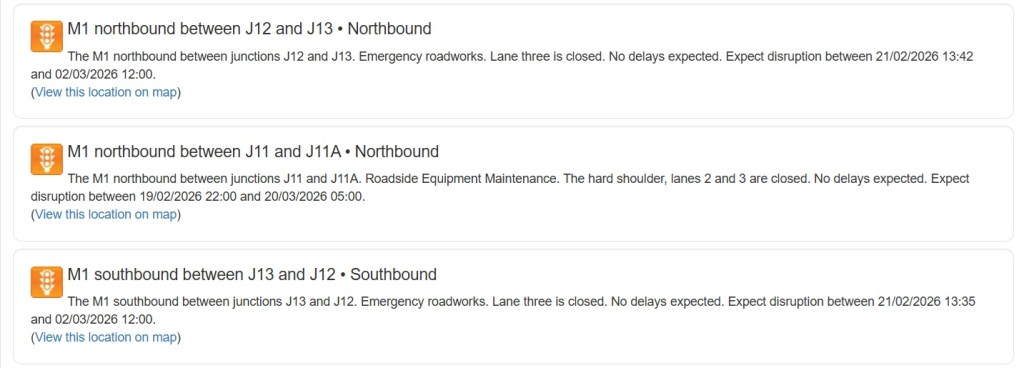
Although the story was dated nearly two weeks ago (14 February) at a time when all lanes on the northbound carriageway were open, it appears that lane three is again closed in both directions.
When it says “no delays expected”, the hard shoulder on this dynamic hard shoulder scheme is being used.
It looks as if the drainage defect has been caused by the replacement of the steel barrier with concrete, which has somehow compromised the drainage in one or more ways, including possibly changing the hydraulics and compressing the soil.
This has in turn weakened the barrier supports, according to National Highways.
And with cabling having been laid, it looks as if it might be a complex problem to fix.
Tony Fisher/BBC
It’s a shame. I have written before about what National Highways was pro-actively doing to replace steel barriers with concrete, which is safer because of the reduced risk of head-on crossover crashes.
Today’s guest blog from Clare Wood from the Stop the A38 Expansion Campaign takes up the theme of transparency over the value for money of major road projects.
National Highways’ publication of a preliminary market engagement notice for the long-delayed A38 Derby Junctions scheme, now estimated at £600 million and set to run for 10 years, should not be mistaken for progress.
Originally budgeted at £200–250m, the scheme has more than doubled in cost. National Highways and ministers now suggest that legal challenges and inflation are to blame.
That narrative is convenient but it is also misleading.
The A38 is not a victim of vexatious legal challenges. It is a project repeatedly exposed for weak appraisal, unlawful approval and economic obsolescence, problems of the Government’s own making both under Conservatives and Labour.
This is an outdated, poorly justified road expansion project propped up by weak governance. The scheme was part of the Labour Government’s infrastructure spending review last year.
The increased scheme costs have been known since July 2025 as the Office for Road and Rail published a report on National Highways’ performance. It’s worth noting legal challenges are not noted as a reason for increased costs and the Lower Thames Crossing has faced the greatest increases in costs but never dealt with a legal challenge.
As the A38 scheme has spiralled in cost, there remains no Full Business Case, no published Accounting Officer Assessment. The Information Commissioner’s Office has ruled that National Highways must disclose the information used by Government to approve the A38 expansion in last year’s Spending Review. National Highways is appealing against the decision and the Department for Transport is delaying a related internal review on the cancellation of Midlands Main Line electrification, raising serious concerns about transparency in how these major funding decisions were made.
National Highways has blamed the legal challenges for rising A38 costs yet conveniently failed to share any details about those legal challenges.
Both legal challenges to the scheme were the result of concerns raised during official examination processes that were ignored.
The first challenge succeeded because the then transport secretary, Grant Shapps, conceded the approval was unlawful — the scheme was permitted to proceed without properly considering its cumulative carbon emissions, despite significant environmental and climate harms documented in National Highways’ own planning documents.
Returning to the subject of money down the drain, Shropshire Council Council is finally set to scrap one half of a controversial new road on which it has burned £32m of taxpayers’ money.
I wrote about the Shrewsbury North West extensively at Highways magazine, including the controversy over the possible contamination to the town’s water supply and the fake claim by the then transport secretary that the scheme was fully funded with money saved by curtailing HS2.
Better Shrewsbury Transport (BeST) have done an amazing job calling out all the problems with…building new roads in a climate emergency.
A report on the future of the Shrewsbury North West Relief Road (NWRR) will be presented to the meeting of Shropshire Council’s full Council on Thursday 26 February [2026]. The report will recommend to Council the cancellation of the NWRR due to it being unaffordable.
A road safety supervisor who struck and killed a pedestrian while speeding at almost twice the limit has avoided jail.
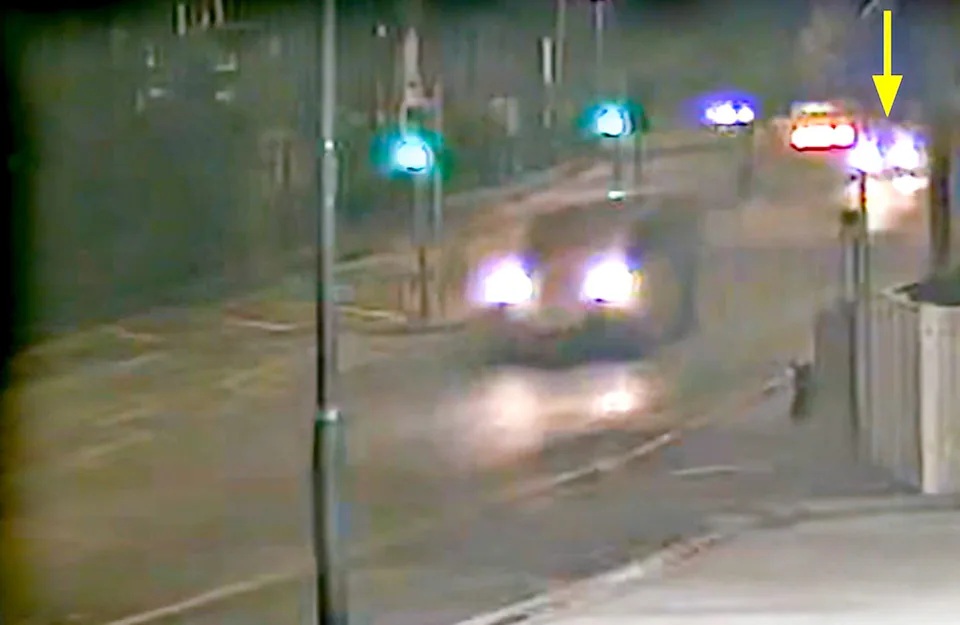
Martin Hayward was driving his Audi A4 at up to 56 mph in a 30 mph zone in Southampton when Clare Munn stepped out onto a crossing.
The National Highways road safety supervisor was said to be “flying” down the road and had already overtaken several cars before colliding with Ms Munn at between 40 and 50 mph.
Yes, Hayward worked for National Highways and safety is its highest priority. It has not responded to my enquiry as to whether he still works for them.
While National Highways and ministers like to talk about the delays to infrastructure projects caused by the planning process, objectors and wildlife, the announcement that transport secretary Heidi Alexander plans to cancel the planning permission for a £100m road scheme is a reminder that government throws huge amounts of money on schemes that never come to anything.
Notice is hereby given that the Secretary of State for Transport is proposing to exercise the power to make an order, without an application being made, to revoke the A47 Wansford to Sutton Development Consent Order 2023 (the DCO).
The Secretary of State is satisfied that there are exceptional circumstances, namely that following the 2025 Spending Review, the government chose not to continue its commitment to funding this scheme. Accordingly, the Secretary of State proposes to exercise the power to make an order to revoke the DCO (the proposed order).
Indeed, when Alexander announced that the £100m project and other road schemes would be scrapped, she accused the previous government of promising infrastructure projects with “no plan to pay for them”.
There was of course the earlier case of the A1 Morpeth to Ellingham scheme, which the Tories pretended was still happening even after shelving it, granting a DCO that Labour subsequently revoked, and running up a bill of £70m.
Still, Labour seems to have found £3bn of public money down the back of the sofa for the privately funded Lower Thames Crossing smart motorway.
As the West Yorkshire Combined Authority (WYCA) continues to insist that there is nothing to see over the secret report into its mass transit plans, the man in charge of the project is leaving as it is kicked into the long grass.
In a post on LinkedIn beginning “Time to change direction”, Mike Birch, the authority’s mass transit director has said:
I have reached the very difficult decision to leave my position as Mass Transit Director at West Yorkshire Combined Authority.
Since joining the programme early last year, the focus has shifted from an accelerated delivery programme, to one following a more traditional sequential approach. The next few years will now be spent delivering the business case, a very different leadership focus. I am proud to have led this incredible transformative programme, with an amazing dedicated team.
I will be leaving in mid April, seeking my next challenge……
When someone leaves a senior post to seek a new challenge, it’s usually a sign that all is not well and in this case, as Birch notes, the project has been “resequenced” so that it will no longer try to do spatial planning with business case development.
This followed the “peer review” report from the National Infrastructure and Service Tranformation Authority (NISTA), which WYCA has refused to publish on the grounds that it would undermine public confidence in the programme.
Perhaps the departure of the man who at the helm when the ship hit the iceberg will help?





 Transport Insights
Leave a comment