
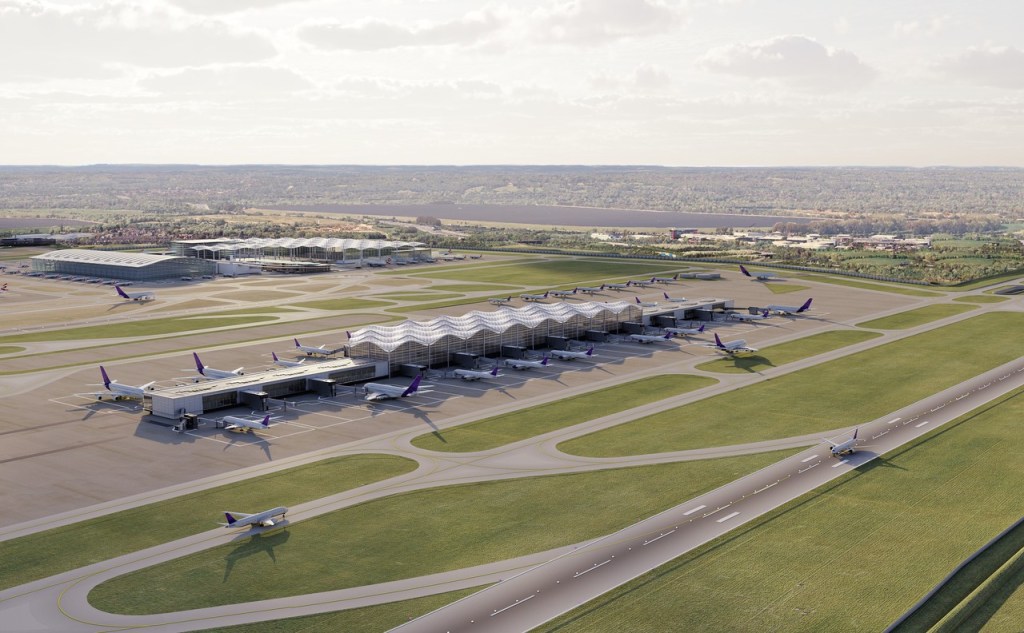
Interesting journalistic takes on the latest advice on Heathrow expansion from the Climate Change Committee (CCC), which appears to rule the whole thing out, barring some major fudge or magical thinking from the government, which of course we can expect.
Heathrow expansion incompatible with climate goals, UK government advisers warn
Expanding Heathrow would add as much carbon to the atmosphere as the city of Birmingham and is incompatible with the UK meeting its legally binding climate targets, the independent Climate Change Committee has warned.
But here’s the rub:
“There is no credible pathway for Heathrow airport expansion within the UK’s climate commitments under current policies,” the committee said in a report.
The CCC appears to have left the door open for the government to bring in new policies – or pretend to do so.
In fact, the Guardian has a different take on the story:
Heathrow airport should be allowed to expand only if airlines pay for the removal of carbon dioxide from the atmosphere, the government’s climate advisers have said.
…
The “only way” to manage such expansion within the UK’s climate commitments was for the aviation industry to become more efficient, use an increasing proportion of “sustainable aviation fuels” (SAF) in place of fossil fuels, and pay for the permanent removal and storage of carbon from the atmosphere.
This has led to some people smelling a rat:
But campaigners rejected the CCC’s plan of relying on nascent technologies to wipe out the impact of an expansion that would commit the UK to much higher emissions for decades, and called on ministers to halt all airport expansion.
Tony Bosworth, campaigner at Friends of the Earth, accused the CCC of “pulling its punches”, pointing to recent research by the Tyndall Centre that found SAF and carbon removals were unproven and unlikely to ramp up in time to the extent needed to justify airport expansion.
The airlines are unhappy and say the costs would price a lot of people out of flying. The FT says:
The CCC forecast that the costs borne by the industry lowering emissions, which would run into the billions in total, would add about £150 to flights to Alicante in Spain and roughly £400 to the price of a ticket to New York.
Of course, if that were to happen, you probably wouldn’t have the demand to justify the new runway, which still seems to be predicated on helping people make these types of flight en masse in a climate emergency.
In fact, putting the costs onto the airlines, and therefore the passengers, is a matter of equity. The FT says:
Half of UK residents did not fly abroad, and a third of all international flights were taken by the top 5 per cent of travellers, classed as anyone who takes more than five round-trip flights a year, the CCC said.
On the subject of magical thinking, Carbon Brief reported last week:
The UK government has slashed its hopes for electric planes and “sustainable aviation fuels” (SAFs), ahead of giving the green light to a third runway at Heathrow.
An “ambitious” rollout of new technologies and efficiency upgrades will only cut flight emissions by a quarter over the next two decades, according to forecasts quietly released in June.
This would leave aviation emissions in 2050 nearly 50% higher than expected under the “jet-zero” strategy, launched by the previous Conservative government in 2022.
This appears to be already factored in to the CCC report. So what will the government try next?
 Transport Insights
Leave a comment