
This week, I was asked to look at and comment on this BBC story about a mysterious “drainage defect” that has led to the closure of the “lane three” northbound and southbound on the M1.
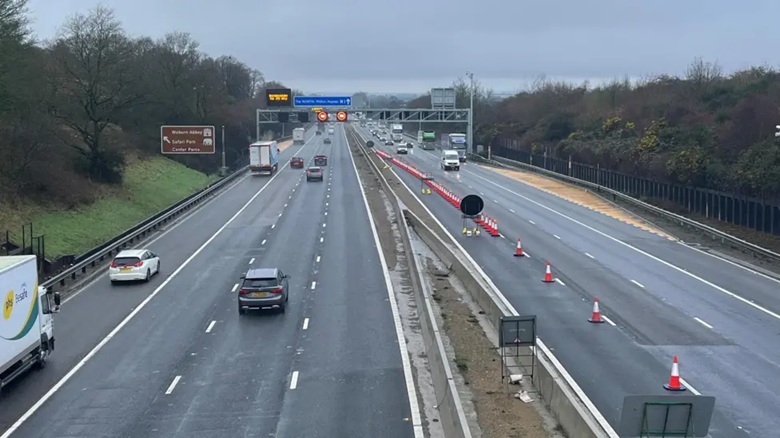
Work is continuing on a stretch of the M1 in Bedfordshire as engineers investigate a “drainage defect” in the central reservation, according to National Highways.
Lane closures between junction 12 at Toddington and junction 13 for Brogborough were first put in place on 27 January.
Although the story was dated nearly two weeks ago (14 February) at a time when all lanes on the northbound carriageway were open, it appears that lane three is again closed in both directions.
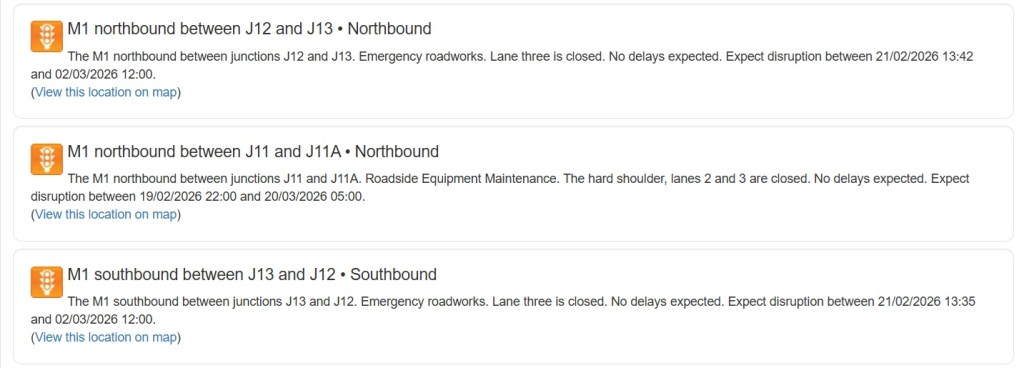
When it says “no delays expected”, the hard shoulder on this dynamic hard shoulder scheme is being used.
It looks as if the drainage defect has been caused by the replacement of the steel barrier with concrete, which has somehow compromised the drainage in one or more ways, including possibly changing the hydraulics and compressing the soil.
This has in turn weakened the barrier supports, according to National Highways.
And with cabling having been laid, it looks as if it might be a complex problem to fix.
Tony Fisher/BBC
It’s a shame. I have written before about what National Highways was pro-actively doing to replace steel barriers with concrete, which is safer because of the reduced risk of head-on crossover crashes.
In 2019, the then chief executive of what was then Highways England, Jim O’Sullivan, described concrete barriers in the central reservation as ‘one of the biggest single innovations in recent years that has made a huge difference to the safety of any road’.
This initially included putting in concrete barriers on all lane running smart motorways, where this was part of the specification.
By the time of this 2024 article, with new smart motorways scrapped, National Highways was still adding concrete barriers on stretches that had been due to be converted.
But it seems that pro-active activity has stalled and that only life-expired barriers are now being replaced as concerns grow over the impact (literally) of heavier electric vehicles.
Of course there may be a new programme in the new road investment strategy, due next month.
Clearly National Highways, whose first priority is safety, wouldn’t be spending hundreds of millions of pounds on a single new road scheme without seriously investing in road safety.
 Transport Insights
Leave a comment