Transport Insights

The transport stories you won't see in the industry-friendly media

Author

Chris Ames

Tag: m1

  • Thankfully, lane closures will be in place

    Returning to the mysterious “drainage defect” that undermined the stability of the new concrete central barriers on a stretch of the M1 in Bedfordshire, the BBC reported in quick succession that the defect was “still not fixed” and then that work “is due to begin”.

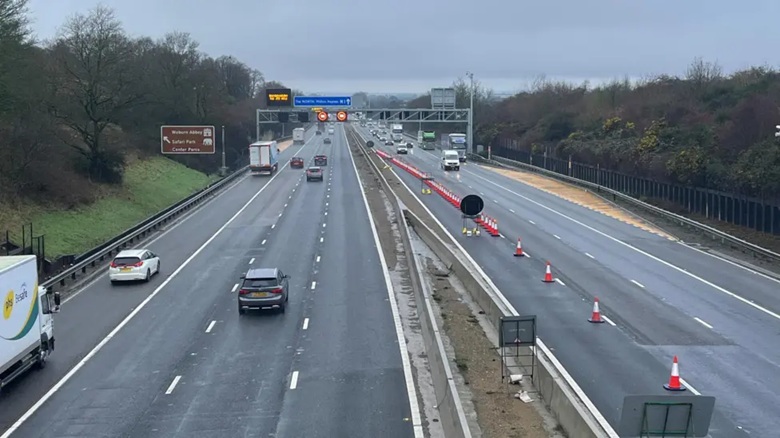
    National Highways said the drainage defect, which had emerged in mid January between junctions 12 and 13 but which they were trying to get to the bottom of, had weakened the supports for what are obviously very heavy barriers.
    Tony Fisher/BBC

    Initially there were lane closures but then, as the BBC reported last week:

    they had been able to remove the lane closures early last week “due to the improving weather” but did not say when the “drainage defect” would be repaired.

    That article quotes me as saying that it looked like National Highways was taking advantage of the drier period:

    [But] it seems unlikely that it would be able to carry out significant work to repair any damaged drainage without reinstating lane closures to create a sufficiently wide and safe working environment.

    A day later, the BBC reported:

    Work to fix a damaged drainage pipe on the M1 in Bedfordshire is due to begin eight weeks after the problem first occurred.

    And, crucially (for me):

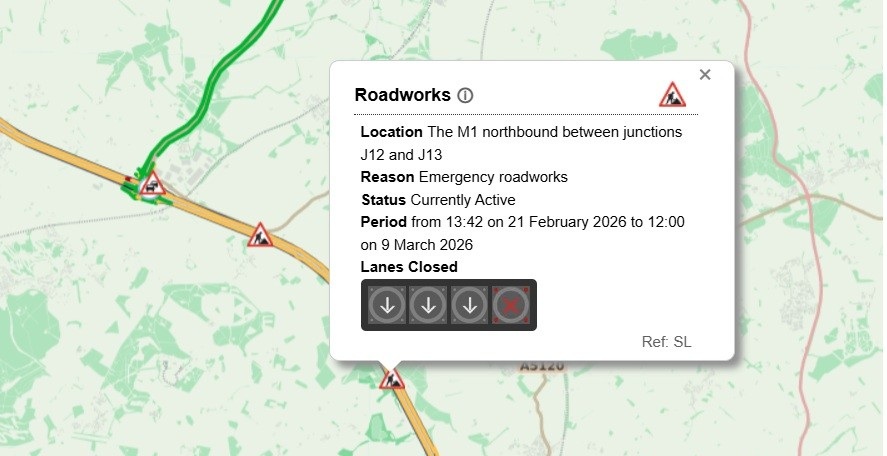
    Lane closures will be in place as well as several overnight closures.
  • Working hard to work out the problem

    It’s not clear whether National Highways is any closer to solving the drainage defect that has compromised the new concrete central barrier on the M1 between junctions 12 and 13.

    The problem first emerged in January and the roadworks, which were officially scheduled to finish this week, have been extended for at least another week.

    The story appears to be the same as when the BBC reported it two weeks ago.

    Image: Tony Fisher/BBC

    National Highways told me today that the barrier supports have been weakened by the drainage defect and that the hard shoulder remains open as a live lane to maintain three lanes open in both directions, with reduced speed limits for safety reasons.

    A spokesperson said:

    Our engineers have been working hard to identify the cause of a drainage defect in the central reservation. We continue to assess the situation and are planning the repairs needed. We would like to thank drivers for their continued patience.

    Meanwhile, an answer from transport minister Lilian Greenwood to a parliamentary question from shadow transport secretary Richard Holden highlights that there are stretches of the strategic road network with wire rope barrier of unknown age:

    National Highways has approximately 143 miles of wire rope safety barrier on its network. For context, the total length of Vehicle Restraint Systems (VRS) on National Highways’ network is approximately 6462 miles, of which wire rope safety barrier is one type. National Highways does not hold the data on when all wire rope safety barriers were installed.

    Leave a comment

  • Undermining confidence

    National Highways appears no nearer to fixing the “drainage defect” that is disrupting a stretch of the M1, closing lane three in each direction.

    I wrote last week about the problem, which has, according to the government-owned company, weakened barrier supports in the central reservation, but which it is unable to explain.

    The BBC reported last week:

    Despite several inquiries by the BBC, National Highways has been unable to clarify the exact nature of what they describe as a “drainage defect” or what caused it.

    The roadworks, which began on 28 January (pictured), were officially scheduled to finish yesterday but have been extended for another week.

    National Highways has not responded to my request for comment, presumably because it does not know what is going on.

    As I post this, there are northbound delays, which is unsurprising as the road is currently operating as a three lane motorway with the hard shoulder in use as a running lane and an obvious lack of resilience.

    Leave a comment

  • Concrete barriers and the weight of expectation

    This week, I was asked to look at and comment on this BBC story about a mysterious “drainage defect” that has led to the closure of the “lane three” northbound and southbound on the M1.

    Work is continuing on a stretch of the M1 in Bedfordshire as engineers investigate a “drainage defect” in the central reservation, according to National Highways.

    Lane closures between junction 12 at Toddington and junction 13 for Brogborough were first put in place on 27 January.

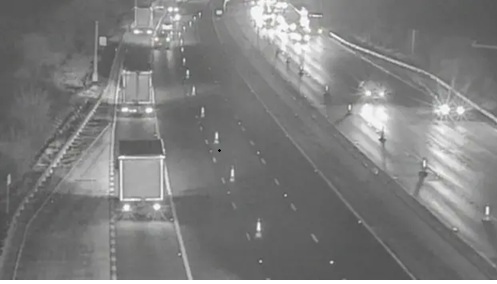
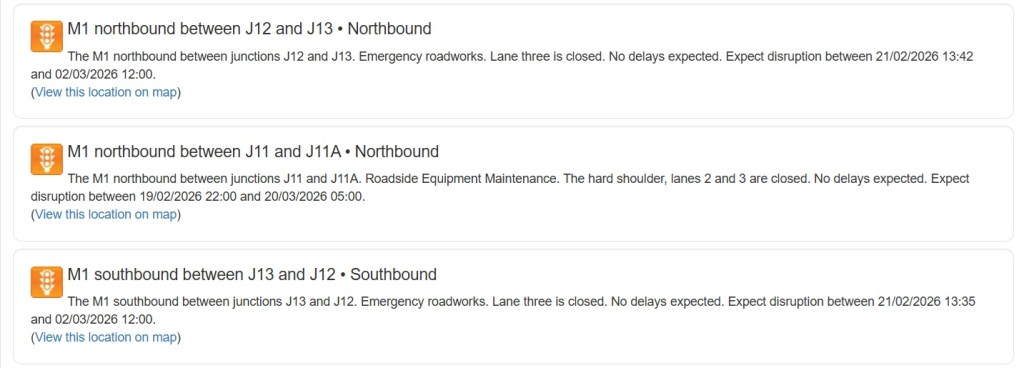
    Although the story was dated nearly two weeks ago (14 February) at a time when all lanes on the northbound carriageway were open, it appears that lane three is again closed in both directions.

    When it says “no delays expected”, the hard shoulder on this dynamic hard shoulder scheme is being used.

    It looks as if the drainage defect has been caused by the replacement of the steel barrier with concrete, which has somehow compromised the drainage in one or more ways, including possibly changing the hydraulics and compressing the soil.

    This has in turn weakened the barrier supports, according to National Highways.

    And with cabling having been laid, it looks as if it might be a complex problem to fix.

    Tony Fisher/BBC

    It’s a shame. I have written before about what National Highways was pro-actively doing to replace steel barriers with concrete, which is safer because of the reduced risk of head-on crossover crashes.

    (more…)