
The release of POPE evaluation reports on smart motorways has triggered a debate in the House of Lords, with a government spokesperson quoting a statistic about the high level of danger on A roads to suggest that smart motorways are safer by comparison.
The debate began with Lord Harries of Pentregarth asking the government:
what assessment they have made of the post opening project evaluations of smart motorways in relation to (1) safety, and (2) value for money.
The initial answer from Baroness (Judith) Blake of Leeds, previously leader of Leeds City Council, appeared to be that the government had made no assessment in relation to value for money:
While National Highways reports show that smart motorways are meeting or exceeding safety objectives in all but one upgrade, we know that people need to feel safe as well as be safe. That is why National Highways invested some £900 million to improve safety and educate drivers. The reports show that these upgrades have added vital capacity to some of the country’s busiest roads and are largely on course to meet their environmental goals.
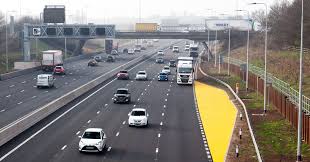
Given that most smart motorways were literally a way of adding capacity to motorways by using the hard shoulder as a running lane, it’s a bit desperate to say the POPE reports show that they had done this.
But Lord Harries tried again on the value for money point:
…according to National Highways’ official reports, these big projects to convert hard shoulders on the M1, M4, M6 and M25 were regarded as poor, or very poor, value. I wonder whether the Government agree with that assessment. My main concern, however, is safety. Although I totally respect the huge improvements made by the technology—the electronic signs that can control traffic and close lanes—it has nevertheless been shown that casualties and serious injuries have gone up on some stretches of these smart motorways: the M3 and parts of M1, for example. Therefore, what further steps will the Government take to improve safety on these smart motorways?
Blake’s response was that schemes were “delivering economic benefits”, which is not the same as saying that these benefits were worth the money spent on them, but she then made a bizarre point about the high casualty rate on A roads.
Although carrying half the traffic, 327 more people were killed or seriously injured on A-roads compared with motorways. We take road safety seriously, and recently published our new road safety strategy, in which we outline the further measures we are intending to take.
She later said:
I have to go back to the fact that 793 people were killed or seriously injured on the motorways in 2023, compared with 1,120 on A-roads.
The figures come from National Highways’ 2023 Road safety performance overview, which shows that A roads on the strategic network (SRN) do indeed carry just over half the traffic on the network, which means that A roads as a whole are are a bit less than three times more dangerous that.
But these statistics lump all motorways together, whether they be “smart” or conventional, and compare them against all kinds of A roads, with single carriageway A roads being particularly dangerous. Blake later referred to
the absolutely disgraceful issue of the safety statistics on our roads
but I don’t think talking about how unsafe A roads are is a good way to defend the safety record of smart motorways.
 Transport Insights
Leave a comment