
National Highways buried increases in fatalities from a new smart motorway by comparing a five-year period before the scheme opened with a three-year period afterwards.
The company has finally released a huge batch of Post Opening Project Evaluation (POPE) reports that the Department for Transport (DfT) has prevented it publishing, some going back many years.
They show a mixed picture for safety across a variety of all lane running (ALR), dynamic hard shoulder and controlled motorways, and that some schemes worsened journey times to the point where they provide “very poor” value for money, on top of the huge disruption involved in building them.
The POPE report for the M1 junctions 19 to 16 ALR scheme, which opened in 2018 after the hard shoulder had been converted to a permanent running lane, claimed that::
The number of fatal collisions has not changed with a total of four before and after the project became operational.
However, in the three years before the scheme opened, there were three fatalities, meaning that fatalities had increased by 33%.
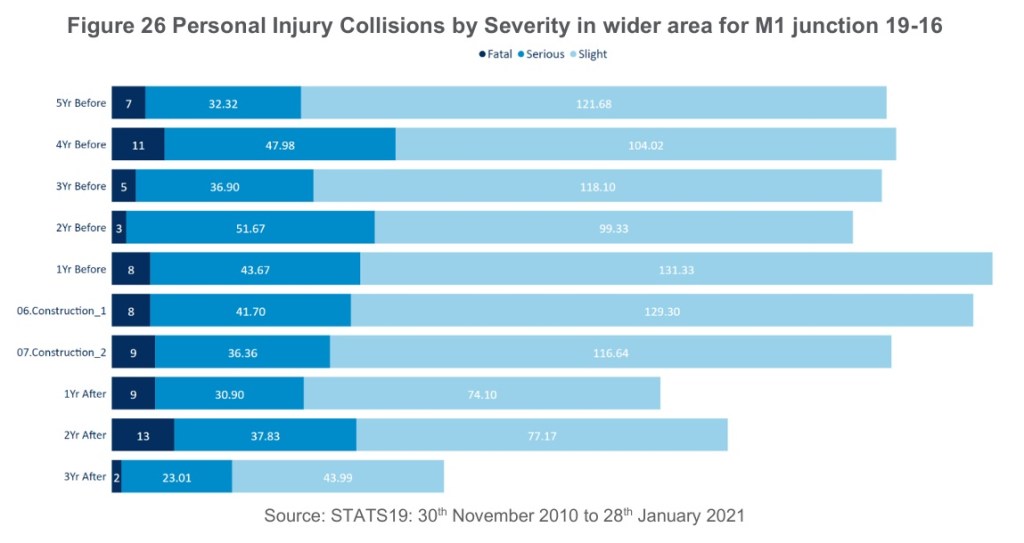
The report did the same for fatalities recorded in the wider area around the scheme. It stated:
After the project was constructed, we have observed a decrease in collisions resulting in fatalities (the total before the project was 34, compared to 24 after).
In fact, the figure of 24 comes from the three years after opening and during the thee years before construction started there were 16 fatalities, representing a 50% increase. The figure of 24 fatalities over three years represents an annual average of eight, and would be 40 over five years.
In addition, the last of these years, running to 28 January 2021, was a year of significantly lower traffic levels due to the Covid-19 pandemic.
The POPEs also include a mixture of killed and seriously injured crashes (KSIs – the measure against which National Highways was measured over the 2020-25 roads period) and other measures, such as fatality weighted injuries.
Among POPE reports showing a KSI total is the M3 Junctions 2-4a ALR scheme, which opened in 2017 and showed an increase of around a third in both the overall number of KSIs and the number per hundred vehicle miles, which measures KSIs compared to traffic levels.
The five-year POPE report for the M1 junctions 39 to 42 ALR project shows that the scheme led to an increase in KSI casualties but offered ‘poor’ value for money because predicted journey time savings used to justify the scheme did not materialise.
The appraisal forecast a significant traffic growth and improving journey times; the observed data suggested a more modest traffic growth accompanied by slightly slower journey times in most time periods and considerably slower average journey times in the northbound morning peak.
The M1 report covers a period from 2018 to 2021 and has a foreword from National Highways’ chief customer and strategy officer, Elliot Shaw, dated September 2024.
The five-year pope for the M3 scheme is dated September 2025 while other reports have forewords dated September 2023, despite the DfT claiming that it was carrying out “assurance”.
 Transport Insights
Leave a comment