
As National Highways’ safety record gets worse, the spin from both the company’s chief executive and its regulator continues.
The latest government data shows that 1,931 people were killed or seriously injured (KSI) on the strategic road network (SRN) in 2024. This is an increase of 23 people (1%) compared to 2023.
So the number of KSIs is going up when it is supposed to be going down.
In a blog post, the Office of Rail and Road (ORR) notes that this is 38% below the (2005-09) baseline against which National Highways is required to achieve a 50% reduction by the end of this year, “which means that National Highways needs to achieve a further reduction of 12 percentage points (381 KSI casualties) if it is to achieve its target”.
The ORR says:
The latest figures confirm that it is now almost certain the target will not be met.
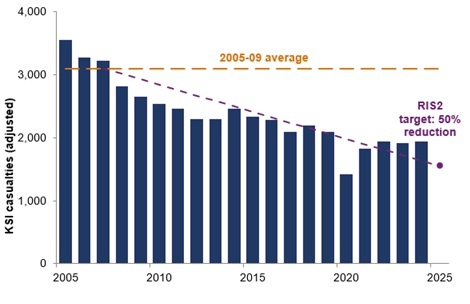
Note that the regulator says the target will not be met, rather than that National Highways will miss the target.
It just can’t help acting as apologist for the company that it claims to hold the company to account. It adds:
Over the same period, traffic on the SRN also increased by 1%. As a result, the KSI casualty rate was unchanged in the most recent year, at 20 such casualties per billion vehicle miles travelled. Excluding 2020 and 2021 (when fewer people were travelling because of COVID-19), this is the equal lowest casualty rate recorded on the SRN.
It also restates its claim, which it has repeatedly failed to justify, that the company is doing it reasonably can to improve safety:
But even if National Highways does not meet its target for the end of 2025, it is important that the company continues to do all it reasonably can to reduce casualties by as much as possible.
Meanwhile, fresh from giving an exclusive interview to the official Highways UK podcast, National Highways chief executive Nick Harris has also spoken exclusively to Highways magazine:
On many measures, RIS 2 was successful. It reduced the number of people who would have been killed or seriously injured. [But] It did not achieve the target of the 50% reduction. So our aspiration is to go further.
Bearing in mind that the 38% reduction would miss the company’s RIS 1 (2020) target of a 40% cut in casualties, which it only met because of lower traffic levels during the Covid pandemic, this is extreme complacency.
As is Harris’ claim that in the forthcoming RIS 3 the company expects to have the greatest impact on improving safety by carrying out improvement plans on A roads using the iRAP star rating approach.
That’s exactly what the company should have been doing in RIS 1, but it couldn’t be bothered.
Harris does suggest that some kind of a target is “part of the RIS 3 conversation”.
But that has become an irrelevance as history shows that it can miss targets – thousands more people can be killed or seriously injured – with no consequences, just excuses.
 Transport Insights
Leave a comment