
National Highways’ response to the coroner examining the death of a motorist on a “smart motorway” section of the M6 where the emergency areas are officially too far apart also raises concerning questions about the effectiveness of the technology involved.
In June 2023, Kevin O’Reilly ran out of petrol on the all lane running M6 northbound approaching Junction 12 and was stationary in lane three when his car was hit by an HGV.
Emma Serrano, area coroner for Staffordshire sent National Highways a Regulation 28: Report to Prevent Future Deaths in relation to the death of Mr O’Reilly, expressing concern over the frequency of emergency areas and that the motorway was ‘not monitored’.
I wrote about the issues around emergency area spacing – and what the government isn’t doing about them – earlier today but what National Highways said about the role that stopped vehicle detection (SVD) played is very worrying:
Having reviewed our CCTV footage after the incident, we determined that Mr O’Reilly’s vehicle was slow moving until approximately 30 seconds before the collision. Once stopped, SVD operated correctly in detecting the vehicle and triggered the automatic “Report of obstruction” message just after the HGV, that collided with Mr O’Reilly’s car, passed the variable message sign. Therefore the HGV driver was not presented with this warning message.
So, everything worked as it should, but a driver in a stationary vehicle without access to an emergency area (in the absence of a hard shoulder) still lost his life.
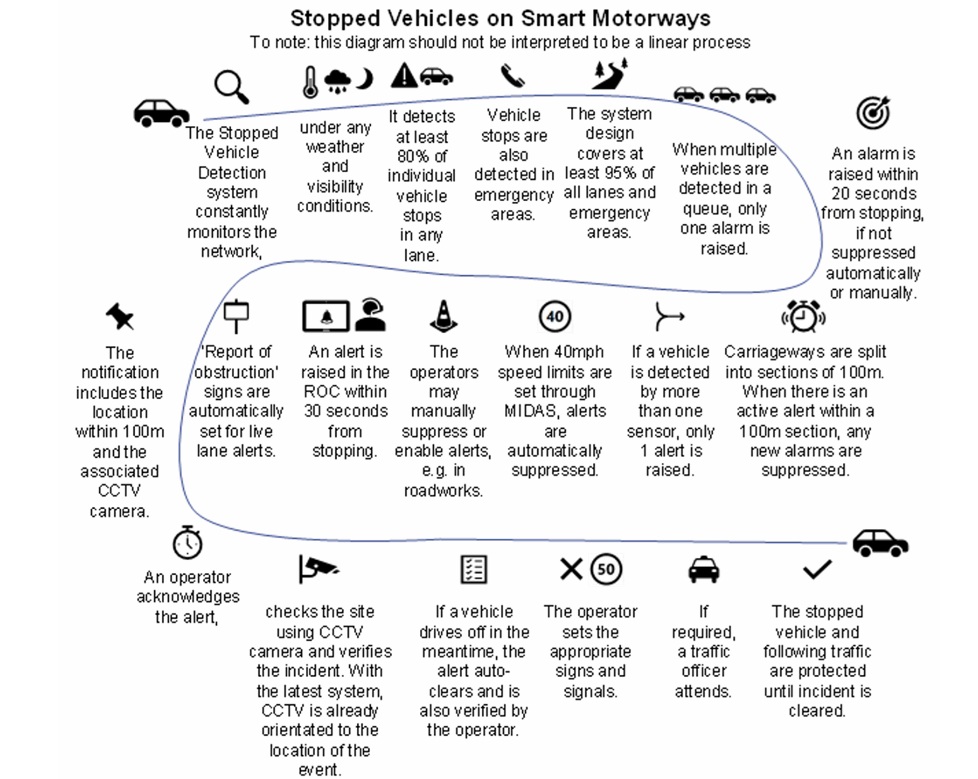
A diagram from an Office of Rail and Road report explains why the first sign, which was not in any case seen by the lorry driver, was a “Report of Obstruction”, rather than a red X to close the lane. That would have required an operator in a control centre to confirm the issue and set signs.
The fact that, according to National Highways, a driver was hit approximately 30 seconds after stopping on a smart motorway, despite the SVD working, reinforces the comment in the draft third Road Investment Strategy that I posted about yesterday:
National Highways should not be over-reliant on technology, for example drawing on insights from the use of cameras and stopped vehicle detection when considering driver safety and welfare.
The cameras in this incident were not being actively monitored and operators must have been horrified that by the time they located the stopped vehicle a fatal collision had occurred.
The case illustrates that failings in the two key aspects of smart motorway safety – emergency areas and technology – can be fatal.
This brings me back to the draft RIS 3 and the absence of any serious commitment (so far) to improve road safety, alongside the postponement of National Highways “zero harm” target from 2040 to 2050.
If the Labour government will not fund improvements to safety on smart motorways – as the Tories did – fatalities like this will continue to occur. In coroner speak, future deaths will not be prevented.
 Transport Insights
Leave a comment