
Looking back at what was said in 2022 about the secret decision to shelve the A1 Morpeth to Ellingham scheme, it is quite clear that both National Highways and its regulator misled the public, and both organisations have conspicuously failed to deny that they did so.
I have previously noted that the Tory government’s decision to withdraw all funding from the scheme after the 2021 Spending Review is cited in a leaked report obtained by the Newcastle Chronicle.
However, the National Audit Office’s (NAO) November 2022 report cites the scheme as one of two that had been shelved earlier that year:
In February 2022, DfT formally notified National Highways that two projects on the watchlist had been deprioritised as an outcome of the 2021 Spending Review. These two projects remained in the portfolio awaiting a final decision on whether to proceed but their funding has been removed.
So to be absolutely clear, between February and November 2022 the A1 Morpeth to Ellingham scheme had no funding.
Let’s look then at National Highways’ Delivery Plan 2022-2023, which was published pretty well in the middle of that period. Under “Our activities during 2022-23”; it states:
We will start work on two schemes [including] A1 Morpeth to Ellingham which will upgrade multiple sections of the A1 to dual carriageway to provide continuous high quality dual carriageway from Newcastle to Ellingham, north of Alnwick.
A pretty unambiguous pledge to start work on a scheme that had no funding and unarguably a direct lie but National Highways has not responded to my request for explanation or comment.
Similarly the Office of Rail and Road’s (ORR) Annual Assessment of National Highways’ performance April 2021 to March 2022, “Presented to Parliament pursuant to section 10(8) of the Infrastructure Act 2015” and “Ordered by the House of Commons to be printed on 14 July 2022” lists the scheme as one of “12 schemes where RIS2 funding was reduced in SR21”.
So already the public and Parliament are being misled by the ORR’s description of the scheme as having had its funding “reduced”, rather than outright withdrawn.
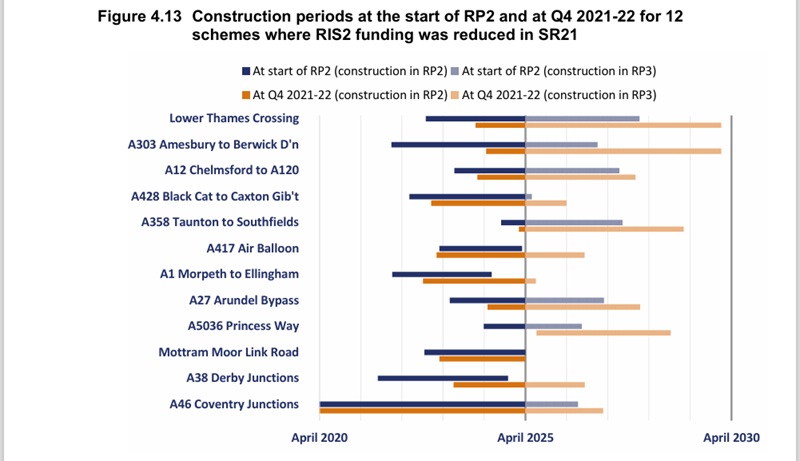
To make matters worse, the ORR then presented Parliament with a graphic (above) showing the construction period for the scheme beginning in 2022-23.
It then falsely claimed that the scheme was “currently forecasting spend of £255m against a RP2 baseline of £39m”. The scheme was not currently forecasting any spend as it was unfunded.
The ORR has not responded to my request for explanation or comment but I’d like to return here to its earlier non-denial/explanation for not disclosing the withdrawal of funding, which was that
“The detail of ongoing governmental policy decisions is not something that ORR can include in regulatory reporting of National Highways’ performance”.
In fact, the report in question is full of reporting on the detail of ongoing governmental policy decisions, including falsely claiming that the scheme’s budget had been “reduced” and:
In January 2022, following the Transport Select Committee’s (TSC’s) report on the roll-out and safety of smart motorways, the government announced a pause to the construction of all new smart motorways until five years’ worth of safety data for existing smart motorways is available.
So, in order to avoid addressing how it misled the public, the ORR has resorted to…misleading the public some more.
In July 2023, the Transport Select Committee, one of whose members from the time is the current committee’s chair, published a report on Strategic road investment, which noted the difficulty of tracking National Highways enhancement schemes:
Kate Cohen, Director for Roads and Projects Infrastructure at the Department for Transport, explained the various reporting resources to us:
Every year there are three annual publications of progress on the RIS. One is the delivery plan produced by National Highways. One is the ministerial statement that gets presented to Parliament each year. Then there is an annual assessment by the ORR [Office of Rail and Road]. In those three documents, which are published annually, together with the annual report and accounts for National Highways, there is a complete list of progress against all the KPIs and all the schemes’ progress against their predicted start of works and opening dates for the key milestones. (emphasis added)
The report presented to Parliament “pursuant to section 14 of the Infrastructure Act 2015” states that, aside from smart motorways, no schemes have been so much as paused as they are otherwise all either completed, under construction or in development:
In total, as at the end of March 2022, of the 69 schemes originally announced in RIS2; 10 have been completed, 23 are currently under construction, 25 are in the development phase (including 23 at various stages of the planning process) and 11 have been paused following the Transport Select Committee’s recommendations.
The select committee report adds that:
On 29 March 2023 we asked Richard Holden MP, Parliamentary Under Secretary of State for Roads, for a definitive list of all projects in each of the RIS portfolios, along with their current status. We were grateful to receive a response, but noted that the information given in it on RIS 2 progress and a potential list of RIS 3 schemes was extracted from the National Highways Delivery Plan Update, published some eight months previously, in July 2022.
The report adds that it was aware that the delivery plan had been overtaken by postponements of some schemes but it is a further illustration that MPs are told that National Highways delivery plan is reliable, when in fact the company lied to them.
I also approached the Department for Transport for comment/explanation. It issued the usual blanket assertion that “These claims are not true” but has not yet stated which claims it is referring to. Who knows? Perhaps it is disputing the factual statement from the NAO that funding was “withdrawn” in 2022 as that part is mysteriously missing from its statement:
“DfT formally notified National Highways in February 2022 this project had been deprioritised following the 2021 Spending Review. As the project still required final decisions on whether to proceed, it remained in delivery plans until being formally cancelled in October 2024.”
I think the DfT is equating the NAO’s “remained in the portfolio awaiting a final decision on whether to proceed” with remaining “in delivery plans” but the whole point is that the scheme should not have been in National Highways’ 2022-2 delivery plan because it had no funding and was effectively parked “awaiting a final decision on whether to proceed” .
On that subject, the Morpeth to Ellingham scheme has a curious history of Tory ministers promising to take it forward in unfunded back-of-the-envelope announcements.
The November 2022 NAO report was being put together at the time of the collapse of the Truss premiership, which saw Kwasi Kwarteng as chancellor announce a Growth Plan full of infrastructure projects to be accelerated. The NAO commented:
In September 2022, one of these deprioritised projects – A1 dualling Morpeth to Ellingham – was identified for acceleration by government in its Growth Plan, despite remaining on National Highways’ watchlist as poor value for money. There is now an expectation that National Highways would start construction on the majority of its schemes in the Growth Plan by the end of 2023. It is not yet clear how National Highways will fund the cost of acceleration or works (estimated to be at least £216 million in March 2021), or if additional funding will be provided.
In fact, Kwarteng’s successor as chancellor, Jeremy Hunt, had already ditched most of the growth plan. A week after the NAO report was published, the 2022 Autumn Statement stated:
The government will seek to accelerate delivery of projects across its infrastructure portfolio, rather than focus on the list of projects that were flagged for acceleration in the Growth Plan.
So the A1 scheme remained (secretly) unfunded and lost any suggestion that it would be taken forward any time soon.
And, as I have said, a year later the Sunak government cited the scheme as receiving funding under the laughing stock that was the Network North redistribution of HS2 cash, despite it being, in theory a committed and fully funded RIS 2 scheme.
 Transport Insights
Leave a comment