Transport Insights

The transport stories you won't see in the industry-friendly media

Author

Chris Ames

Tag: smart motorways

  • More media coverage of POPEs demo

    The brilliant Claire Mercer has posted two TV news reports on yesterday’s demonstration, on the Smart Motorways Kill Facebook feed and YouTube.

    I think both reports give a good explanation of the issue, but by way of a reminder, roads minister Simon Lightwood is refusing to release a raft of Post Opening Project Evaluation (POPE) reports on smart motorways, which would reveal their record on issues such as safety, value for money and environmental impact.

    The first is from Fred Dimbleby of ITV’s Calendar:

    And a second from Spencer Stokes of BBC Look North:

    Leave a comment

  • MP joins calls for release of POPEs

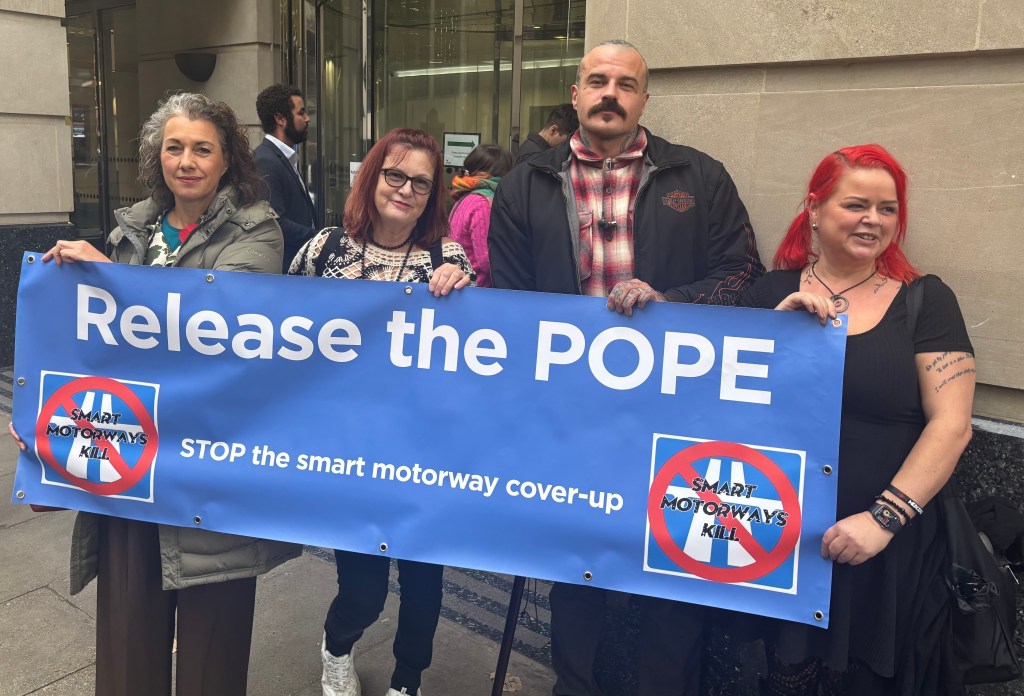
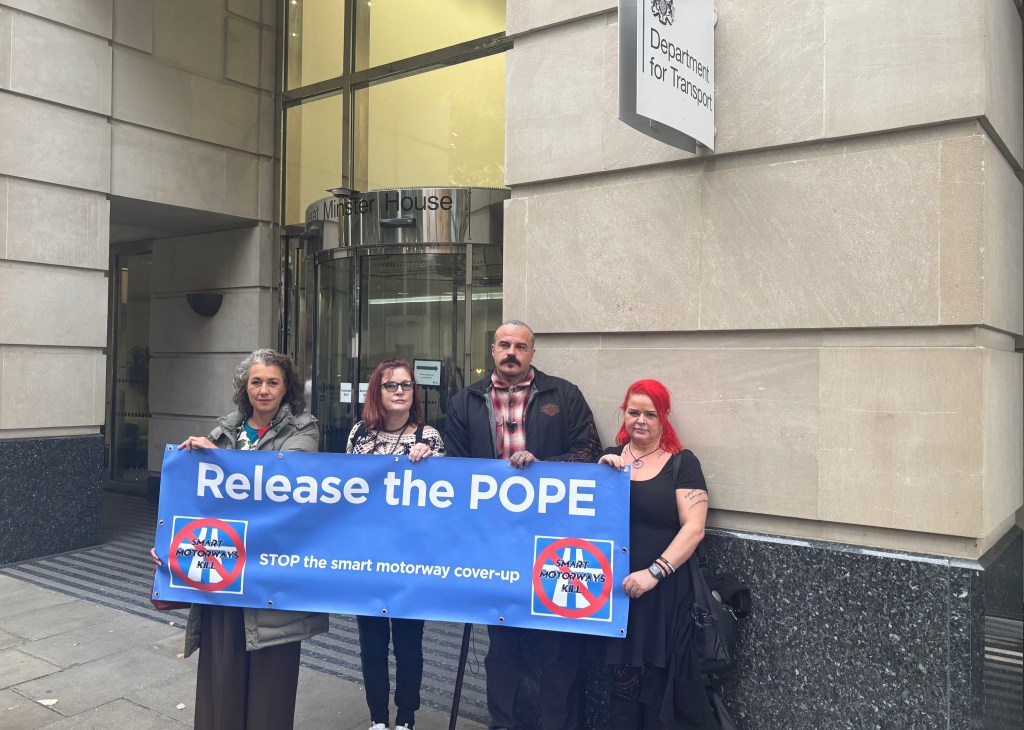
    A Labour MP joined campaigners outside the office of the Department for Transport (DfT) today, calling for suppressed reports on the impact of smart motorway schemes to be released.

    The event was a collaboration between myself and Claire Mercer of the Smart Motorways Kill campaign and aimed to highlight the fact that the DfT is refusing to release a raft of Post Opening Project Evaluation (POPE) reports on smart motorways, which would reveal their record on issues such as safety, value for money and environmental impact.

    It generated a significant amount of attention, with Mercer interviewed by local and national media, telling them that she aimed to “shame” ministers into taking action.

    According to a 2022 report by National Highways’ regulator, the Office of Rail and Road (ORR), nine POPE reports were due to be completed that year alone. It is not known how many have been compiled since.

    Both National Highways and the ORR have blamed ministers for the failure to make the reports public, with the DfT claiming that the reports are still undergoing an “assurance” process.

    Sarah Champion, Member of Parliament for Rotherham, who is Mercer’s MP, also attended the demonstration, at which a banner demanding “Release the Pope” was held up at the entrance to the DfT’s offices.

    (more…)
  • Lightwood backs smart motorway cover-up

    The roads minister has backed the continued suppression of a raft of evaluation reports on the safety and effectiveness of smart motorway schemes, some of which were due for publication three years ago.

    I revealed in September that ministers are sitting on a huge amount of data on the controversial schemes, in the form of multiple post opening project evaluation (POPE) reports, including at least nine that were due for completion in 2022.

    Although the reports were produced by National Highways, the Department for Transport (DfT) called them in and has not allowed them to be published, on the grounds that it is “undertaking its final assurance”.

    An event at the DfT tomorrow will highlight the continuing suppression of the reports and call on ministers to release them in the name of transparency.

    The event is a collaboration between myself and Claire Mercer of the Smart Motorways Kill campaign, who wrote to DfT ministers to invite them to attend.

    She has received a reply from Simon Lightwood, as the minister responsible for the strategic network, who has both declined to attend and backed the patently false claim that the reports are still undergoing assurance. He wrote:

    National Highways does evaluate the economic impact after schemes have been operational for five years and we are committed to transparency, but this is a complex process, and it is right that we take the time to fully assure findings. This process is ongoing, and we will provide an update on publication in due course.

    The phrase “in due course” indicates that Lightwood is not even prepared to say when “an update on publication” will be provided, let alone when – or even if – the reports will actually be published.

    In backing this lie, Lightwood has firmly owned the cover-up of what are looking increasingly like very damaging findings.

    The event will take place at the Department for Transport, 33 Horseferry Rd, London, SW1P 4DR at 12:15pm on Wednesday 5 November.

    Leave a comment

  • DfT to feel the heat over smart motorway cover-up

    I will be taking part in an event at the Department for Transport on Wednesday to highlight the continuing suppression of evaluation reports on the safety and effectiveness of smart motorways and to call on ministers to release them in the name of transparency.

    I revealed in September that ministers are sitting on a huge amount of data on the controversial schemes, in the form of multiple post opening project evaluation (POPE) reports, including at least nine that were due for completion in 2022.

    When the five-years after POPE on the scheme to convert the M1 between junctions 10 and 13 to dynamic hard shoulder was published in September 2021, it revealed that it had cost the economy £200m instead of a projected benefit of £1bn, because it slowed traffic down. It made national news.

    The event is a collaboration between myself and Claire Mercer of the Smart Motorways Kill campaign, who has done most of the work.

    Confirmed attendees at the event include her MP, Sarah Champion, and crash survivor Jack Gallowtree, as well as representatives from road safety and motoring groups.

    Irrespective of what you think about smart motorways, as the official press release puts it:

    The event’s purpose is to shine a spotlight on the years of delay and lack of transparency surrounding these critical reports. Campaigners are urging the DfT and National Highways to release all outstanding POPE evaluations, answer questions, and ensure that lessons are learned to improve future road safety and infrastructure planning.

    Who could argue with that?

    The event will include a demand to “Release the POPE”, a playful reference to the occasions in the past when the pontiff has been captured, including following the 1527 sack of Rome.

    Expected to be a lot more orderly, it will take place at the Department for Transport, 33 Horseferry Rd, London, SW1P 4DR at 12:15pm on Wednesday 5 November.

    There won’t be fireworks, but we hope ministers will feel the heat over the continued cover-up.

  • AA calls for POPEs to be released

    The AA has picked up on my revelation that the Department for Transport (DfT) is sitting on a large number of post-opening evaluations of smart motorways and suggested that the loss of the hard shoulder may be responsible for an increase in delays on the strategic road network.

    The DfT has published Average delay on the Strategic Road Network in England: monthly and annual averages which shows that the average delay up to June 2025 was 11.6 seconds per mile, up 5.5% in a year.

    The AA said it believes that the impact of smart motorways is now “firmly under the spotlight”, adding that drivers are avoiding lane one through fear of running into a stranded vehicle, which undermines the efficiency and speed of these roads.

    Another reason for increased delays on motorways without a hard shoulder is that they have less resilience when things go wrong.

    Elsewhere on the network, major schemes like the one at Junction 10 of the M25 have continued to cause significant traffic jams.

    The AA also noted my report that several Post Opening Project Evaluation (POPE) reports into all lane running schemes have yet to be released, and called for their immediate publication.

    Head of roads policy Jack Cousens said:

    With numerous stretches of so-called smart motorway now in regular use, rather than improving traffic flow it seems to have created more bottlenecks.

    There are several reports about these schemes which have not yet been released by the Department for Transport which would show what, if any, improvements drivers have experienced.

    We need these documents released to understand what traffic flow benefits have been made, alongside a value for money assessment on these motorways drivers perceive as dangerous.

  • Exclusive: Labour blocks smart motorway safety data

    Ministers are sitting on a huge amount of data on the safety and value for money of smart motorway schemes, including at least nine that were due for completion in 2022.

    The concealment of multiple post opening project evaluation (POPE) reports will raise concerns that the government is once again hiding inconvenient facts about the controversial roads, as it did in 2021, when I put pressure on the Department for Transport (DfT) over reports that it was suppressing.

    When the five-years after POPE on the scheme to convert the M1 between junctions 10 and 13 to dynamic hard shoulder was published in September 2021, it revealed that it had cost the economy £200m instead of a projected benefit of £1bn, because it slowed traffic down. It made national news.

    In its Annual Assessment of National Highways’ performance 2021-22, regulator the Office of Rail and Road stated:

    We are scrutinising the company’s POPE publication plan for smart motorway schemes. Nine of these are due to be completed in 2022. In July 2021, the company published the five-year POPE for the M1 junctions 10 to 13 dynamic hard shoulder running scheme.

    That POPE was the last report on a smart motorway to be published, which is unsurprising given how terrible the data was, although aggregated safety data is published separately.

    When I asked National Highways why no more POPE reports had been published, a spokesperson told me:

    We have provided the Department for Transport (DfT) with the smart motorway post opening project evaluation (POPE) reports. These are multiple detailed evaluations of scheme performance and DfT is now in the process of undertaking its final assurance.

    Obviously, for those reports completed in 2022, “undertaking final assurance” means locked in a cupboard.

    (more…)
  • Exclusive: Second secretly shelved scheme surfaces

    I can exclusively reveal the other major scheme in the second road investment strategy (RIS 2) that ministers secretly pulled the plug on during the 2021 Spending Review.

    According to a November 2022 report from the National Audit Office:

    In February 2022, DfT formally notified National Highways that two projects on the watchlist had been deprioritised as an outcome of the 2021 Spending Review. These two projects remained in the portfolio awaiting a final decision on whether to proceed but their funding has been removed.

    The NAO revealed that one of these schemes was the A1 Morpeth to Ellingham scheme, which the company formally paused almost immediately, but it did not name the other scheme, which was also blacked out of all documents previously disclosed to me.

    Now the Department for Transport has told me that the second, previously unnamed scheme was the M25 Junctions 10-16.

    (more…)

  • Smart motorway shortcomings combined in fatal crash

    National Highways’ response to the coroner examining the death of a motorist on a “smart motorway” section of the M6 where the emergency areas are officially too far apart also raises concerning questions about the effectiveness of the technology involved.

    In June 2023, Kevin O’Reilly ran out of petrol on the all lane running M6 northbound approaching Junction 12 and was stationary in lane three when his car was hit by an HGV.

    Emma Serrano, area coroner for Staffordshire sent National Highways a Regulation 28: Report to Prevent Future Deaths in relation to the death of Mr O’Reilly, expressing concern over the frequency of emergency areas and that the motorway was ‘not monitored’.

    I wrote about the issues around emergency area spacing – and what the government isn’t doing about them – earlier today but what National Highways said about the role that stopped vehicle detection (SVD) played is very worrying:

    Having reviewed our CCTV footage after the incident, we determined that Mr O’Reilly’s vehicle was slow moving until approximately 30 seconds before the collision. Once stopped, SVD operated correctly in detecting the vehicle and triggered the automatic “Report of obstruction” message just after the HGV, that collided with Mr O’Reilly’s car, passed the variable message sign. Therefore the HGV driver was not presented with this warning message.

    So, everything worked as it should, but a driver in a stationary vehicle without access to an emergency area (in the absence of a hard shoulder) still lost his life.

    (more…)

  • Don’t look to Labour to fix smart motorways

    The draft of the third Road Investment Strategy (RIS 3) published this week suggests that ministers are happy with a smart motorway network where many places to stop in an emergency are officially too far apart, putting drivers at increased risk.

    In November 2021, the Transport Select Committee recommended that:

    The Department and National Highways should retrofit emergency refuge areas to existing all-lane running motorways to make them a maximum of 1 mile apart, decreasing to every 0.75 miles where physically possible.

    The Department (for Transport – DfT) accepted this recommendation in principle and in January 2022 announced that £390m would be spent by the end of March 2025 to retrofit “more than 150 additional emergency areas”, alongside a pause on the construction of new all lane running smart motorways.

    The waters were muddied when it emerged that National Highways was counting other places to stop towards the spacing standard, but the company did deliver a promised 151 new emergency areas by the end of March under the National Emergency Area Retrofit (NEAR) programme.

    Although this was said to provide “around a 50% increase in places to stop”, neither the DfT nor National Highways ever said how far the programme would go to fill in all the gaps where the spacing was longer than the official standard.

    National Highways has told me that it had  “prioritised locations where emergency areas could make the most difference and bring benefits to drivers as soon as possible” and suggested that it would like to see a continuation of the programme.

    Labour delayed the start of RIS 3 by a year and gave the company an interim settlement for the current year that says nothing about improving safety on smart motorways.

    In a section on Smart Motorways, the draft RIS 3 document claims that “substantial investment continues to improve the safety of the existing network” citing “the recent completion of additional Emergency Refuge Areas on the All Lane Running (ALR) smart motorways under the National Emergency Areas Retrofit (NEAR) programme”, which it acknowledges “was finished in March 2025” – a whole year before the new RIS.

    There is no commitment to continuing the retrofit of what Labour has now returned to calling “Emergency Refuge Areas”, which leaves National Highways with a spacing standard that it is not funded to deliver.

    (more…)