Transport Insights

The transport stories you won't see in the industry-friendly media

Author

Chris Ames

Tag: smart motorways

  • Did Lightwood exaggerate speed camera fix?

    The Daily Mail has reported that National Highways is some way off identifying and implementing a permanent solution to the issue that led to thousands of drivers being wrongly clocked for speeding on smart motorways.

    The paper picks up on yesterday’s statement from roads minister Simon Lightwood and in particular the revelation that the problem was fully identified in October and prosecutions halted, adding that “speed camera enforcement on smart motorways was secretly switched off two months ago”.

    Lightwood also said:

    A Home Office-approved solution to this issue has now been agreed. National Highways will be working with the police to allow them to implement this solution as a priority.

    However, the Mail reports:

    But it has emerged that National Highways still does not fully understand how the fault occurred and a permanent solution won’t be found until next year. 

    In the meantime, when the camera enforcement system is switched back on, National Highways will have to provide daily updates to police on the times when they believe the camera system is not functioning properly.

    Leave a comment

  • Lightwood makes light of speed camera snafu

    Roads minister Simon Lightwood has claimed that drivers who break the law “can expect to be punished”, despite confirming that tens of thousands of drivers have got away with speeding offences because of National Highways’ latest technology failure on smart motorways.

    In written parliamentary statement, Lightwood confirmed, but sought to play down, the fact that an “anomaly” over the settings on variable speed limit enforcement cameras occurred approximately 2,650 times over four years, leading to a similar number of wrongful prosecutions.

    But that’s only half the story. As Lightwood told MPs:

    Independently, the National Police Chiefs’ Council took action to instruct all affected police forces to cancel wider prosecutions related to infringements in progress, regardless of whether they were impacted by this issue. As a result, tens of thousands of people’s speed awareness courses are being cancelled, and thousands of historic fixed penalty notices and criminal justice prosecutions are being discontinued.

    Lightwood also explained why his department had covered the problem up for around three months, without explicitly stating that it had done so:

    Throughout this process, I have been clear with all partners that we must ensure our road network remains safe. We therefore took the decision, following a safety assessment from National Highways, not to undermine public confidence in enforcement and risk impacting driver behaviour before we had a solution to this issue approved and ready to roll out.

    He ended his statement with an assertion that the facts have proven to be wholly untrue.

    Compliance with the law is being enforced in a variety of ways across our roads, as has always been the case. If you break the law, you can expect to be punished.

    As I commented yesterday, if tens of thousands of drivers breaking the law cannot be prosecuted because smart motorway technology is, once again, not up to the job, that is a major safety issue.

  • National Highways races to play down speed camera cock-up

    The revelation that thousands of drivers have been wrongly prosecuted because speed cameras on smart motorways and elsewhere had the wrong settings is a major embarrassment for National Highways, which is why it is, typically, trying to play it down.

    I’m not sure it will boost confidence that the issue has only been admitted by the government-owned company and the Department for Transport (DfT) after a so-called fix has been put in place, but here is the headline on the National Highways press release:

    Fix being rolled out after variable speed camera anomaly

    As the Daily Mail points out:

    The scandal will yet again raise concerns about the safety of smart motorways, which are stretches of road where variable speed camera technology is used to manage traffic flow and reduce congestion.

    It’s fair enough to point out that too rigid enforcement doesn’t put anyone at risk but the story feeds into the general problem that, as the draft of the third Road Investment Strategy put it:

    National Highways should not be over-reliant on technology, for example drawing on insights from the use of cameras and stopped vehicle detection when considering driver safety and welfare.

    This is code for saying that the technology on smart motorways isn’t up to the job.

    (more…)
  • DfT adds insult to death and injury on smart motorways

    There’s a good write-up in the (Sheffield) Star of the current situation over the release of the 14 evaluation reports on smart motorways that ministers are sitting on, with the Department for Transport’s (DfT) excuses not fooling anyone.

    It features Claire Mercer’s reaction to the DfT being unable to say that there is anything other than a  made-up “assurance” process to justify the ongoing suppression of the Post Opening Project Evaluations (POPEs).

    The reality, as National Highways told me, is that ministers have to agree a “comms handling plan” before telling us how (un)safe the projects are.

    Speaking to The Star, Claire – founder of the Smart Motorways Kill Campaign – scolded the DfT and said she believes the “only reason” for the delays can be that roads minister Simon Lightwood is “merely preparing to spin what are likely to be very negative findings.”

    The Star does include Mercer’s allegation that Lightwood lied to her by falsely claiming that an assurance process is “ongoing”:

    (more…)
  • Minister lied to me, smart motorway widow says

    Claire Mercer of Smart Motorways Kill has also concluded that the claim that the Department for Transport (DfT) is still “assuring” 14 smart motorway evaluation reports going back three years is a fiction – and that roads minister Simon Lightwood lied to her about this.

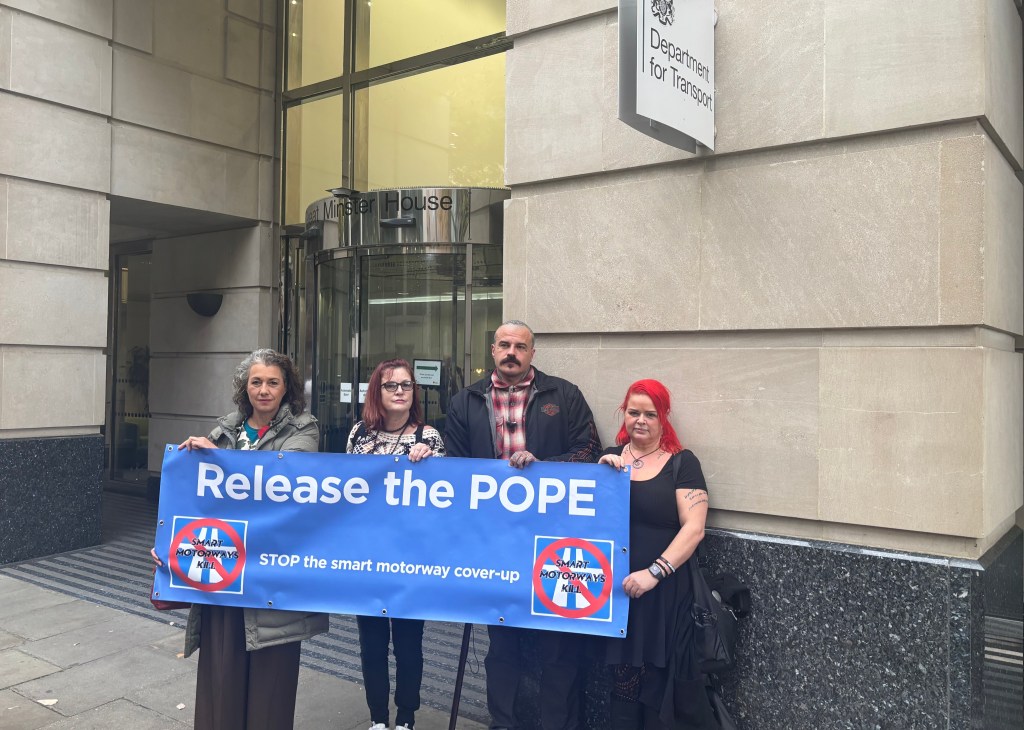
    Mercer, whose husband Jason was killed, along with Alexandru Murgeanu, on a smart motorway stretch of the M1 in 2019, co-organised the protest outside the DfT last month calling for the Post Opening Project Evaluation (POPE) reports to be released.

    Lightwood wrote to her at that time to defend the suppression of the reports, saying:

    …it is right that we take the time to fully assure findings. This process is ongoing

    As I wrote on Monday, when challenged over the “process” by Mercer’s MP, Sarah Champion, Lightwood resorted to claiming that a “wider assurance”, rather than the formal assurance for each scheme was happening. This is clearly a fiction.

    Mercer’s solicitors, Irwin Mitchell, also wrote to the DfT to challenge the process. It told them that the reports:

    are currently completing the final governance and approval stages

    adding:

    it is right that the department take the time to fully understand and assure findings prior to publication

    Again, the pretence that a formal assurance process is happening has evaporated.

    Mercer has seen through this and has not forgotten what Lightwood told her. She said:

    (more…)
  • Minister fibs to keep smart motorway failings secret

    Roads minister Simon Lightwood has admitted that no genuine assurance process is taking place that would justify his cover-up of National Highways’ evaluations of smart motorways.

    He has responded (sort of) to another question from fellow Labour MP Sarah Champion about the 14 Post Opening Project Evaluation (POPE) reports on smart motorways that the Department for Transport (DfT) is suppressing.

    Judging from Lightwood’s determination to hide these reports until he works out how to spin them, you might imagine that they show that the safety, economic benefits and environmental impact of individual schemes are not great

    Asked:

    what the assurance processes are under which the Post Opening Project Evaluation (POPE) of Major Schemes are conducted

    Lightwood replied:

    National Highways follows its established “Analytical Assurance Framework” for assuring POPE reports, which includes fourth line independent external expert analytical assurance from DfT.

    As these are complex reports it is right that my officials take the time to provide summary advice of these reports in the round and undertake wider assurance to advise me on the quality of collective findings.

    The first part appears to be untrue as National Highways does not have an analytical assurance framework that is separate from the DfT’s framework, but this is probably irrelevant as Lightwood is no longer claiming that this is still happening.

    Instead he has made up a completely new process under which his officials supposedly group together a whole bunch of POPE reports to summarise them and carry out a fictional “wider evaluation”. Implicitly, he is admitting that no formal assurance process is being carried out.

    To be fair, he is not actually saying either that an informal “wider assurance” process is happening, just that it is right that it should happen.

    Of course, the point about such a process is that concern for the “quality of collective findings” does not mean that the individual reports need any further assurance before they can be released.

    We are back to the reality – that ministers are working out to spin – or bury – the bad news.

  • DfT warns of dangers of premature release

    The Department for Transport (DfT) has joined National Highways in refusing my freedom of information request for the 14 evaluations of smart motorway safety that ministers are suppressing, but officials don’t seem keen to claim explicitly that the documents are still trapped in a three-year “assurance” process.

    Neither have they repeated the National Highways line that ministers have to work out how to spin the data in the Post Opening Project Evaluation (POPE) reports, which could show that the safety, economic benefits and environmental impact of individual schemes are not great.

    Like the government-owned company, the DfT has withheld the POPEs under Section 22 of the Freedom of Information Act, which applies an exemption to information intended for future publication, claiming that “they are intended for publication in the near future”.

    But in making the public interest case for keeping the public in the dark, DfT officials have not said that any kind of assurance process is *actually taking place*:

    Premature release before pre publication checks are carried out could result in inaccurate or misleading information being shared. This would not be in the public interest. Pre-publication procedures, such as verification and full review are essential to ensuring the integrity of the information contained therein.

    We are very much in The Thick of It “this is exactly the sort of thing we should be doing” territory here. Officials may know that these things are not happening in reality.

    (more…)

  • Lightwood hides behind non-existent process on POPEs

    Hapless roads minister Simon Lightwood continues to own the cover-up over the unpublished evaluation reports on smart motorways, while giving nothing away.

    To recap, the Department for Transport (DfT) is sitting on a total of 14 Post Opening Performance Evaluation (POPE) reports, at least nine of which were due to be completed by National Highways in 2022, and will not allow the government-owned company so publish them.

    This is supposedly while it carries out “assurance”, but National Highways has said it cannot publish the reports until ministers work out how to spin the data.

    Rotherham MP Sarah Champion (pictured, left) has asked two parliamentary questions (so far). The first was:

    To ask the Secretary of State for Transport, what discussions she has had with National Highways on Post Opening Project Evaluation (POPE) reports; and what her planned timetable is for publication of existing unpublished POPE reports.

    In response to which, Lightwood merely owned the cover-up without answering the question:

    Post opening project evaluation (POPE) reports are detailed and complex evaluations and it is right that we take the time to fully assure findings. We are committed to transparency and will provide an update on publication in due course.

    Champion then asked:

    (more…)

  • DfT working out how to spin bad news on smart motorway safety

    Update: National Highways has told me that the DfT is sitting on a total of 14 reports. Of these, nine are five years after and five are one year after.

    National Highways has said it will publish the reports on smart motorway performance that the Department for Transport (DfT) has been suppressing for nearly three years once ministers have decided how to spin the “complicated” data.

    As I have reported, ministers called in the Post Opening Project Evaluation (POPE) reports, at least nine of which were due to be completed by National Highways in 2022, and have not allowed the government-owned company so publish them, supposedly while it carries out “assurance”.

    The reports could show that individual smart motorway schemes are failing on issues such as safety, the environment and their impact on the economy.

    I asked both National Highways and the DfT to disclose the reports under the Freedom of Information Act but the company has refused under section 22 (1), claiming that it had agreed “a clear route” to publication with the DfT.

    Among other “public interest” reasons for withholding the data it said:

    We have agreed an approximate date for release by DfT pre Christmas 2025 (subject to DfT agreeing the comms handling plan.

    Publication will take place once other specified actions have taken place including briefing of ministers, agreement on a comms plan and final quality assurance.

    It explained that the POPE are “complicated” and that it is in the public interest “that the communication of the results is led by the DfT”.

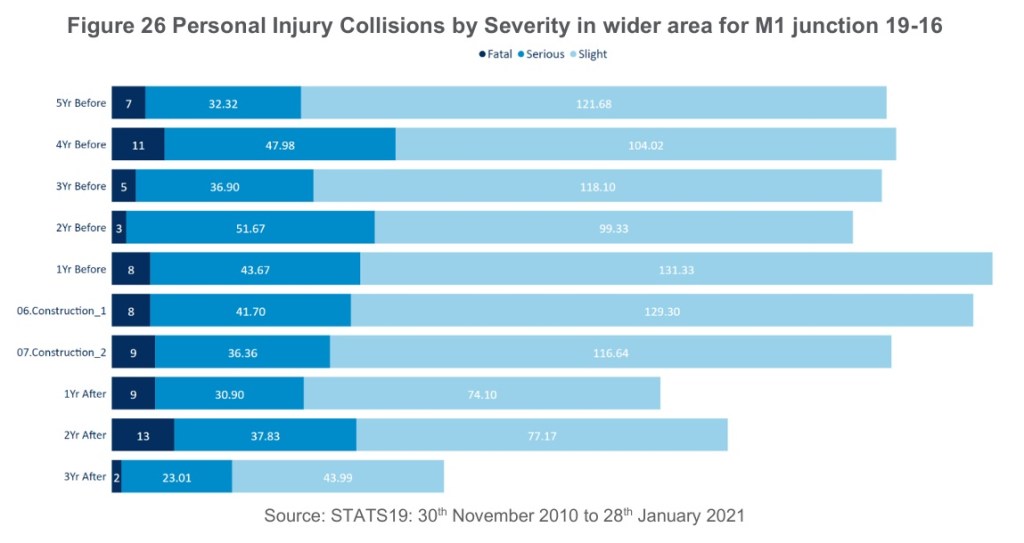
    Significantly, National Highways added that the safety sections “include further analysis of data that is already in the public domain, and which has been reported on by NH in its annual stocktake and safety reports”.

    Unable to resist spinning the findings even in a supposedly objective balancing exercise, National Highways added:

    The POPE reports support the conclusion already drawn that Smart Motorways are amongst the country’s safest roads.

    This is clearly the DfT’s concern – National Highways can amalgamate data to disguise the fact that individual schemes are less safe than they want to admit but POPE reports are at a scheme level.

    Leave a comment

  • National Highways explains suppression of POPE reports

    Highways News has, quite rightly, published a response from National Highways on the issue of the suppressed evaluation reports on smart motorways, and it’s one that subtly makes the case for them to be released.

    Last week, I attended an event at the Department for Transport (DfT), which I have revealed to be sitting on a large number of Post Opening Project Evaluation (POPE) reports on smart motorways, which would reveal their record on issues such as safety, value for money and environmental impact.

    The response from National Highways is I think, pretty much what it told me, but very revealing:

    (more…)