Transport Insights

The transport stories you won't see in the industry-friendly media

Author

Chris Ames

Tag: ris 3

  • RIS 3 will not give the full picture on enhancements cost

    A transport minister has confirmed that we will be kept in the dark about the costs of individual “enhancement” schemes when the next road investment strategy (RIS 3) is published in March, underlining just how little transparency there is about roads spending.

    It follows the Department for Transport (DfT) still refusing to say how much the Structures Fund that it announced in June will actually be worth and how much the four-year budget for local road enhancements will be, even after clarifying that there will be a total of £1bn for both.

    Responding to yet another question from shadow transport secretary Richard Holden – this time about whether the full scheme costs for all projects will be published in the final RIS 3 document – Simon Lighwood said:

    The third Road Investment Strategy (RIS3) will be published in March 2026 and will include a total funding line for all enhancements to the strategic road network to be delivered during the period 2026-2031.

    This does mean that we will be able to judge whether the DfT has put its money where its mouth is over pledges in the draft RIS of “a greater focus than ever before on the maintenance and renewal of the network”.

    Without even a headline figure so far for the cost of enhancements, or even the capital/resource split in the £25bn five-year budget, it is impossible to judge this pledge.

    (more…)
  • National Highways looks to clear funding stream to fund clear streams

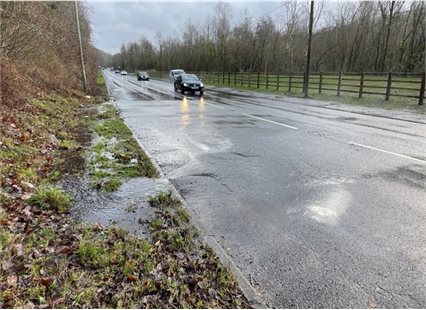
    National Highways is set to be given funding and a clear target to tackle toxic water runoff from its roads under a new-style “National Programme” in the forthcoming road investment strategy (RIS 3).

    The government-owned company is under pressure to tackle the contaminated water that runs off the strategic road network (SRN) into sensitive waterways in particular.

    Last month Parliament’s Environmental Audit Committee (EAC) challenged its chief executive, Nick Harris, on its plans and funding.

    He replied without explanation that it expects to be “funded to do all 250” of the “high-risk” outflows on the strategic road network that it has prioritised for mitigation.

    It has now emerged that water quality will fall under a National Programme for environmental mitigation, as floated in the draft RIS 3 published in August:

    We are considering introducing new National Programmes to deliver defined outputs that support RIS objectives or commitments which are not within other programmes (for example, supporting specific programmes of activity around safety and environmental mitigation).

    The company has since published a Preliminary Design Playbook, produced by consultants and setting out measures to mitigate high-risk outflows.

    In an interview with New Civil Engineer, Stephen Elderkin, director of environmental sustainability at the government-owned company, said:

    Rather than having different design teams coming afresh to each of those locations, given that we’ve now got a national programme, we’ve centralised it.

    He added:

    We take pollution contained in water running off our network incredibly seriously. It can contain heavy metals, hydrocarbons, tyre crumbs and other particulates and without suitable management of that runoff there is a risk of polluting water bodies where it gets discharged into water so this, this matters. It matters for health and it matters for ecosystems; it’s quite an extensive problem.

    (more…)

  • New new dawn for A46 bypass

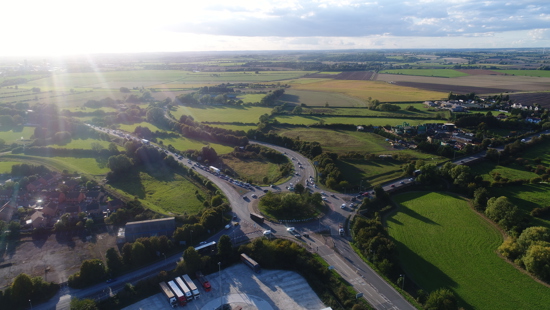
    Ministers have again given the “green light” to the A46 Newark Bypass, although the £500m scheme has no delivery timetable.

    Rail minister Lord Hendy has approved a development consent order for the project, presumably because Labour is doing so little to improve the rail network, apart from not announcing funding for Northern Powerhouse Rail.

    National Highways said the move:

    means the formal green light has been given for the scheme to tackle congestion on a crucial trade corridor through the East Midlands. 

    The Department for Transport also announced in July that it given the green light to the scheme, “which could support thousands of new jobs and homes, if planning approval is granted”. Perhaps that was more of an amber light?

    But a National Highways press release notes that:

    In the coming months, National Highways will work with the Department for Transport (DfT) to identify the most efficient and cost-effective delivery timetables for this project, as part of the process of setting the next Road Investment Strategy. An update on timings will be given next year.

    So, if you are interpreting a green light as saying that the scheme is in a position to go forward, think again.

    Interestingly, in July the DfT told Newark and Sherwood District Council:

    We are currently working with DfT to identify the most efficient delivery times for the A46 Newark Bypass scheme, and these will be published alongside RIS3 in March 2026.

    No mention of cost there. Maybe they need to wait for the money to be genuinely in place.

    Leave a comment

  • Robbing maintenance to pay renewal?

    This week I have made my debut as a columnist in LTT magazine, with an analysis of the draft third Road Investment Strategy, (RIS 3) concluding with the idea that there are a lot of gaps to be filled in.

    Promises of “a greater focus than ever before on the maintenance and renewal of the network” have not, SOFA, been backed with confirmation that asset management will get more money.

    The closest the document comes is a reference to “increased renewals funding” which isn’t even described as increasing in real terms.

    The document states:

    The final RIS strategy will define how this [£25bn] is split between capital and resource expenditure and outline the main categories of spend, including the schemes that will be delivered.

    Operations, Maintenance and Renewals are lumped together in a single section, which begins with a classic lie:

    43% of the RIS2 investment programme focussed on operating, maintaining, and renewing the existing network.

    Yes, £10.8bn of the eventual RIS 2 budget of £24bn was spent on these three things, but money spent on operating the network was resource spending, not investment.

    There is then a statement of the should-does-not-mean-yes variety – an assertion of what is needed without a commitment to actually do it:

    Maintaining a safe and reliable road network depends on a well-funded, carefully coordinated maintenance programme, delivered through a balanced combination of operations, maintenance, and renewals (OMR) activities.

    (more…)

  • Greenwood goes back to the future of roads

    Future of roads minister Lilian Greenwood has been out and about in the Midlands, touting Labour’s decision not to cancel a road building scheme from the second Road Investment Strategy (RIS 2).

    The M54-M6 link road was one of five schemes from RIS 2 that were confirmed by the Department for Transport (DfT) in July, following the spending review, having been subject to the value for money review that the then transport secretary, Louise Haigh, announced a year earlier.

    Apparently forgetting that her own government had called the longstanding scheme into question, Greenwood called it a “no-brainer”. It has also been said that it could be a “game changer” for the region. Other cliches are available.

    Apparently also forgetting that the scheme had been subject to a value for money review, Greenwood said she did not know how much it was going to cost. It was estimated at around £200m in 2019 so the current cost of the blank cheque will be a lot higher.

    According to the BBC, she said:

    We’ve got National Highways working really hard now to finalise the costs, to work out the schedule, to appoint a delivery partner; all that will be confirmed as part of the roads investment strategy that we’ll be publishing before the end of March next year.

    The DfT rather carelessly lost its previous contractor, sorry, “delivery partner”, Bam Nuttall in 2023.

    The four other schemes that the government “confirmed” in July were: A38 Derby Junctions; M60/M62/M66 Simister Island; A46 Newark Bypass; and the A66 Northern Trans-Pennine.

    All were “confirmed” RIS 2 schemes but frozen by Labour so it is giving itself credit for unblocking things it blocked. At least, for once, Greenwood didn’t claim that this was part of its Plan for Change.

    All schemes will be returned to RIS 3 and take up quite a lot of whatever capital funding it includes for enhancements. It was always expected that the “tail” of schemes slipping from RIS 2 to RIS 3 would make up a big chunk of the latter.

    The big picture is that Labour’s future of roads minister has confirmed that the future of roads is a lot of road schemes from the past.

    Leave a comment

  • Puttng lipstick on a pig

    Transport Action Network (TAN) has posted another of its National Highways Watch pieces, with significant input from me, and it has been almost simultaneously vindicated by comments in the draft Third Road Investment Strategy (RIS 3).

    The piece Highway robbery – abusing Designated Funds compares National Highways’ use of designated funds, pictorially at least, to putting lipstick on a pig – i.e. prettifying large and potentially environmentally destructive road building schemes with greenwashing.

    TAN has discovered that National Highways is syphoning off money from a dedicated fund for environmental and safety improvements (called ‘Designated Funds’1) to use it as sweeteners or greenwashing for new roadbuilding schemes. National Highways is also raiding the “ringfenced” funding to pay for mitigation that should come out of the scheme budgets.

    The piece highlights a number of alleged misuses of designated funds, including “sweetening the Lower Thames Crossing”:

    A document on “Benefits and Outcomes” submitted as part of the scheme’s planning application mentions “Designated Funds” 25 times, and claims that “Over £30 million of designated funds have been allocated to Lower Thames Crossing”, despite having to make clear that these benefits technically “fall outside of the remit of the DCO [planning application]”.

    (more…)