Transport Insights

The transport stories you won't see in the industry-friendly media

Author

Chris Ames

Tag: orr

  • DfT confirms funding withdrawn from A1 scheme

    I have a further explanation from the Department for Transport (DfT) on why it doesn’t think that National Highways and the Office or Rail and Road (ORR) misled the public and Parliament when they said the A1 Morpeth to Ellingham scheme would start construction in 2022-23, despite being deprioritised and its funding withdrawn.
    It isn’t really much of an explanation and appears to depend on conflating the suggestion that these bodies should have said the scheme was cancelled (it wasn’t; I didn’t) with what I actually said, which is that they should not have actively pretended it was going ahead within a specific timeframe, when it wasn’t.

    I think the top line is that:

    The claims National Highways and the Office of Rail and Road misled the public are untrue, as the positions they set out were in accordance with the status of ministerial decisions on the projects at the time.

    This depends on pretending that schemes going ahead soon and not (yet) being cancelled is the same thing. In addition: 

    A Spending Review funding allocation is not the same as a project decision; the latter requires specific approval by a Transport Minister. 

    The DfT also says that the scheme remained in the RIS portfolio [which] is reflected in the language used by the National Audit Office (NAO) report in September 2022 and the subsequent National Highways delivery plan.

    It is absolutely true that the scheme remained without funding in the portfolio awaiting a final decision on whether to proceed, as the NAO revealed and as I reported.

    But again, the DfT is trying to pretend that being in the portfolio without funding awaiting a final decision on whether to proceed is compatible with what National Highways said and the ORR also reported, which is that it was going ahead *that year*.

    (more…)
  • National Highways and ORR misled public and Parliament over A1 scheme

    Looking back at what was said in 2022 about the secret decision to shelve the A1 Morpeth to Ellingham scheme, it is quite clear that both National Highways and its regulator misled the public, and both organisations have conspicuously failed to deny that they did so.

    I have previously noted that the Tory government’s decision to withdraw all funding from the scheme after the 2021 Spending Review is cited in a leaked report obtained by the Newcastle Chronicle.

    However, the National Audit Office’s (NAO) November 2022 report cites the scheme as one of two that had been shelved earlier that year:

    In February 2022, DfT formally notified National Highways that two projects on the watchlist had been deprioritised as an outcome of the 2021 Spending Review. These two projects remained in the portfolio awaiting a final decision on whether to proceed but their funding has been removed.

    So to be absolutely clear, between February and November 2022 the A1 Morpeth to Ellingham scheme had no funding.

    Let’s look then at National Highways’ Delivery Plan 2022-2023, which was published pretty well in the middle of that period. Under “Our activities during 2022-23”; it states:

    We will start work on two schemes [including] A1 Morpeth to Ellingham which will upgrade multiple sections of the A1 to dual carriageway to provide continuous high quality dual carriageway from Newcastle to Ellingham, north of Alnwick.

    A pretty unambiguous pledge to start work on a scheme that had no funding and unarguably a direct lie but National Highways has not responded to my request for explanation or comment.

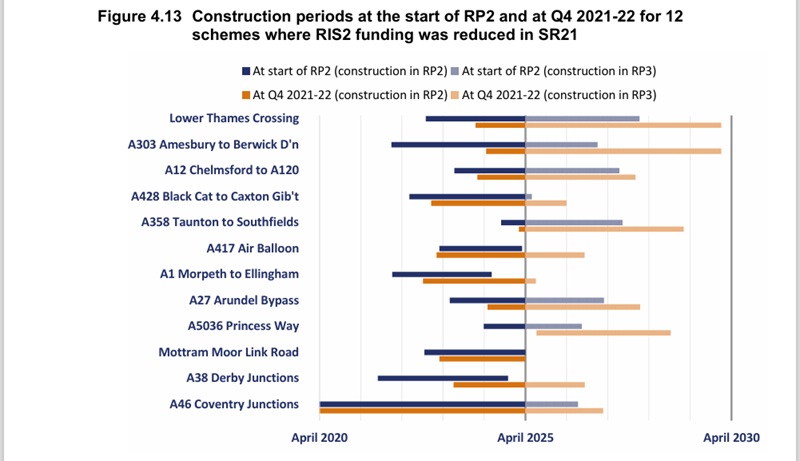
    Similarly the Office of Rail and Road’s (ORR) Annual Assessment of National Highways’ performance April 2021 to March 2022, “Presented to Parliament pursuant to section 10(8) of the Infrastructure Act 2015” and “Ordered by the House of Commons to be printed on 14 July 2022” lists the scheme as one of “12 schemes where RIS2 funding was reduced in SR21”.

    So already the public and Parliament are being misled by the ORR’s description of the scheme as having had its funding “reduced”, rather than outright withdrawn.

    To make matters worse, the ORR then presented Parliament with a graphic (above) showing the construction period for the scheme beginning in 2022-23.

    It then falsely claimed that the scheme was “currently forecasting spend of £255m against a RP2 baseline of £39m”. The scheme was not currently forecasting any spend as it was unfunded.

    (more…)

  • ORR determined to hide the truth about A1 scheme cancellation

    I have a response – of sorts – from the Office of Rail of Road (ORR) on the question of what it knew about the secret decision to shelve the A1 Morpeth to Ellingham scheme. It’s a response that shows the regulator to be unable or unwilling to be straight with the public.

    To recap, last week the Newcastle Chronicle reported, based on a leaked Department for Transport report, that:

    …during the 2021 Spending Review the funding for the scheme was “withdrawn” and the plan was “deprioritised”. The report adds: “The funding decision was not made public, but we instructed National Highways to cease work on the scheme.”

    Rather than answer my question about what and when it was told about the decision to shelve the scheme during a time when its dashboard continued to show it as a live scheme, the regulator told me:

    “ORR’s enhancements reporting showed the delays for some enhancement schemes, including the A1 Morpeth to Ellingham scheme. The detail of ongoing governmental policy decisions is not something that ORR can include in regulatory reporting of National Highways’ performance.”

    Dismissing the shelving of a scheme and the withdrawal of funding as part of ongoing governmental policy decisions is as worrying as it is disingenuous.

    Is the ORR telling us that live National Highways enhancement schemes listed in a road investment strategy that is intended to provide certainty are quietly shelved all the time while it pretends that they are merely “delayed”?

    If this is true and the ORR is constantly hiding such developments from the public, it is even more pointless as a regulator than I thought it was.

    I have reminded the ORR of my original question, which it can only delay answering because of the Freedom of Information Act.

    Leave a comment

  • How National Highways planned to fail on safety

    Returning to the subject of National Highways’ pledge to carry out 43 “additional” actions during 2024-25 to improve its failing safety record, a raft of recent documents from the company and its regulator suggest that it *might* have spent more money on the issue, but there remains no confirmation on either point.

    To recap, according to the Office of Rail and Road (ORR), National Highways’ enhanced safety plan, which both bodies have continued to hide from the public, was said to have included 43 additional actions for the year: 24 road safety schemes, eight communications campaigns, and 11 ‘working with others’ actions. Only 33 were delivered during the year and almost all of the undelivered actions were road safety schemes.

    Both organisations said these actions, in a plan delivered in March 2024, were “additional” to the company’s 2024-25 delivery plan, which was published a year later and did not list specific actions.

    I calculated that during the first four years of the second (2020-25) roads period, National Highways had spent £105.8m from its Safety and Congestion designated fund, leaving around £34m to be spent of the £140m five-year budget against a projected “investment” of £27m in the delivery plan.

    In its Annual Report and Accounts for the year, the company, claimed to have “invested” £41.3m in around 160 projects improving safety or congestion. When added to the existing spend, this corresponds with the £147m “spend” in the ORR’s “efficiency and finance” report for RIS 2, although the ORR may have included cost of schemes that have not been completed.

    So National Highways *may* have spent more over the year than it claimed *as the year ended* to have intended to spend and appears to have overshot its RIS 2 budget of £140m.

    Its annual report says that with cuts for designated funds, there was “an exercise to prioritise those schemes contributing to corporate and legislative targets and commitments”. This appears to have led to a boost to the Safety and Congestion fund via by a raid on the Users and Communities fund and National Highways *may* have focused the Safety and Congestion fund more on safety and congestion.

    But there is no real evidence that this happened and National Highways has never said how many of its Safety and Congestion fund were safety and how many were congestion.

    (more…)

  • Unpicking National Highways’ environmental record

    The Office of Rail and Road’s (ORR) Annual Assessment of National Highways’ performance: end of the second road period April 2020 to March 2025 has details of the company’s performance against KPIs on environmental issues and it’s a bio-diverse picture to say the least.

    Cutting corporate carbon emissions is one KPI where the company has failed and failed badly; it’s also a measure where I have been tracking the moving of the goalposts for sometime, and have indeed contributed to the moving of the goalposts.

    In 2023 I reported that the company was claiming to have a mechanism for reporting against its target of a 75% cut against a 2017-18 baseline that amounted to a one-way bet. The expected cut was mainly because the expected decarbonisation of electricity from the grid.

    National Highways claimed to have reached a backroom deal with the government whereby its emissions were based on forecasts of the carbon intensity of electricity, even if they had been proved wrong.

    This was news to the government and a few months later it announced that the calculation methodology would remain based on actual emissions, but the target would be reduced to a 67% cut. It said this wouldn’t make the easier to achieve, which was an interesting spin to say the least.

    The latest ORR report notes that last year the government reduced the target again – to 56%. But…

    At the end of RP2, National Highways achieved a 51% reduction in its corporate carbon emissions compared to the baseline. Therefore, the company did not meet this KPI target of a 56% reduction for the road period.

    And the ORR notes that it challenged National Highways to speed up its move to LED lighting but it refused. So it ended up with a 51% cut against an original target of 75%.

    (more…)

  • ORR covers for National Highways’ failure…again

    National Highways delivered just three quarters of the actions in its secret “Enhanced Safety Plan” for the final year of the 2020-25 roads period (RP2) but its regulator has again claimed that the company is “doing everything that it can” to “try and meet” its casualty reduction target, which it is likely to miss badly.

    The Office of Rail and Road’s (ORR) Annual assessment of National Highways’ performance – April 2024 to March 2025 includes a short section on road safety in which it appears to have once again moved the goalposts to spare National Highways’ blushes.

    The ORR’s (third) Annual assessment of safety performance on the strategic road network, published in March stated:

    National Highways’ enhanced safety plan set out 43 actions that the company would take to improve safety in the final year of RP2. These actions are in addition
    to its existing commitments to improve safety that are set out as part of RIS2, and within annual delivery plans.

    It revealed that by the end of January/February it had delivered just 22, comprising five road safety schemes, eight communication campaigns and nine ‘working with others’ actions.

    The new report discloses that:

    At the end of March 2025, the company had delivered 33 actions of the 43 actions that were included in its enhanced safety plan. It plans to deliver eight more by the end of 2025, with one scheme removed from the plan following objections from a local authority. The remaining action is related to the Roads Policing Review and will be taken forward once government publishes its response to the review.

    Despite promising to “hold National Highways to account” for delivery of this plan, the regulator praises its efforts:

    We consider that, in 2025, the company is doing everything that it can in the final year to try and meet the target…

    There is a clear sleight of hand from the regulator in redefining the year that it is talking about, from the final year of RP2 (i.e. 2024-25) to “the final year” of the calendar year 2025, by the end of which serious casualties should be down by a half.

    However, further to my post earlier today, the ORR seems to have dropped the claim that the 43 actions were “additional” to existing plans. I have asked it if it now accepts that it cannot verify this.  

    Leave a comment

  • Lax ORR fails hold National Highways to account

    All five road safety schemes that National Highways actually delivered under its “enhanced safety plan” for the last year of the second roads period fell under an existing safety programme, with no evidence that they were “beyond its previously planned activities”, as required by the company’s regulator.

    But the Office of Rail and Road (ORR), which demanded that the company produce the “enhanced plan” to address its poor casualty reduction record, failed to carry out any checks to ensure the actions were genuinely additional.

    In fact, both the company and the regulator have insisted (without evidence) that the actions in the enhanced safety plan, which was given to the ORR in March 2024, were “additional” to National Highways’ 2024-25 Delivery Plan Update, which was not published until this March and does not list specific activities.

    National Highways appears to have actually cut the funding available for safety improvements at the end of the whole 2020-25 roads period, including the year covered by the plan.

    The disclosure casts further doubt on the competence of the ORR and its willingness to hold National Highways to account, as it claims to do, after it refused to publish the plan but praised the company for “doing everything it reasonably can” to address its failing safety record.

    (more…)

  • ORR spins the cuts to Network Rail

    I’ve been reading the Office of Rail and Road’s (ORR) Annual assessment of Network Rail 2024 to 2025 alongside the ORR’s press release on that and other reports on the rail industry and it seems as if the ORR is trying to spare the government’s blushes.

    The annual assessment, which is the ORR’s review of Network Rail’s performance during the first year of the five-year control period 7 (CP7), says up front:

    As we noted in our final determination for CP7, funding is constrained, reflecting wider fiscal conditions. In planning for this control period Network Rail has had to make choices about how expenditure should be prioritised to deliver best value for the railway now and in the future. Constrained funding means that Network Rail will be spending less on renewals and more on life-extending repairs and maintenance in CP7 than in CP6. As such, Network Rail forecasts a small reduction in the residual life of its assets, which will require effective risk management activities to be identified and implemented.

    As a result our monitoring of Network Rail for this control period is focussed on these risks, which if not effectively managed could result in a deterioration of train service performance in the latter part of the control period, will make delivering train performance very challenging for Great British Railways in the next funding period, and will lead to inefficient spend on infrastructure in the future.

    The closest the press release comes to addressing this is an opaque quote from chief executive John Larkinson:

    (more…)
  • A1 cancellation lies – who knew what when?

    Local news outlets in the North East are reporting a potentially huge scandal over a recently cancelled National Highways scheme, with a shocking tale of deceit potentially involving the government-owned company, the previous (Tory) government and the Office of Rail and Road (ORR).

    The Newcastle Chronicle reports that:

    Department for Transport staff were ordered to stop working on plans to dual the A1 in Northumberland back in 2021 – three years before it was approved by the Conservative Government, leaked documents have revealed. 

    And:

    …during the 2021 Spending Review the funding for the scheme was “withdrawn” and the plan was “deprioritised”. The report adds: “The funding decision was not made public, but we instructed National Highways to cease work on the scheme.”

    In another twist on this story, the Chronicle notes that the scheme was included in the Network North announcement following the cancellation of the northern leg of HS2.

    This goes some way to explaining something that baffled me at the time. In October 2023 I reported that:

    …the A1 scheme is described in the current RIS programme as a ‘committed’ scheme. As part of the process of seeking a development consent order (DCO), National Highways submitted a document to the Planning Inspectorate (PINS) asserting that the scheme was funded.

    However, as Highways has reported, the scheme has been held up by repeated delays from ministers. So far there remains an unpublished recommendation from PINS.

    In its annual assessment of National Highways 2022-23, the Office of Rail and Road noted that the scheme should have started work during that year but was delayed by ministers’ postponement of the DCO decision.

    (more…)

  • DfT doubles down on planned publication

    National Highways’ delivery plan and safety action plan for the current financial year will be published this month, the Department for Transport (DfT) has told me.

    The government-owned company’s Interim Settlement for the current year, during which no road investment strategy is in place, states that to support progress towards achieving its December 2025 casualty reduction target “National Highways must deliver a series of safety improvements set out in its Safety Action Plan for 2025/26”.

    The safety action plan has not been published, but in May roads minister Lilian Greenwood told fellow Labour MP Ruth Cadbury, who is chair of the Transport Select Committee, that it “will form part of National Highways 2025-26 delivery plan for the Interim Settlement which will be published in the coming months”.

    I have requested the plan under the Freedom of Information Act from the DfT, National Highways and the Office of Rail and Road but each refused my request on the spurious grounds that a document that was not produced for publication is intended for future publication alongside another document.

    In response to a review request, the DfT has now told me: “We expect the requested information to be published in July 2025.”

    (more…)