
With the third Road Investment Strategy (RIS 3) due imminently, does the latest safety report from National Highways’ regulator give any reliable hints about what the government-owned company will be expected to do to improve the inherent safety of its roads?
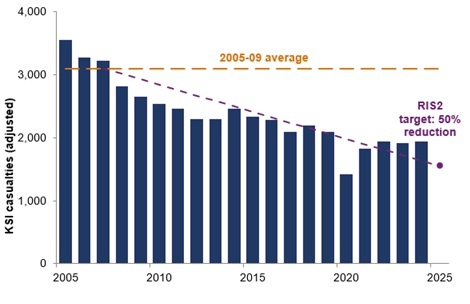
While the Office of Rail and Road (ORR) seems to be on a mission to give National Highways a free pass as it fails badly to meet its safety targets, its recent annual assessment of safety performance on the strategic road network suggests that National Highways is planning to make at least some improvements.
iRAP star rating provides an objective measure of the level of ‘built-in’ safety for vehicle occupants, motorcyclists, cyclists and pedestrians. It uses star ratings on a five-point scale, where a 1-star rating reflects a high-risk road with little safety infrastructure, while 5-star indicates a road with minimal risk, designed for safety.
As part of our work to assess National Highways’ approach to improving safety we asked the company to demonstrate how it uses iRAP assessments to inform the development of safety interventions on the SRN. We have reviewed case studies and evidence the company has used to develop schemes currently in feasibility and design stages, for potential delivery in road period 3 (RP3).
The report concludes:
The evidence provided shows that National Highways is applying iRAP analysis to existing 1- and 2-star routes to identify the interventions most likely to improve safety outcomes. These include measures such as improved lane delineation, enhanced signing, pedestrian and cyclist safety improvements, speed management and access control (where road users join the SRN from local or other major roads). The aim of these interventions is to raise the star rating of the route and reduce the predicted number of KSI casualties over time.
A cynic like me might think identifying potential interventions is pretty meaningless unless there is a chance of delivering them.
But the flipside of this is that both the company and its regulator must have some expectation that resources will be provided in RIS 3 for this purpose.
The problem is that the draft RIS 3, published in the summer, is so vague.
Let’s start with what National Highways said in its 2023 Initial Report for the RIS that was due to start in 2025 until the new government put it back a year:

 Transport Insights
Leave a comment