Transport Insights

The transport stories you won't see in the industry-friendly media

Author

Chris Ames

Tag: funding

  • Exclusive: DfT, NH, ORR caught in Weekend at Bernie’s scam

    I have obtained another document about the secret shelving of the A1 Morpeth to Ellingham scheme that amounts to something of a smoking gun, showing that both National Highways and its regulator deliberately hid from Parliament that fact that the scheme had been “paused” as well as defunded.

    To recap, the Treasury secretly defunded and deprioritised the scheme in the (late) 2021 Spending Review and told the government-owned company and the Office of Rail and Road (ORR) this in February 2022.
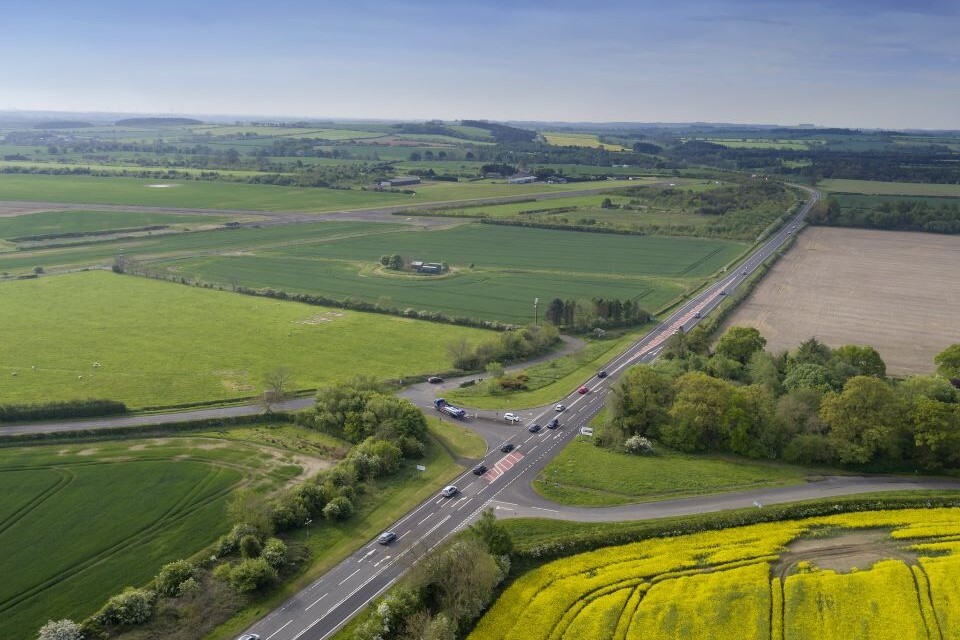
    Despite this, both organisations said in reports presented to Parliament in July 2022 that the scheme would go ahead in the financial year 2022-23.

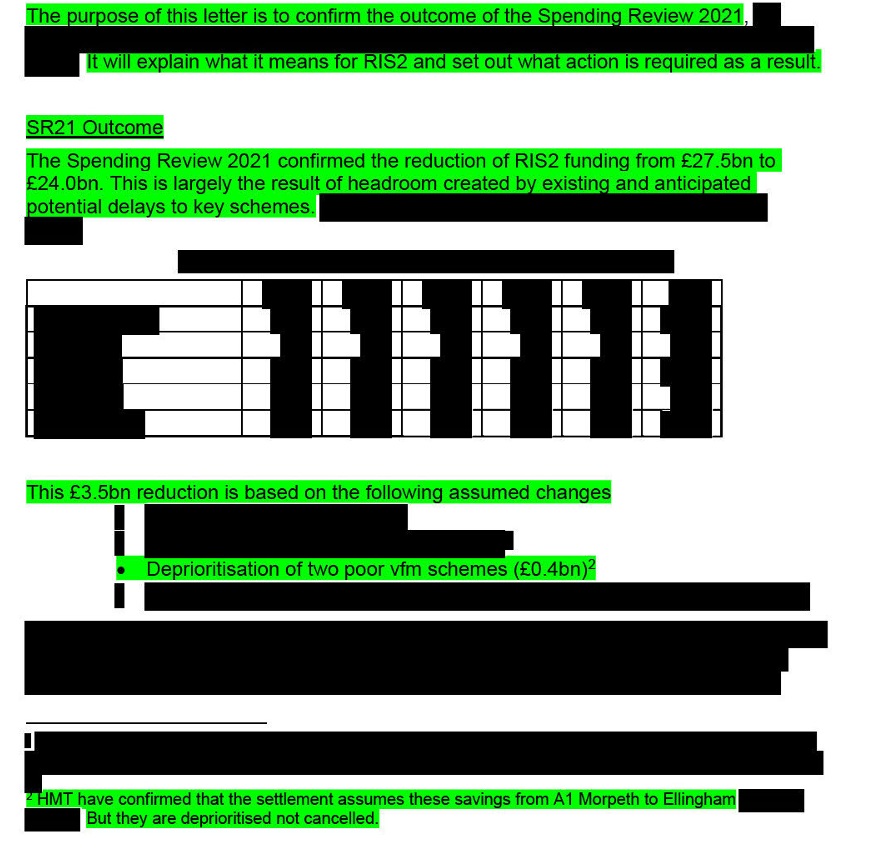
    The new document is a Department for Transport (DfT)/ National Highways “change control” form on the subject of a funding change for the 2020-25 Roads Period (RP2) to formalise the outcome of the Spending Review, which overall saw the company’s budget cut from £27.4bn to £24bn.

    The document makes clear that the A1 scheme was “paused” which is obviously incompatible with the claim in National Highways’ 2022-23 Delivery Plan that works would start that year. The ORR repeated this lie in its annual assessment 2021-22.

    The document also makes clear that the scheme had been “deprioritised with no further development funds”. It further states:

    The SR21 settlement includes pausing the development of two schemes with poof VfM. These will be dealt with as separate change control submissions, the timing and communication of which will have to be carefully timed with any broader announcements in response to TSC or Union Connectivity reports and any DCO process considerations.

    (more…)

  • Robbing maintenance to pay renewal?

    This week I have made my debut as a columnist in LTT magazine, with an analysis of the draft third Road Investment Strategy, (RIS 3) concluding with the idea that there are a lot of gaps to be filled in.

    Promises of “a greater focus than ever before on the maintenance and renewal of the network” have not, SOFA, been backed with confirmation that asset management will get more money.

    The closest the document comes is a reference to “increased renewals funding” which isn’t even described as increasing in real terms.

    The document states:

    The final RIS strategy will define how this [£25bn] is split between capital and resource expenditure and outline the main categories of spend, including the schemes that will be delivered.

    Operations, Maintenance and Renewals are lumped together in a single section, which begins with a classic lie:

    43% of the RIS2 investment programme focussed on operating, maintaining, and renewing the existing network.

    Yes, £10.8bn of the eventual RIS 2 budget of £24bn was spent on these three things, but money spent on operating the network was resource spending, not investment.

    There is then a statement of the should-does-not-mean-yes variety – an assertion of what is needed without a commitment to actually do it:

    Maintaining a safe and reliable road network depends on a well-funded, carefully coordinated maintenance programme, delivered through a balanced combination of operations, maintenance, and renewals (OMR) activities.

    (more…)

  • DfT makes no promises over National Highways runoff clean-up

    The government has, unsurprisingly, failed to back National Highways chief executive Nick Harris’ optimism that it will fund the company’s plans to clean up its “very worst locations” for water pollution.

    Yesterday, Harris was asked at the Environmental Audit Committee about National Highways plan to “mitigate” by 2030 what it now estimates to be around 250 high risk outfalls and soakaways – where toxic road runoff runs off into watercourses and the environment generally.

    What certainty did he have that this would be funded in the third Road Investment Strategy (RIS 3)? Well, he was “proceeding on the basis that we will be funded to do all 250”.

    Naturally I asked the Department for Transport whether it could clarify this.

    It has responded with little more than a confirmation that the RIS 3  document will be published in March (which is a surprise as the draft said “no later than” March rather than giving a specific month) with its funding and what is expected of it only made clear at that point.

    What we know is that National Highways will have nearly £25bn over five years, with no clarity on how much of this will be capital and how much “resource” or how much will be spent on enhancements or maintenance, renewals or operations. There may or may not be a designated fund for the environment, and perhaps something else called a national programme.

    Is Harris simply engaging in wishful thinking, or does he know something we don’t?

  • Up to its old tricks: DfT conceals local road upgrade budget

    The Department for Transport (DfT) has confirmed that there is a budget for local road upgrades in England for the next four years but has refused to say what that budget is.

    The secret fund will pay for two categories of local authority upgrade – the Major Road Network (MRN) and Large Local Majors (LLM), which previously fell under a funding stream called the National Roads Fund (NRF) that also included National Highways’ funding.

    A DfT spokesperson has effectively confirmed that the NRF no longer exists but did refer to an MRN/LLM programme.

    Using the Freedom of Information Act, I asked the DfT what the individual or combined budgets were for the MRN and LLMs for the period covered by the Spending Review, which is up to and including 2029-30. It implicitly confirmed that this information exists by explicitly refusing to provide it.

    The DfT may be following a tried and tested PR strategy of announcing a large headline figure and then the smaller allocations within that – effectively re-announcing the same cash as it did this week. But it may be that the total budget is never stated.

    The DfT previously told me that the MRN/LLM funding falls under the £24bn capital funding for strategic and local roads up to 2030 that was announced in the spending review, with further announcements “in due course”.

    The government has since announced that the third Road Investment Strategy (RIS 3) will get nearly £25bn up to 2031. A large proportion of this will come from the £24bn, although not all of the cash for the RIS will be capital funding. Nearly 70% of the “interim settlement” of £4.8bn for the current year is capital.

    (more…)

  • It’s not investment; it’s spending

    The Department for Transport (DfT) has managed to pull off two of its favourite tricks in an announcement this morning, re-announcing funding and labelling it “investment” when it’s day-to-day.

    Millions of people across the country will have greater access to jobs, education and public services thanks to a £104 million government funding boost, which will be shared with communities outside England’s major cities.

    The gist of the story is that the DfT has confirmed the Local Transport Grant (LTG) resource allocations that English councils outside city regions will receive for the next three years, with the headline figure of £104m having been announced in the Spending review.

    So, despite claims that the cash is a “boost”, it’s the deceitful labelling of the continuation of an existing funding stream as extra cash.

    There is a small amount of extra cash for a small number of councils from 2027, but this comes on the back of previous freezes, which continue into 2026-27.

    The annual total of £28m next year is therefore the same as this year, and the year before, with £38m a year after that.

    (more…)
  • Greenwood goes back to the future of roads

    Future of roads minister Lilian Greenwood has been out and about in the Midlands, touting Labour’s decision not to cancel a road building scheme from the second Road Investment Strategy (RIS 2).

    The M54-M6 link road was one of five schemes from RIS 2 that were confirmed by the Department for Transport (DfT) in July, following the spending review, having been subject to the value for money review that the then transport secretary, Louise Haigh, announced a year earlier.

    Apparently forgetting that her own government had called the longstanding scheme into question, Greenwood called it a “no-brainer”. It has also been said that it could be a “game changer” for the region. Other cliches are available.

    Apparently also forgetting that the scheme had been subject to a value for money review, Greenwood said she did not know how much it was going to cost. It was estimated at around £200m in 2019 so the current cost of the blank cheque will be a lot higher.

    According to the BBC, she said:

    We’ve got National Highways working really hard now to finalise the costs, to work out the schedule, to appoint a delivery partner; all that will be confirmed as part of the roads investment strategy that we’ll be publishing before the end of March next year.

    The DfT rather carelessly lost its previous contractor, sorry, “delivery partner”, Bam Nuttall in 2023.

    The four other schemes that the government “confirmed” in July were: A38 Derby Junctions; M60/M62/M66 Simister Island; A46 Newark Bypass; and the A66 Northern Trans-Pennine.

    All were “confirmed” RIS 2 schemes but frozen by Labour so it is giving itself credit for unblocking things it blocked. At least, for once, Greenwood didn’t claim that this was part of its Plan for Change.

    All schemes will be returned to RIS 3 and take up quite a lot of whatever capital funding it includes for enhancements. It was always expected that the “tail” of schemes slipping from RIS 2 to RIS 3 would make up a big chunk of the latter.

    The big picture is that Labour’s future of roads minister has confirmed that the future of roads is a lot of road schemes from the past.

    Leave a comment

  • Don’t look to Labour to fix smart motorways

    The draft of the third Road Investment Strategy (RIS 3) published this week suggests that ministers are happy with a smart motorway network where many places to stop in an emergency are officially too far apart, putting drivers at increased risk.

    In November 2021, the Transport Select Committee recommended that:

    The Department and National Highways should retrofit emergency refuge areas to existing all-lane running motorways to make them a maximum of 1 mile apart, decreasing to every 0.75 miles where physically possible.

    The Department (for Transport – DfT) accepted this recommendation in principle and in January 2022 announced that £390m would be spent by the end of March 2025 to retrofit “more than 150 additional emergency areas”, alongside a pause on the construction of new all lane running smart motorways.

    The waters were muddied when it emerged that National Highways was counting other places to stop towards the spacing standard, but the company did deliver a promised 151 new emergency areas by the end of March under the National Emergency Area Retrofit (NEAR) programme.

    Although this was said to provide “around a 50% increase in places to stop”, neither the DfT nor National Highways ever said how far the programme would go to fill in all the gaps where the spacing was longer than the official standard.

    National Highways has told me that it had  “prioritised locations where emergency areas could make the most difference and bring benefits to drivers as soon as possible” and suggested that it would like to see a continuation of the programme.

    Labour delayed the start of RIS 3 by a year and gave the company an interim settlement for the current year that says nothing about improving safety on smart motorways.

    In a section on Smart Motorways, the draft RIS 3 document claims that “substantial investment continues to improve the safety of the existing network” citing “the recent completion of additional Emergency Refuge Areas on the All Lane Running (ALR) smart motorways under the National Emergency Areas Retrofit (NEAR) programme”, which it acknowledges “was finished in March 2025” – a whole year before the new RIS.

    There is no commitment to continuing the retrofit of what Labour has now returned to calling “Emergency Refuge Areas”, which leaves National Highways with a spacing standard that it is not funded to deliver.

    (more…)

  • Has the draft RIS taken a sledgehammer to local road funding?

    An obvious point to make about the draft of the 3rd Road Investment Strategy (RIS 3) is that it looks set to gobble up almost all of the £24bn announced by Rachel Reeves in the spending review, with the local network getting around £1bn a year.

    Let’s start with the spending review:

    Providing £24 billion of capital funding between 2026-27 and 2029-30 to maintain and improve motorways and local roads across the country. This funding increase will allow National Highways and local authorities to invest in significantly improving the long-term condition of England’s road network, delivering faster, safer and more reliable journeys;

    The draft RIS 3 sets a total funding envelope of £24.98bn up to and including 2030-31. Assuming that this is approximately £5bn a year, that makes £20bn up to 2030, leaving just £4bn to maintain and improve local roads across the country.

    Even before you get into funding for improvements under the Major Road Network and Large Local Majors funding stream(s), this isn’t even enough to fund the current level of £1.6bn a year for local road maintenance.

    On the other hand, we don’t know how much of the RIS funding will be capital and how much resource.

    Leave a comment

  • Exclusive: ORR knew shelved A1 scheme had been defunded

    I have obtained new documents showing that National Highways’ regulator knew the government had removed funding from a large roadbuilding scheme and was hiding this from the public and Parliament. The regulator then falsely reported that the scheme would go ahead when it got planning permission.

    By doing this, the Office of Road and Rail (ORR) – supposedly an independent watchdog – became complicit in the deception over the shelving of the A1 Morpeth to Ellingham scheme, which has undermined parliamentary oversight of the government-owned company’s operation and development of the strategic road network.

    As has previously been reported, the Department for Transport (DfT) told National Highways in February 2022 that the A1 scheme had been deprioritised and its funding removed following the Spending Review in late 2021.

    Despite this, both National Highways and the ORR published reports and presented them to Parliament claiming that the scheme would enter construction in the 2022-23 financial year.

    I have now obtained correspondence between the DfT and National Highways from February 2022, which was copied to the regulator, showing not only that a cut to the company’s funding included a saving from not progressing the A1 scheme but that a deliberate decision had been taken to keep the public and Parliament in the dark about the scheme being shelved.

    A letter from a senior DfT official to National Highways’ chief financial officer notes that:

    No public announcement was made about the A1 Morpeth to Ellingham [and another redacted scheme]. Plans will be drawn up for communications about the A1 Morpeth to Elllingham, but for the time being it remains a committed scheme recognising that costs will continue to accrue pending a decision.

    (more…)

  • Watt achievement?

    Labour, to its credit, is cracking on with the Transpennine Route Upgrade (TRU), filling gaps left by the Tories, but looks like it may be falling into the Tory habit of making unfunded promises when it comes to Northern Powerhouse Rail.

    A couple of weeks ago ministers and Network Rail announced that the latest stretch of the TRU, between Church Fenton and York, had been completed on time and on budget, allowing an electrified passenger train to run between the two.

    Network Rail said:

    This achievement means that 25% of the 70-mile Transpennine main line is now electrified, laying the foundations for a faster, greener and more reliable railway between Manchester, Huddersfield, Leeds and York once complete.

    It is an achievement but means that TransPennine Express will continue to run (mainly) bi-mode Nova 1 (class 802) trains along the route, running on diesel for the 75% that is not electrified, and carrying both diesel engines and electric motors, which is hardly efficient or environmentally beneficial.

    (more…)