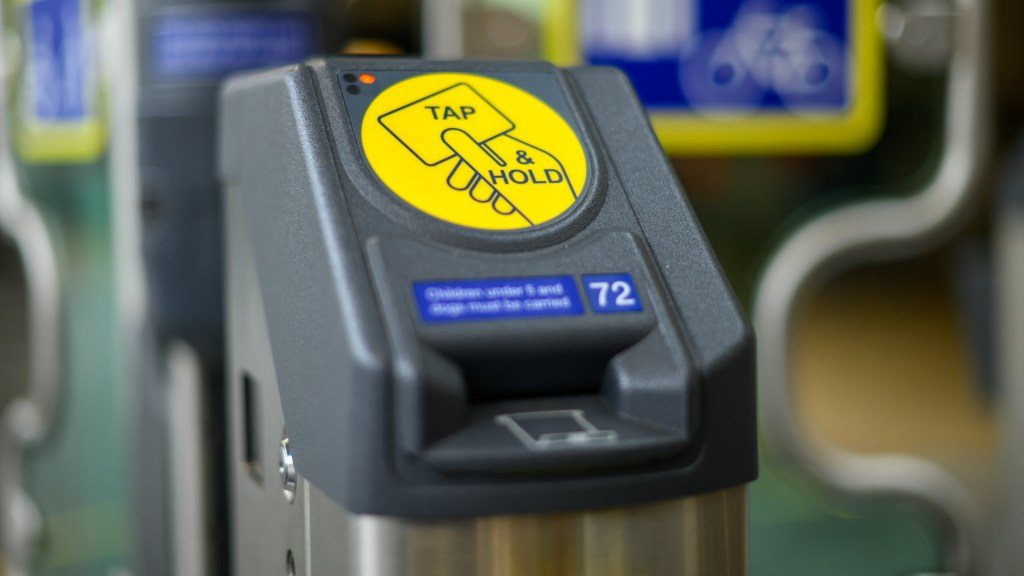
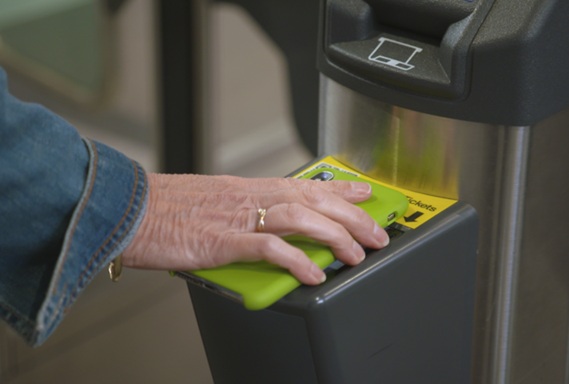
Transport Insights

The transport stories you won't see in the industry-friendly media

Author

Chris Ames

Tag: contactless

  • DfT pays as it goes nowhere fast

    I’ve had an update from the Department for Transport (DfT) on what its next (planned) steps are over the delayed rollout by Transport for London (TfL) of contactless pay as you go (PAYG) to 233 rail stations outside the capital – and it’s not getting better any time soon.

    The DfT has told me that its partnership with TfL and Network Rail has successfully delivered PAYG at just 103 stations in and around the South East – and that’s with the 233 due by 2024.

    That was the figure I had on Friday.

    The DfT said it continues to work on expanding the technology to new stations and that 52 new stations will go live in 2027, with details on future delivery “in due course” – that old bureaucratic phrase for we can’t/won’t say just now.

    But it does look as if by 2027 they mean early in the year:

    This Government’s £156 million investment in PAYG contactless schemes means that by spring 2027, Pay as You Go will be available at over 140 more stations across Greater Manchester, the Midlands and the South East.
    This claim combines attempts to roll out contactless PAYG in three separate parts of England, i.e. adding Project Oval in the South East with schemes in Greater Manchester and the Midlands under what is now called Project Coral.

    Adding the 52 to 17 planned in Greater Manchester and 75 in the West Midlands will indeed give you something slightly north (sorry) of 140.

    But is it “This Government’s £156m investment”? Actually it was the last government, or the last but one if you include Starmer.

    The DfT’s £68,100,000 contract award to TfL for Expanding Pay As You Go on Rail in the South East was reported in 2021, while the rollout in Greater Manchester and the Midlands was announced in February 2024.

    I suppose if you consider that it is the current government that is paying as it goes along…
    Leave a comment

  • Rail delivery shambles continues

    The shambles that is the rollout of contactless payments to rail stations in the South East outside London continues with a programme that should have been completed two years ago still less than half way through and no confirmation of the next steps.

    I have been reporting this issue for years and it’s going from worse to worser.

    In January of 2025, I reported that the delayed delivery of contactless to 47 stations the following month was due complete the first phase (53 stations) of a programme covering a total of 233 stations.

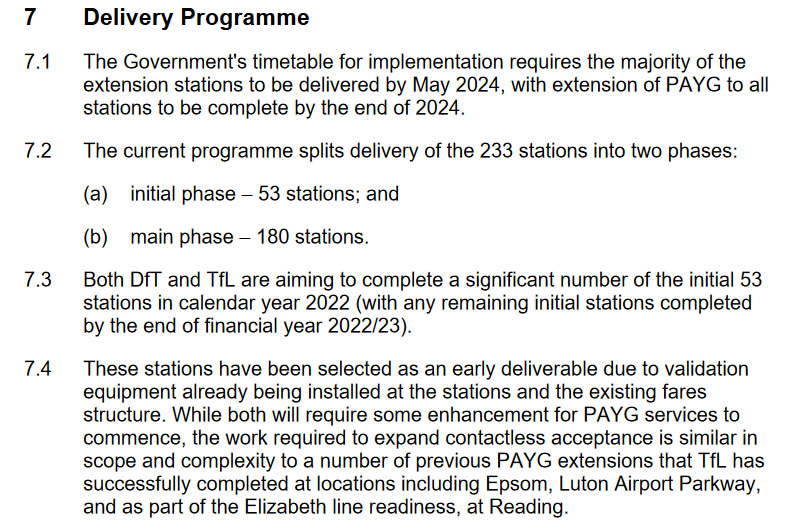
    This first phase was due to have been done by the end of the 2022-23 financial year, with a revised date of December 2023, with the remaining 180 stations upgraded by the end of 2024.

    This is all based on a paper from Transport of London (TfL), which is delivering the programme as it depends on its technology.

    By November 2025, the DfT was promising the delivery of 50 more stations the following month, but was unable to give a completion date for the programme, although it did say that it expected to announce further stations for delivery mid 2026 “in due course”.

    But the following month the Rail Delivery Group (RDG) reported:

    From 14 December 2025, pay as you go (PAYG) with contactless cards and devices will be available to customers at another 30 National Rail stations in South-East England.

    PAYG contactless will be rolled out to a further 20 stations, including Stansted and Southend airports, on Greater Anglia route during Summer 2026 after issues were identified in testing.

    The following explanation was given:

    (more…)

  • Hendy: Our PAYG upgrade is long overdue

    There’s more good news, bad news on the rail ticketing front with Greater Anglia adding contactless technology to the 20 stations that were due to get it at the end of last year but which were put back to the summer.

    But, although the delay isn’t as bad as it was predicted to be, the whole programme to spread Transport for London’s (TfL) pay as you go (PAYG) beyond London is still years behind and less than halfway complete.

    Out of 233 stations that should have had the technology by the end of 2024, only 103 have now been delivered by TfL.

    Rather embarrassingly for rail minister Lord Hendy (who used to head TfL), he keeps saying the same thing about the upgrade being long overdue, even as he tries to sing its praises.

    In November, it was announced that 50 stations would go live the following month – the first tranche of a second phase. Hendy said:

    Rail ticketing is far too complicated and long overdue an upgrade to bring it into the 21st century.

    In December, it was announced that only 30 stations had been delivered:

    PAYG contactless will be rolled out to a further 20 stations, including Stansted and Southend airports, on Greater Anglia route during Summer 2026 after issues were identified in testing.  

    These are the 20 stations that have now had the technology implemented. Hendy said:

    Rail ticketing is long overdue an upgrade to bring the rail network into the 21st century.

    He is surprisingly frank on this: the upgrade is long overdue and, as I reported in November, there is no target date for adding the remaining 130 stations.

    Leave a comment

  • As you were

    It’s a sign of how desperate the government is for good news that today the Department for Transport (DfT) has issued a press release in which the prime minister claims that not putting up rail fares “will put more money in working people’s pockets”.

    It is indeed good news that fares have not gone up at the beginning of this month and if the DfT says this is the first freeze for 30 years, I am happy to believe them, although they seem to be happier pointing to increases under the Tories than last year’s increase.

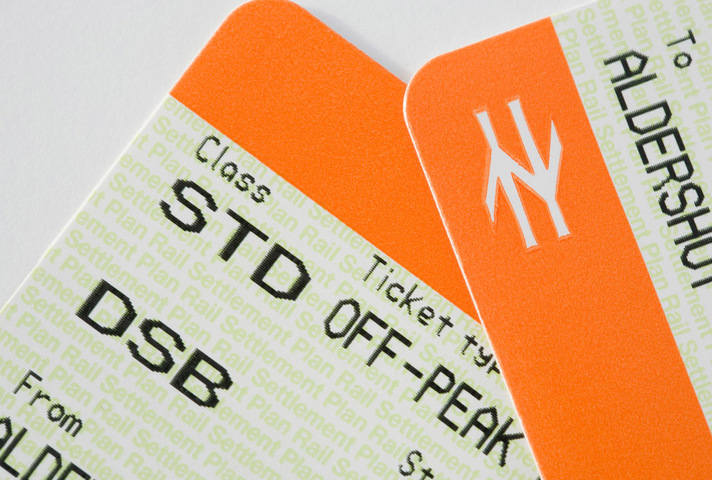
    British rail tickets for Standard off-peak travel day return for disabled. Image shot 11/2008. Exact date unknown.

    Here’s what Keir Starmer is claimed to have said:

    This freeze – the first since the 90s – will put more money in working people’s pockets. By keeping costs down we are making journeys more affordable for millions of people – putting train travel back into the service of passengers, not profits.

    I’m not sure how not charging people more is actively putting money in their pockets and of course the government takes the revenue risk on rail fares under National Rail Contracts.

    Meanwhile, the DfT says:

    With transport costs making up 14% of household spending, this cost-cutting move is providing real savings for passengers

    This is true but a bizarre thing to say all the same. Transport costs may make up 14% of household spending but rail fares could be as low as 1% of spending in the average household.

    It’s also quite funny that the DfT has used a picture (above) of old fashioned orange magnetic stripe tickets to illustrate the story – the ones the whole industry is trying to move away from. Just for fun, I left the caption in.

    But the DfT also rather stupidly refers to:

    building on the expansion of successful Pay As You Go and fares trials across the country

    In fact, the whole process of expanding pay as you go in the South East beyond London is and continues to be, a shambles.

    Of 50 stations that were due to go live in December, 20 (on Greater Anglia Routes) had to be delayed.

  • No end in sight for delayed contactless roll-out

    The Department for Transport (DfT) has confirmed that there is no target date to complete its programme of enabling rail stations in the South East outside London to accept contactless payments.

    As I reported on Monday, the 50 stations due to be upgraded are the first stations in the second phase of a programme being delivered by Transport for London (TfL), which should have been completed last year.

    The first phase of 53 stations was delivered earlier this year, meaning that so far less than half the overall programme of 233 has been delivered.

    A DfT spokesperson told me “We don’t have a specific target completion date to share,” which could just mean that they don’t want to disclose a new target date that might be missed.

    The DfT did say that it expects to announce further stations in the South East for delivery mid 2026 “in due course”.

    TfL refused to tell me anything, on the grounds that the programme that it is delivering for the DfT is the DfT’s programme.

    That didn’t stop Alex Williams, TfL’s chief customer and strategy officer, saying

    We are delighted to be extending pay-as-you-go with contactless to a further 50 stations from 14 December, including Stansted Airport, making it easier for those arriving at the airport to travel to London and experience all the city has to offer.

    It may be of course that the delay is not due to technical difficulties but to the DfT releasing the funding slowly.

  • DfT and TfL adrift on contactless roll-out

    The Department for Transport’s (DfT) claim that tap-in, tap-out payment for trains has been “expanded across south-east England” has to be one of the most misleading press releases I have seen for a long time.

    It’s misleading not only because it’s by no means the universal coverage that the word “across” implies but because the programme is nowhere near the coverage that should have been achieved by the end of last year.

    The good news is that the addition of the 50 new stations to the Transport for London (TfL) system in four weeks’ time, including Stansted and Southend airports, means that passengers travelling to every London airport will be able to use contactless ticketing – assuming that they could tap in when then started their journeys.

    But, as I have reported extensively, this is part of a programme of 233 stations that TfL is delivering for the DfT – effectively extending the Oyster network – that was originally due to be completed by the end of 2024.

    It’s the first instalment on the “main phase” of 180 stations, with the “initial phase” of 53 stations being completed earlier this year, nearly two years late.

    (more…)