
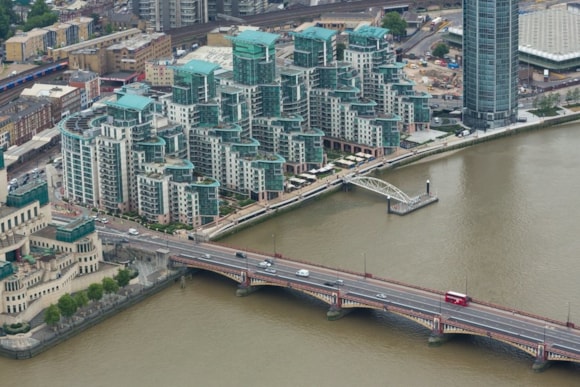
With the mythical Structures Fund likely to be massively oversubscribed, it’s no wonder that Transport for London is keen to draw attention to the terrible state of Vauxhall Bridge.
Still misdescribing the non-existent fund* as “the government’s £1bn structures fund” the BBC’s Karl Mercer (with Tim Stokes) reports:
Vauxhall Bridge will have to shut to buses and fire engines within two to four years unless about £60m is invested in repairs, Transport for London (TfL) has warned.
The crossing, which is the busiest bridge in central London, could even have to close fully to vehicles in four to 10 years without the necessary work, it said.
I’ve written about the state of the bridge and TfL’s failure to look after it for Highways magazine, both in this online article in 2020 and this July 2026 article in the magazine itself.
Having said in 2020 that TfL was going to implement a “short-term fix”, rather than necessary major renewals work, it wasn’t surprising that TfL implemented an 18-tonne weight limit this year and that its structures fund bid paints a worrying picture.
But, given that the 2020 work included bridge deck waterproofing and drainage improvements, it’s quite surprising to see David Rowe, TfL’s director of investment planning, telling BBC London that the bridge’s waterproofing had “failed”.
It’s even more surprising when Nick Fairholme, TfL’s director of project and programme delivery, said in 2020:
by doing this work now, we’re protecting it for decades to come.
Indeed, the structures fund bid states in relation to the work that TfL is seeking funding for:
The proposed intervention is Phase 2 of a coordinated programme to restore structural integrity, extend asset life and remove operational restrictions on the bridge. Phase 1, completed in 2020, renewed the waterproofing system to reduce water ingress into the structure.
TfL is now saying that:
it was identified that Phase 2 interventions would need to be delivered within five years to avoid the need for weight restrictions.
This might be true, but it doesn’t explain why the waterproofing that was supposed to protect the bridge “for decades to come” has failed, or why
Phase 2 focuses on addressing corrosion of the steel superstructure and the underlying causes of deterioration, principally the ongoing effects of water ingress.
I reported earlier this year that the main problem leading to the weight restriction was caused by corrosion to a crossbeam. The funding bid states:
There is significant corrosion across the underside steelwork, which is caused by prolonged water ingress. This has resulted in progressive section loss and reduced structural capacity. A 2025 structural assessment confirmed that the Span 1 crossbeam no longer satisfies full loading requirements, necessitating the implementation of an 18T restriction. While this represents the most critical location currently driving restrictions, similar deterioration patterns are evident across multiple spans, which suggests that, without intervention, further section loss is likely to occur, and similar restrictions may be required elsewhere.
That is a truly shocking situation, added to which, as the BBC has also noted:
Continued deterioration is also expected to require the removal of fascia panels, which are at risk of detaching and falling onto the river below, posing a safety hazard to passing vessels and resulting in a visibly degraded appearance for a prominent London landmark.
The BBC also reports that of seven TfL-managed road bridges across the Thames,
three – Vauxhall, Lambeth and Westminster – are rated as being in a “very poor” state, with the other four – Twickenham, Kew, Chiswick and Battersea – marked as “poor”.
The Department for Transport is still not saying when it will announce the outcome of structures fund bids and indeed roads minister Justin Madders has declined to say whether he expects it to be before the House of Commons rises in December.
The Department is currently reviewing proposals submitted to the Structures Fund. While a date for announcing the outcome has not yet been confirmed the Department hopes to announce the outcome of Structures Fund applications this year as set out at the fund launch.
My guess is that it is no longer reviewing proposals at all but is merely waiting for a day to bury bad news.
* I cast doubt over the existence of the Structures Fund because it doesn’t have a set budget and overlaps with schemes that could have already been funded by the MRN/LLM funding stream, with which it shares £1bn over four years.


Leave a Reply