
In this guest post, Jo Bradley of Stormwater Shepherds looks at National Highways’ plans to address toxic road runoff it the context of the legal and regulatory framework that should be protecting our watercourses.
Pollution from highway runoff is finally getting the recognition that it deserves, and being discussed in high places. The pollution is acknowledged, albeit very briefly, in the recent Water Sector White Paper, and there is a nod to it in last year’s Environmental Improvement Plan. But this is not enough; this is one of the largest sources of river pollution, so passing mentions in policies and plans are inadequate.

There are no highway outfalls identified in the River Basin Management Plans as sources of pollution, and the Environment Agency still refuses to regulate the outfalls using the appropriate regulations. We are eating this elephant one bite at a time but it simply isn’t fast enough; we need to put it through the mincer and find a way to eat it more quickly than ever before.
While we must applaud the commitment from National Highways to deliver pollution treatment schemes for at least 182 outfalls and soakaways in the next five years, we must remember that this represents a tiny proportion of their outfalls and soakaways and is built on 25 years of inaction.
The company’s own research revealed the risk of harm from this pollution back in 2000, but the risk assessment model that it then built, conveniently concluded that only 250 of their outfalls and soakaways posed a high risk of pollution, so it delivered very few treatment schemes over the following two decades.
It signed a voluntary agreement with the Environment Agency (EA) to allow it to use this risk assessment model, and, with that, the Agency stepped away and failed to manage or to control this source of pollution. This was then, and remains, a shameful dereliction of duty.
The EA has a statutory duty to measure and control all known discharges of Priority Hazardous Substances, and has known for 30 years that highway runoff contains these substances in significant quantities. So when the Statutory Standards for levels of certain highway-derived pollutants were published in 2015, and the Environmental Quality Standards Directive came into effect, it should have scrapped its voluntary agreement with National Highways and introduced a formal Permitting regime to control these known polluting outfalls. But it didn’t and to this day does not control these outfalls using the regulatory framework that exists to do that, despite its statutory duty to do so.
That brings me back to the list of 182 outfalls and soakaways that National Highways has published, setting out its plan to deliver treatment schemes for these assets in the next five years. Although this is a great step forward, and will cost many millions of pounds, we should acknowledge that it isn’t enough and won’t deliver clean and healthy rivers across England.
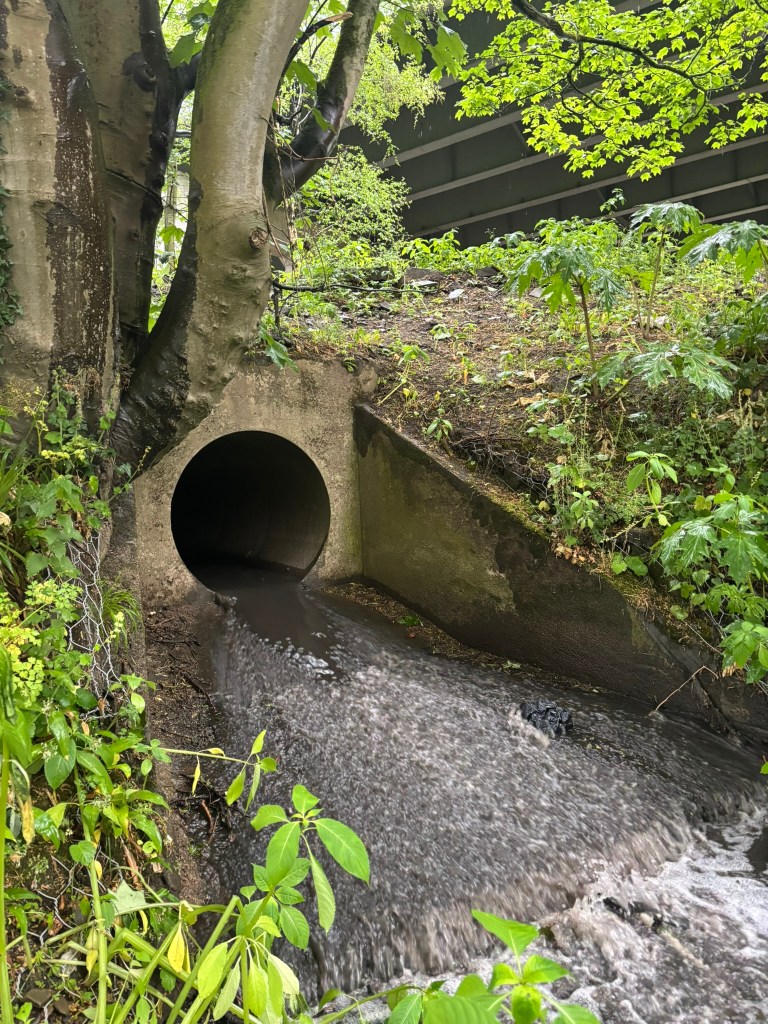
There are still another 20,000 or so outfalls and soakaways across the Strategic Road Network, and an estimated one million across all the other roads, all of which discharge polluting runoff when it rains, to ground, rivers, streams, estuaries and oceans.
Although not all of these outfalls will cause measurable harm to the environment, there is currently no formal, effective process to assess which ones need the installation of a treatment scheme to reduce pollution.
The risk assessment model that National Highways uses doesn’t properly reflect the level of pollution from Polyaromatic Hydrocarbons and seems to underestimate the level of pollution from copper and zinc. Samples taken from highway outfalls by river action groups and charities over recent years have found that every outfall sampled contains levels of Hazardous Substances that exceed published Standards.
Since the Standards are set to prevent acute toxic harm to aquatic life, these exceedances reflect a very real risk of harm to invertebrate and fish populations and preventing rivers from achieving the ‘Good Ecological Status’ that the Agency is duty-bound to strive for.
The assessment doesn’t properly account for the risk posed to Designated Habitats and Species either, and Natural England has no process in place to measure or to monitor the outfalls that enter the environment at these precious locations. This means that there are motorway outfalls affecting protected habitats across England and no-one assesses their effects on the species that we are supposed to be protecting.
So, in conclusion, the commitment made by National Highways is good, and it is pleasing to see funding to support that commitment so that we can be certain that the schemes will be delivered. But the EA and Natural England need to get a grip of this problem and to properly reflect it in the River Basin Plans and Pollution Reduction Plans so that the regulatory framework can be applied properly and effectively.
This would ensure that the next lists of outfalls to be remediated by National Highways in the following decades will be the right lists to protect precious habitats and to deliver better river health.
If the regulators step up to the mark, the regulatory mechanisms can be applied to other roads too, so that all highway authorities start to address this problem, not just National Highways. And that way, lots of organisations will be taking bites out of the elephant and we might start to see some real progress. It can’t come a moment too soon.
 Transport Insights
Leave a comment