
The transport secretary has declined to say that she is confident that Network Rail has the funds to keep the railway safe as landslips hit the rail and road networks, driven by climate change.
Appearing before the Transport Committee, Heidi Alexander was asked by Rebecca Smith, Conservative MP for South West Devon, if she was
confident that Network Rail has the resources to safely maintain the railway network during this control period.
Her reply emphasized that spending has gone up, which it has, rather than answering what is the real question:
We are spending more money in Control Period 7 on activities to address improving resilience connected to weather and climate change. So climate change adaptation, I guess, is the phrase that I’m searching for. So in Control Period 7, we’re spending 2.6 billion, which is significantly more than we were spending in Control Period 6. So I think it’s right that the Network Rail are doing that because they are very alive to the challenges that changing weather patterns have for the rail network.
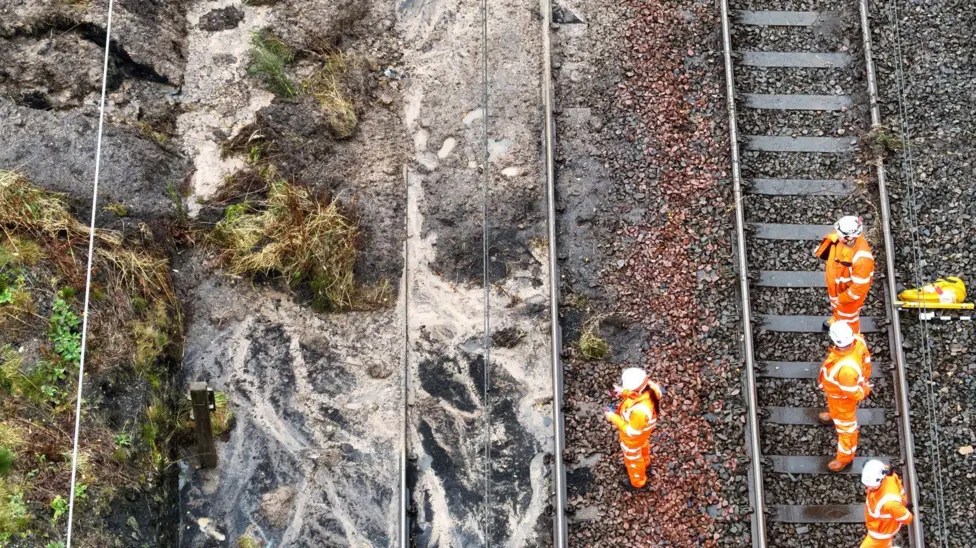
Smith had referenced a recent incident in Cumbria, i.e. the derailment of a train caused by a landslip onto the track. The Rail Accident Investigation Branch has said its preliminary examination found that a drainage channel running across the slope above the washed-out material, was unable to accommodate the volume of water present, saturating the material and initiating the landslip.
But, as this BBC report points out in a detailed piece that looks at the wider issue, that was followed by a landslip affecting the A592 in the region, which Westmorland and Furness Council said could be closed for months. After Storm Desmond in 2015, the nearby A591 was blocked by landslips that both blocked the road and washed its base away.
Alexander was also asked about the planned change in emphasis in the forthcoming third road investment strategy, away from enhancements and towards renewal and maintenance. After pointing out that she has given the go-ahead to some major enhancement schemes, she said:
We do need to make sure that we’re maintaining that infrastructure sensibly because otherwise the costs will build up over the longer term and we’ll see more disruption, because the network won’t be performing as it should.
We’re investing in the structures fund as well in order to deal with this issue of ageing assets where a local authority doesn’t have the ability itself to cover the full costs of repair.
She cited the example of Galley Hill Road in Kent
… which is on the top of a cliff and it’s basically just shut. I mean, we’re 21st century country. I don’t think we can allow that sort of situation to perpetuate.
She promised that her department would “be saying more” about how the structures fund will work – as I have reported, very little detail has so far been given to the local authorities that might bid to it.
She confirmed that the £1bn associated with the structures fund:
Will also be used to pay for the road schemes that we take through as a result of the review of the MRN/LLM process; we’re looking at which schemes we’re going to take forward there.
This is more of the double speak where local road schemes that were said to have been green-lit have no guarantee of funding and, as I have said before, that billion will not go very far if it has to pay for the structures fund and enhancements on the local network.
 Transport Insights
Leave a comment