
I can exclusively reveal the other major scheme in the second road investment strategy (RIS 2) that ministers secretly pulled the plug on during the 2021 Spending Review.
According to a November 2022 report from the National Audit Office:
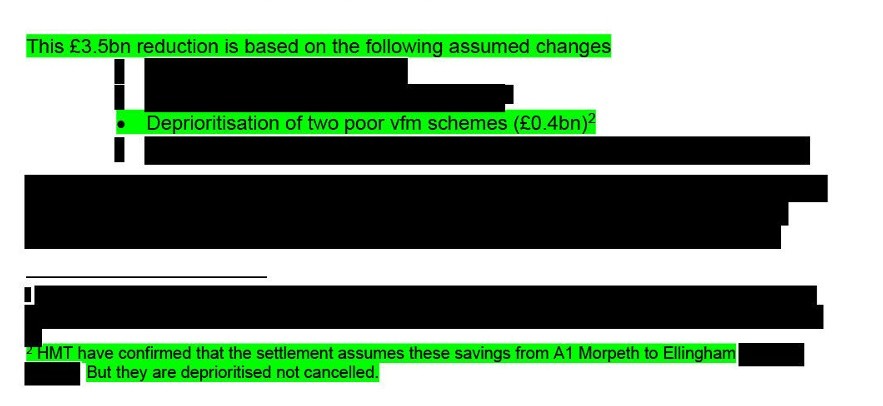
In February 2022, DfT formally notified National Highways that two projects on the watchlist had been deprioritised as an outcome of the 2021 Spending Review. These two projects remained in the portfolio awaiting a final decision on whether to proceed but their funding has been removed.
The NAO revealed that one of these schemes was the A1 Morpeth to Ellingham scheme, which the company formally paused almost immediately, but it did not name the other scheme, which was also blacked out of all documents previously disclosed to me.
Now the Department for Transport has told me that the second, previously unnamed scheme was the M25 Junctions 10-16.
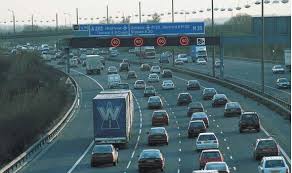
This scheme aimed to convert one type of “smart motorway” scheme to another. It was a longstanding controlled motorway scheme with a hard shoulder that was to be converted to a less safe all lane running (ALR) scheme.
It dated back to the first (2015-20) RIS, but was “rescheduled” in 2017 as part of a big reshuffle of RIS 2. It was also one of the planned ALR schemes paused in January 2022 and cancelled altogether the following year.
However, the defunding and deprioritisation in the 2021 spending review took place separately to the wider shelving of ALR schemes and was done on value for money grounds.
It is not hard to see why. An appraisal summary table for the scheme, released to Becca Lush of Transport Action Network under FOI in January 2022, just days after the whole smart motorway programme was paused, shows that it was expected to provide benefits valued at £255.873m at 2010 prices against a cost of £249.677m.
One reason that the scheme had such a poor economic case was that:
For the links that are improved by the scheme there is an increase in reliability through the increase in capacity, which is offset in part by the loss of the hard shoulder which has a negative impact on reliability. In addition, the mainline M25 has an increase in traffic due to the scheme, but does not have an improvement. Overall the impact on reliability is to provide a dis-benefit.
This recognises a known flaw with all lane running schemes – that the loss of the hard shoulder means that when things go wrong the impact (traffic jams) will often be a lot worse.
But it’s fascinating to see an internal appraisal showing how little the money thrown at smart motorways can achieve, with the result that the Treasury pulled the plug. Maybe this was a factor in the cancellation of the whole programme.
The shelving of two schemes in the 2021 spending review was expected to save £400m, with the A1 scheme contributing a saving of £171m. This puts that saving from the M25 scheme at around £230m, in up to date prices, but excluding sunk costs.
The spending review saw National Highways lose £3.5bn from its capital funding, including these two schemes. Its regulator, the Office of Rail and Road, reported that this left it with five-year capital funding of £18bn and this appears to have been unaffected by the pausing of smart motorways, which retained their funding, with the exception of the M25 scheme.
It appears therefore that the defunding of the M25 scheme also led to a gap between National Highways’ projected spending and its funding, in addition to the shortfall from defunding the A1 scheme. The ORR forecast an overspend on National Highways’ enhancement schemes, but without projected spend on defunded schemes, there might have been an underspend.
 Transport Insights
Leave a comment