
The AA has published its analysis of 16 previously suppressed Post Opening Project Evaluation (POPE) reports on smart motorways, pointing out that many are losing the economy money, while their safety record is at best mixed, with some becoming more dangerous after the hard shoulder is removed.
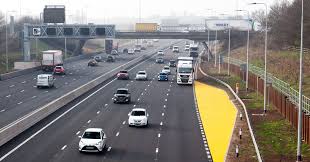
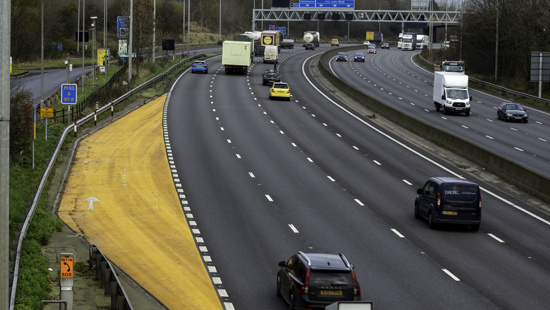
The motoring group has been careful to distinguish between the different types of motorway given so-called “smart” technology – controlled motorways, which keep the hard shoulder; dynamic hard shoulder (DHS), where the hard shoulder can be used as a running lane at during periods of high congestion; and all lane running (ALR), where the hard shoulder is permanently converted into a running lane.

It points out that two schemes – the M25 ALR section between junctions 23 to 27, and the M6 DHS section between junctions 5 to 8 – are losing the economy money and have been rated “very poor” value for money.
A further six schemes have been rated as “not on track – poor” or “not on track – low” in respect of providing value money at the end of the evaluation period once the motorway has been opened to traffic.
The AA points out that in many cases, converting the hard shoulder into a permanent or temporary running lane has reduced the speed of traffic.
Just three schemes were “on track” in relation to value for money at the end of the five-year evaluation period.
The AA noted that many of the reports are dated September 2023, despite many completing their evaluation period between 2017 and 2019.
President Edmund King said:
(more…)After a lengthy wait, these reports finally see the light of day. The reluctant release of these documents, without any announcement feels like an attempt to bury bad news.
This has been a catastrophic waste of time, money and effort. Many of the schemes have slower journeys which causes traffic jams, loses the country cash and worsened the safety record of motorways.
 Transport Insights