Campaigners have declared a partial victory over National Highways’ M60/M62/M66 Simister Island scheme, despite the award of a development consent order (DCO) by the transport secretary.
Transport Action Network (TAN) said it is “very pleased to see that [Heidi Alexander] agreed with us that National Highways must improve the Haweswater Underpass as part of the M60 Simister Island scheme”.
The underpass featured in a National Highways Watch piece that I wrote for TAN about the company’s use of “designated funds” on roadbuilding schemes. National Highways claimed that improving the underpass as an active travel route under the motorway was not part of its scheme, but TAN argued that it should be.
The decision letter on the scheme does not resolve this dispute but does say clearly that Alexander considers that a proposed addition to the DCO of a “requirement” for the company to deliver the scheme of improvements to the Haweswater Underpass “is necessary and proportionate to impact from the Proposed Development”.
I have obtained another document about the secret shelving of the A1 Morpeth to Ellingham scheme that amounts to something of a smoking gun, showing that both National Highways and its regulator deliberately hid from Parliament that fact that the scheme had been “paused” as well as defunded.
To recap, the Treasury secretly defunded and deprioritised the scheme in the (late) 2021 Spending Review and told the government-owned company and the Office of Rail and Road (ORR) this in February 2022.
Despite this, both organisations said in reports presented to Parliament in July 2022 that the scheme would go ahead in the financial year 2022-23.
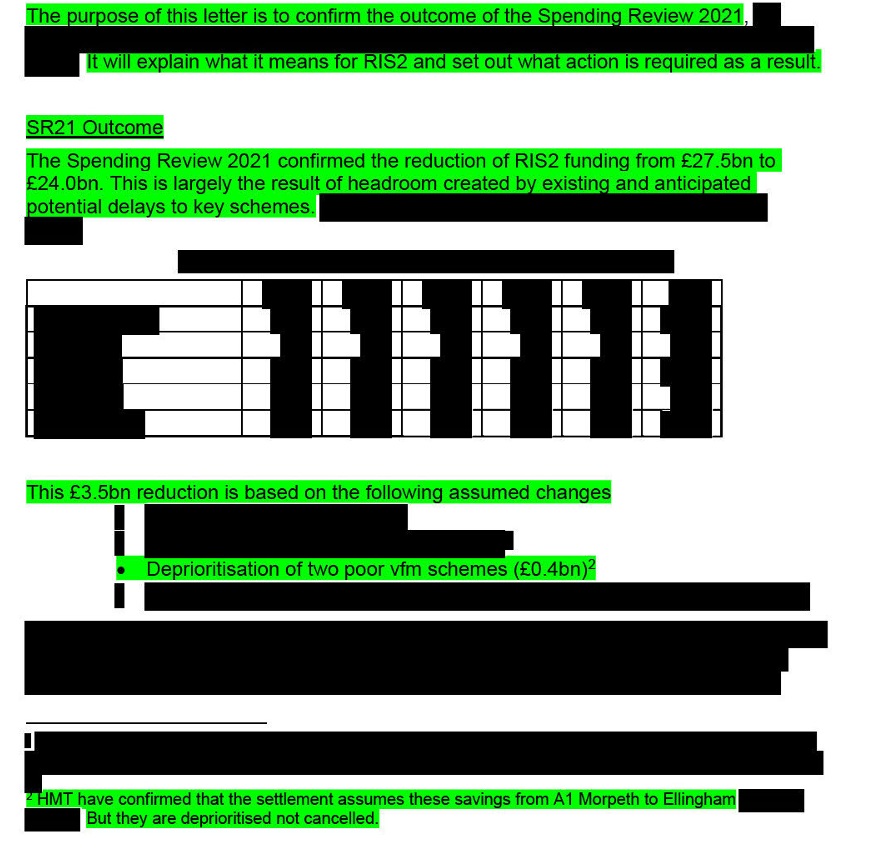
The new document is a Department for Transport (DfT)/ National Highways “change control” form on the subject of a funding change for the 2020-25 Roads Period (RP2) to formalise the outcome of the Spending Review, which overall saw the company’s budget cut from £27.4bn to £24bn.
The document makes clear that the A1 scheme was “paused” which is obviously incompatible with the claim in National Highways’ 2022-23 Delivery Plan that works would start that year. The ORR repeated this lie in its annual assessment 2021-22.
The document also makes clear that the scheme had been “deprioritised with no further development funds”. It further states:
The SR21 settlement includes pausing the development of two schemes with poof VfM. These will be dealt with as separate change control submissions, the timing and communication of which will have to be carefully timed with any broader announcements in response to TSC or Union Connectivity reports and any DCO process considerations.
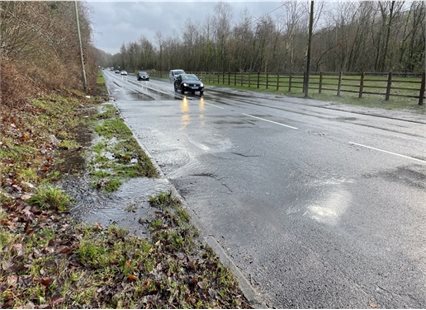
The government has, unsurprisingly, failed to back National Highways chief executive Nick Harris’ optimism that it will fund the company’s plans to clean up its “very worst locations” for water pollution.
Yesterday, Harris was asked at the Environmental Audit Committee about National Highways plan to “mitigate” by 2030 what it now estimates to be around 250 high risk outfalls and soakaways – where toxic road runoff runs off into watercourses and the environment generally.
What certainty did he have that this would be funded in the third Road Investment Strategy (RIS 3)? Well, he was “proceeding on the basis that we will be funded to do all 250”.
Naturally I asked the Department for Transport whether it could clarify this.
It has responded with little more than a confirmation that the RIS 3 document will be published in March (which is a surprise as the draft said “no later than” March rather than giving a specific month) with its funding and what is expected of it only made clear at that point.
What we know is that National Highways will have nearly £25bn over five years, with no clarity on how much of this will be capital and how much “resource” or how much will be spent on enhancements or maintenance, renewals or operations. There may or may not be a designated fund for the environment, and perhaps something else called a national programme.
Is Harris simply engaging in wishful thinking, or does he know something we don’t?
It’s fair to say that National Highways chief executive Nick Harris got a bit of a kicking from MPs yesterday – on the subject of failed tree planting – but he was allowed to give a very vague answer on the subject of funding for cleaning up water pollution.
To recap, Harris and the company’s director of environmental sustainability, Stephen Elderkin, were in front of the Environmental Audit Committee to talk about biodiversity, including tree planting, as well as what the company is doing to mitigate the toxic runoff from its roads.
The headline on water pollution is that Harris said the company had mitigated just 40 “high risk” outlets since he last appeared before the committee in 2021 but now estimated that there are another 250 approximately, which it has pledged to mitigate by 2030.
That is the date – the original end date for the third Road Investment Strategy (RIS 3) in March 2030 – given in National Highways’ 2030 Water Quality Plan, subject to funding of course.
Harris described this as a prioritisation process of getting stuck into the very worst locations, adding that the company has 180 locations where it is developing designs, with more high risk locations expected to be identified.
The problem is that National Highways has no funding for this at the moment. It has a promise of nearly £25bn up to 2031 under the draft RIS but no specific funding streams. Ministers have promised a new focus on repairs and renewals, alongside a long and growing tail of enhancement schemes but there are as yet no designated funds for the environment, for example.
Labour MP Olivia Blake raised the issue of funding and asked Harris what certainty he had that the company would be able to meet the target on mitigation. He replied with wishful thinking:
We’re proceeding on the basis that we will be funded to do all 250. The interim year hasn’t affected our design work. We’re moving forward on the assumption that it’s all going to be funded.
He went on to explain the convoluted process by which National Highways, the Office of Rail and Road and the Department for Transport work towards a final RIS 3 by 2030.
With National Highways appearing before the Environmental Audit Committee on Wednesday, Transport Action Network (TAN) has published another piece in its National Highways Watch series – this time on “Toxic Run-Off”.
This covers the company’s plans, or lack of them, to address the pollution being discharged from its network into the natural environment.
Once again, I have contributed to the TAN piece, despite a lack of co-operation from National Highways, although I would stress that the phrasing used is not necessarily mine. It does punch quite hard, but by no means unfairly.
The piece also quotes from research by Stormwater Shepherds, a group doing great work on the issue, whose UK director of operations, Jo Bradley, will also be appearing before the committee.
The group has pointed out that while Section 100 of the Highways Act 1980 allows highway authorities like National Highways to discharge surface water into any inland or tidal waters, a discharge of polluting matter into a watercourse would usually require a permit from the Environment Agency, and argued that the company is not exempt from enforcement action in this area.
Transport Action Network (TAN) has posted another of its National Highways Watch pieces, with significant input from me, and it has been almost simultaneously vindicated by comments in the draft Third Road Investment Strategy (RIS 3).
The piece Highway robbery – abusing Designated Funds compares National Highways’ use of designated funds, pictorially at least, to putting lipstick on a pig – i.e. prettifying large and potentially environmentally destructive road building schemes with greenwashing.
TAN has discovered that National Highways is syphoning off money from a dedicated fund for environmental and safety improvements (called ‘Designated Funds’1) to use it as sweeteners or greenwashing for new roadbuilding schemes. National Highways is also raiding the “ringfenced” funding to pay for mitigation that should come out of the scheme budgets.
The piece highlights a number of alleged misuses of designated funds, including “sweetening the Lower Thames Crossing”:
A document on “Benefits and Outcomes” submitted as part of the scheme’s planning application mentions “Designated Funds” 25 times, and claims that “Over £30 million of designated funds have been allocated to Lower Thames Crossing”, despite having to make clear that these benefits technically “fall outside of the remit of the DCO [planning application]”.
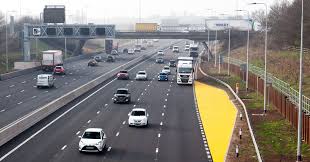
The draft of the third Road Investment Strategy (RIS 3) published this week suggests that ministers are happy with a smart motorway network where many places to stop in an emergency are officially too far apart, putting drivers at increased risk.
The Department and National Highways should retrofit emergency refuge areas to existing all-lane running motorways to make them a maximum of 1 mile apart, decreasing to every 0.75 miles where physically possible.
The Department (for Transport – DfT) accepted this recommendation in principle and in January 2022 announced that £390m would be spent by the end of March 2025 to retrofit “more than 150 additional emergency areas”, alongside a pause on the construction of new all lane running smart motorways.
Although this was said to provide “around a 50% increase in places to stop”, neither the DfT nor National Highways ever said how far the programme would go to fill in all the gaps where the spacing was longer than the official standard.
National Highways has told me that it had “prioritised locations where emergency areas could make the most difference and bring benefits to drivers as soon as possible” and suggested that it would like to see a continuation of the programme.
Labour delayed the start of RIS 3 by a year and gave the company an interim settlement for the current year that says nothing about improving safety on smart motorways.
In a section on Smart Motorways, the draft RIS 3 document claims that “substantial investment continues to improve the safety of the existing network” citing “the recent completion of additional Emergency Refuge Areas on the All Lane Running (ALR) smart motorways under the National Emergency Areas Retrofit (NEAR) programme”, which it acknowledges “was finished in March 2025” – a whole year before the new RIS.
There is no commitment to continuing the retrofit of what Labour has now returned to calling “Emergency Refuge Areas”, which leaves National Highways with a spacing standard that it is not funded to deliver.
Following on from my piece yesterday about the safety commitments – or lack of them – in the draft 3rd Road Investment Strategy, perhaps the most important comment on the issue comes in a section not about safety but “A technology enabled and enabling network”:
National Highways should not be over-reliant on technology, for example drawing on insights from the use of cameras and stopped vehicle detection when considering driver safety and welfare.
For me this is a recognition from government that technology such as stopped vehicle detection (SVD) is not up to the job given to it – keeping people safe when vehicles stop on all lane running “smart motorways” that do not have a hard shoulder.
It can even be read as a repudiation of “smart motorways” themselves, where the word “smart” was used to imply that their key feature was technology, rather than the removal of the hard shoulder, or at least that the former compensated for the latter.
Ministers have let National Highways off the hook over its continued failings on safety, excusing the company’s failure to meet its 2025 casualty reduction target and allowing it to put its 2040 zero harm pledge back by a whole decade.
The Department for Transport has published what it is calling a Draft Road Investment Strategy 3, running from April 2026 to March 2031, although the document is billed as a “high-level vision” policy paper and has very little detail.
The document notes that a consultation on previous papers “revealed that respondents placed the highest importance on improving road safety and environmental outcomes” but offers almost nothing to take these issues forward.
I have obtained new documents showing that National Highways’ regulator knew the government had removed funding from a large roadbuilding scheme and was hiding this from the public and Parliament. The regulator then falsely reported that the scheme would go ahead when it got planning permission.
By doing this, the Office of Road and Rail (ORR) – supposedly an independent watchdog – became complicit in the deception over the shelving of the A1 Morpeth to Ellingham scheme, which has undermined parliamentary oversight of the government-owned company’s operation and development of the strategic road network.
As has previously been reported, the Department for Transport (DfT) told National Highways in February 2022 that the A1 scheme had been deprioritised and its funding removed following the Spending Review in late 2021.
Despite this, both National Highways and the ORR published reports and presented them to Parliament claiming that the scheme would enter construction in the 2022-23 financial year.
I have now obtained correspondence between the DfT and National Highways from February 2022, which was copied to the regulator, showing not only that a cut to the company’s funding included a saving from not progressing the A1 scheme but that a deliberate decision had been taken to keep the public and Parliament in the dark about the scheme being shelved.
A letter from a senior DfT official to National Highways’ chief financial officer notes that:
No public announcement was made about the A1 Morpeth to Ellingham [and another redacted scheme]. Plans will be drawn up for communications about the A1 Morpeth to Elllingham, but for the time being it remains a committed scheme recognising that costs will continue to accrue pending a decision.






 Transport Insights