Two Tory transport secretaries gave Parliament misleading information over the secret decision to shelve a major National Highways scheme, I can reveal.
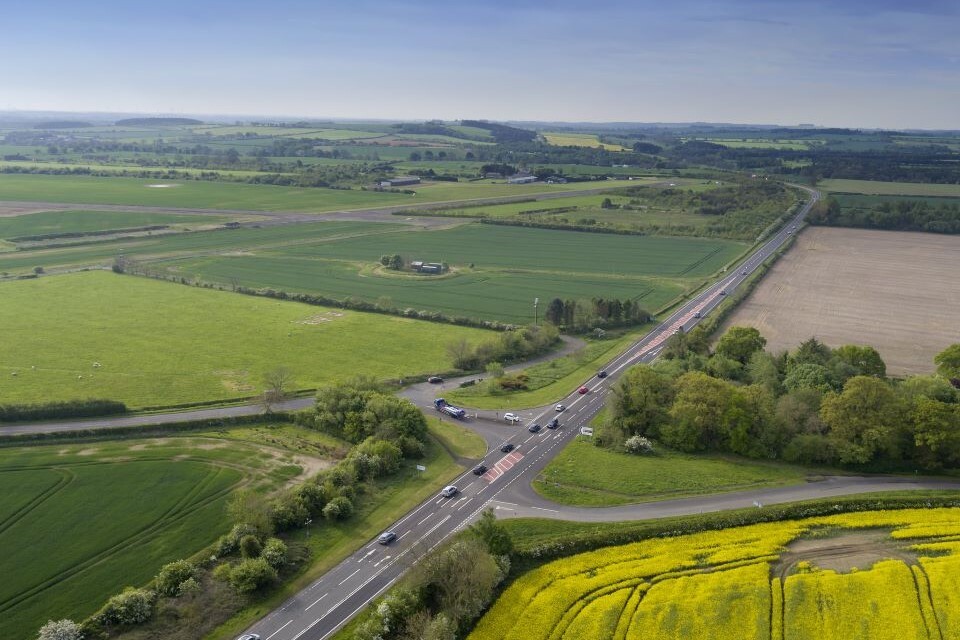
By way of a recap, in February 2022, following the 2021 Spending Review, the Department for Transport (DfT) secretly told National Highways that it should pause two of its enhancement schemes – one smart motorway conversion and the A1 Morpeth to Ellingham scheme.
The smart motorway scheme (M25 junctions 10-16) was officially paused by transport secretary Grant Shapps in January 2022, following a recommendation from Parliament’s Transport Select Committee.
But the DfT, National Highways and regulator the Office of Rail and Road (ORR) conspired to keep the shelving of the A1 scheme from Parliament and the public. As I have reported, both National Highways and the ORR falsely claimed that the “paused” scheme would start work during the 2022-23 financial year.
Ministers are sitting on a huge amount of data on the safety and value for money of smart motorway schemes, including at least nine that were due for completion in 2022.
The concealment of multiple post opening project evaluation (POPE) reports will raise concerns that the government is once again hiding inconvenient facts about the controversial roads, as it did in 2021, when I put pressure on the Department for Transport (DfT) over reports that it was suppressing.
When the five-years after POPE on the scheme to convert the M1 between junctions 10 and 13 to dynamic hard shoulder was published in September 2021, it revealed that it had cost the economy £200m instead of a projected benefit of £1bn, because it slowed traffic down. It made national news.
We are scrutinising the company’s POPE publication plan for smart motorway schemes. Nine of these are due to be completed in 2022. In July 2021, the company published the five-year POPE for the M1 junctions 10 to 13 dynamic hard shoulder running scheme.
That POPE was the last report on a smart motorway to be published, which is unsurprising given how terrible the data was, although aggregated safety data is published separately.
When I asked National Highways why no more POPE reports had been published, a spokesperson told me:
We have provided the Department for Transport (DfT) with the smart motorway post opening project evaluation (POPE) reports. These are multiple detailed evaluations of scheme performance and DfT is now in the process of undertaking its final assurance.
Obviously, for those reports completed in 2022, “undertaking final assurance” means locked in a cupboard.
National Highways has told me that it is aiming to achieve the level of LED streetlight installation during the current year that would keep it (more or less) on track for one of its main decarbonisation targets.
I wrote last week that the company installed 12,745 LED lights during 2024-25, in pursuit of a target of 70% LED street lighting by 2027 in its Net Zero Highways plan.
An early upgrade on the M62, showing sodium (left) vs LED lights
While this took it to 51%, compared to 40% a year earlier, which appears to be the rate of change required to hit the 2027 target, I noted that published documents are unclear about what will happen over the next two years.
There is no mention of the issue in the company’s settlement for the current, interim year and the clearest commitment to taking it forward is an unquantified referent its delivery plan for the year to “delivering our LED lighting programme to support our carbon reduction commitments”.
But a National Highways spokesperson has told me:
We are committed to our target of ensuring 70 per cent of the road network is upgraded with LED lighting by 2027 and we are aiming to install a further 10,000 during 2025-26.
However, upgrading LED lighting is dependent on a number of factors, including severe weather, the availability of road space/local highway diversion routes and the condition of the existing lighting assets on the network.
National Highways’ corporate carbon emissions increased by nearly a fifth over the last year, while emissions from construction and maintenance fell and road user emissions did not fall anything like fast enough to achieve a target of a 55% cut by 2030.
The company has published an annual update to its Net zero highways 2030 / 2040 / 2050 plan, which sets those three dates as targets for net zero corporate emissions, construction and maintenance emissions and road user emissions respectively.
Under the plan, progress towards the corporate emissions target gets a large boost from move to “certified renewable electricity”, which means that such electricity does not count towards the company’s target consumption. This is expected to reduce the company’s own emissions by 51% against a 2017-18 baseline but it is not allowed to use this method for its corporate reporting of its emissions, i.e. its annual report, or its KPI target for RIS 2, which it missed.
Unfortunately, during 2024-25 corporate emissions rose by 18% from 38,388 tCO2e to 45,241 tCO2e. The company said this was largely due to two factors: one motorway service operator ceasing to claim renewable energy certificates, and a data improvement exercise linked to a recalculation of corporate carbon emissions to achieve Science Based Targets Initiative verification.
National Highways’ regulator falsely told Parliament that the company had a projected overspend of nearly a quarter of a billion pounds, but the fictional deficit was almost entirely the result of collusion within government to pretend that a shelved road scheme was still going ahead.
The revelation raises further concerns about whether the Office of Rail and Road (ORR) sees its role as holding National Highways to account or keeping the company’s secrets from Parliament and the public.
It is the latest revelation in the scandal that saw both organisations falsely claim in reports presented to Parliament that the A1 Morpeth to Ellingham scheme, which was shelved in February 2022, would go ahead in the 2022-23 financial year.
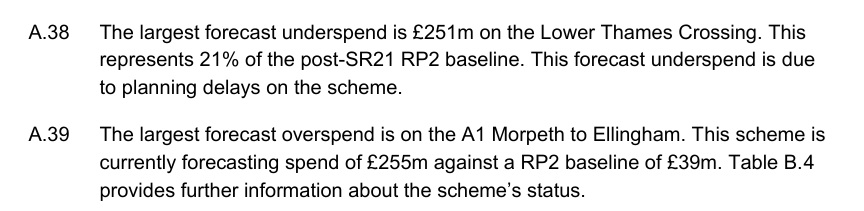
Not only did the ORR’s annual assessment of National Highways for 2021-22 falsely claim that work on the scheme would start in 2022-23, but it reported that the scheme had a huge overspend (£216m) resulting from “forecasting spend of £255m against a RP2 baseline of £39m”.
However, this forecast spend was fictitious and the regulator knew it. It knew very well that the funding for the scheme had been withdrawn (apart from sunk development costs) and that National Highways was delaying formally pausing the scheme in order that it could hide from MPs the fact that it had been shelved.
Campaigners have declared a partial victory over National Highways’ M60/M62/M66 Simister Island scheme, despite the award of a development consent order (DCO) by the transport secretary.
Transport Action Network (TAN) said it is “very pleased to see that [Heidi Alexander] agreed with us that National Highways must improve the Haweswater Underpass as part of the M60 Simister Island scheme”.
The underpass featured in a National Highways Watch piece that I wrote for TAN about the company’s use of “designated funds” on roadbuilding schemes. National Highways claimed that improving the underpass as an active travel route under the motorway was not part of its scheme, but TAN argued that it should be.
The decision letter on the scheme does not resolve this dispute but does say clearly that Alexander considers that a proposed addition to the DCO of a “requirement” for the company to deliver the scheme of improvements to the Haweswater Underpass “is necessary and proportionate to impact from the Proposed Development”.
I have obtained another document about the secret shelving of the A1 Morpeth to Ellingham scheme that amounts to something of a smoking gun, showing that both National Highways and its regulator deliberately hid from Parliament that fact that the scheme had been “paused” as well as defunded.
To recap, the Treasury secretly defunded and deprioritised the scheme in the (late) 2021 Spending Review and told the government-owned company and the Office of Rail and Road (ORR) this in February 2022.
Despite this, both organisations said in reports presented to Parliament in July 2022 that the scheme would go ahead in the financial year 2022-23.
The new document is a Department for Transport (DfT)/ National Highways “change control” form on the subject of a funding change for the 2020-25 Roads Period (RP2) to formalise the outcome of the Spending Review, which overall saw the company’s budget cut from £27.4bn to £24bn.
The document makes clear that the A1 scheme was “paused” which is obviously incompatible with the claim in National Highways’ 2022-23 Delivery Plan that works would start that year. The ORR repeated this lie in its annual assessment 2021-22.
The document also makes clear that the scheme had been “deprioritised with no further development funds”. It further states:
The SR21 settlement includes pausing the development of two schemes with poof VfM. These will be dealt with as separate change control submissions, the timing and communication of which will have to be carefully timed with any broader announcements in response to TSC or Union Connectivity reports and any DCO process considerations.
The government has, unsurprisingly, failed to back National Highways chief executive Nick Harris’ optimism that it will fund the company’s plans to clean up its “very worst locations” for water pollution.
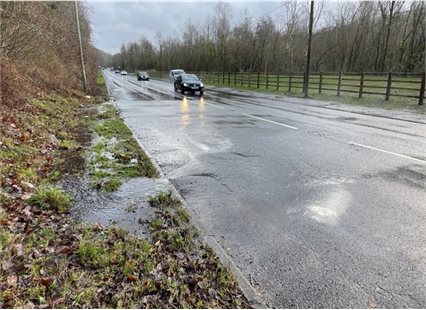
Yesterday, Harris was asked at the Environmental Audit Committee about National Highways plan to “mitigate” by 2030 what it now estimates to be around 250 high risk outfalls and soakaways – where toxic road runoff runs off into watercourses and the environment generally.
What certainty did he have that this would be funded in the third Road Investment Strategy (RIS 3)? Well, he was “proceeding on the basis that we will be funded to do all 250”.
Naturally I asked the Department for Transport whether it could clarify this.
It has responded with little more than a confirmation that the RIS 3 document will be published in March (which is a surprise as the draft said “no later than” March rather than giving a specific month) with its funding and what is expected of it only made clear at that point.
What we know is that National Highways will have nearly £25bn over five years, with no clarity on how much of this will be capital and how much “resource” or how much will be spent on enhancements or maintenance, renewals or operations. There may or may not be a designated fund for the environment, and perhaps something else called a national programme.
Is Harris simply engaging in wishful thinking, or does he know something we don’t?
It’s fair to say that National Highways chief executive Nick Harris got a bit of a kicking from MPs yesterday – on the subject of failed tree planting – but he was allowed to give a very vague answer on the subject of funding for cleaning up water pollution.
To recap, Harris and the company’s director of environmental sustainability, Stephen Elderkin, were in front of the Environmental Audit Committee to talk about biodiversity, including tree planting, as well as what the company is doing to mitigate the toxic runoff from its roads.
The headline on water pollution is that Harris said the company had mitigated just 40 “high risk” outlets since he last appeared before the committee in 2021 but now estimated that there are another 250 approximately, which it has pledged to mitigate by 2030.
That is the date – the original end date for the third Road Investment Strategy (RIS 3) in March 2030 – given in National Highways’ 2030 Water Quality Plan, subject to funding of course.
Harris described this as a prioritisation process of getting stuck into the very worst locations, adding that the company has 180 locations where it is developing designs, with more high risk locations expected to be identified.
The problem is that National Highways has no funding for this at the moment. It has a promise of nearly £25bn up to 2031 under the draft RIS but no specific funding streams. Ministers have promised a new focus on repairs and renewals, alongside a long and growing tail of enhancement schemes but there are as yet no designated funds for the environment, for example.
Labour MP Olivia Blake raised the issue of funding and asked Harris what certainty he had that the company would be able to meet the target on mitigation. He replied with wishful thinking:
We’re proceeding on the basis that we will be funded to do all 250. The interim year hasn’t affected our design work. We’re moving forward on the assumption that it’s all going to be funded.
He went on to explain the convoluted process by which National Highways, the Office of Rail and Road and the Department for Transport work towards a final RIS 3 by 2030.
With National Highways appearing before the Environmental Audit Committee on Wednesday, Transport Action Network (TAN) has published another piece in its National Highways Watch series – this time on “Toxic Run-Off”.
This covers the company’s plans, or lack of them, to address the pollution being discharged from its network into the natural environment.
Once again, I have contributed to the TAN piece, despite a lack of co-operation from National Highways, although I would stress that the phrasing used is not necessarily mine. It does punch quite hard, but by no means unfairly.
The piece also quotes from research by Stormwater Shepherds, a group doing great work on the issue, whose UK director of operations, Jo Bradley, will also be appearing before the committee.
The group has pointed out that while Section 100 of the Highways Act 1980 allows highway authorities like National Highways to discharge surface water into any inland or tidal waters, a discharge of polluting matter into a watercourse would usually require a permit from the Environment Agency, and argued that the company is not exempt from enforcement action in this area.