The Mail/This is Money has an interesting story about a North-South divide that has developed over the installation of public charge points for electric vehicles, slightly spoilt by some gratuitous Labour-bashing.
First, there is a suggestion that the rate of installation is now on a downward curve:
A mere 628 public chargers were installed in December, taking the total number added last year to 14,097, according to industry group Zapmap.
That was down nearly 30 per cent on the 19,834 installed in 2024 and more than 2,500 fewer than in 2023.
On the subject of location, it does seem that close to half are in London and the South East:
Of the 87,796 chargers installed, 27,895 are in London and the South East has 11,136.
By contrast, there are just 2,550 in the North East. Westminster alone has more public charging points than Manchester, Liverpool, Leeds, Sheffield and Newcastle combined.
Ginny Buckley of Electrifying.com is quoted as saying:
Whether the boost is new is always the first question, with the age-old tradition of announcing a funding envelope and then each tranche of funding from it as a separate “new” boost.
Image: DfT
It looks as if the £63m is drawn from the “£200m for charging infrastructure” announced in the Autumn budget.
The details are quite vague: £25m for local authorities, £8m for the NHS and the rest apparently for a “major new grant scheme to help businesses install charging points at depots nationwide”, which the government says it “is launching” but only on the basis that it intends to launch it.
The money is said to “build on” – implicitly to be additional to – the “£400 million announced in the Spending Review to support charging infrastructure, including on the strategic road network”, or rather the redirected portion of the £950 rapid charging fund that Labour scrapped.
The rapid charging fund (RCF), announced in 2020 by then chancellor Rishi Sunak was supposed to support upgrades to the grid to get more electricity to service stations.
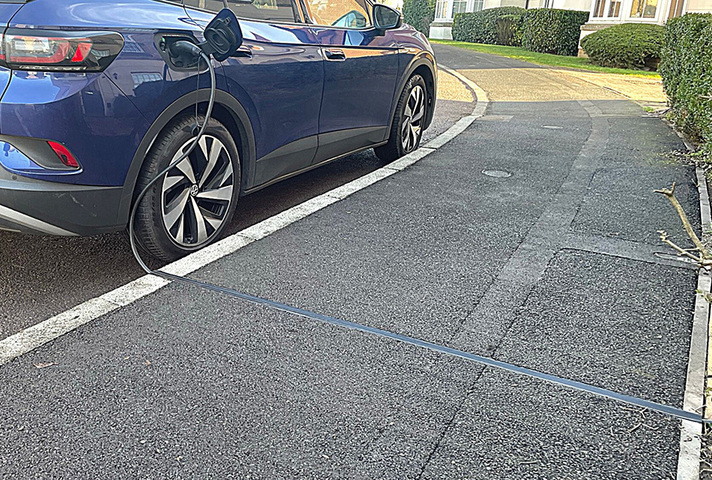
In December 2023 the Department for Transport launched a £70 million pilot scheme to “power up motorway service areas to pave the way for ultra-rapid electric vehicle (EV) chargepoints”, rather lazily using a picture (right) of a car being charged at the roadside.
However, this March the Guardian reported that ministers were considering “diverting money” from the RCF, which had still not paid out any grants.
Reading the latest Guardian story, you get the impression that most experts consider the RCF to be pretty ineffective, with complaints focusing on whether the money should have been spent elsewhere.
Increasing the number of public chargers is seen as crucial to persuading people to switch to electric cars. However, the focus has shifted from rapid chargers, which can allay “range anxiety” on longer journeys, to the slower on-street chargers needed for car owners who do not have private parking spaces.
But here’s the rub:
The Department for Transport said the RCF had never formally been included in budget plans, so the promise was unfunded.
There isn’t any money to divert, like a lot of Tory transport promises.
But what about the March story that said…
Much of the cash allocated to the rapid charging fund (RCF) could be redirected to investments in other charging schemes, or to support the transition to electric vehicles more broadly, although decisions have yet to be made, according to a person close to discussions in government.
And
A government source said that there is no plan to scrap the programme, but added that it needed to be adjusted to reflect the changes in the market.
“We want to make best use of government money,” the person said. “The concept of supporting charging is not going anywhere.”
One lesson from this is never to put any weight on an anonymous source who tells you that there are “no plans” to do something.
And “not going anywhere” is an interesting choice of words for the concept of supporting charging as the government backs away from it.



 Transport Insights