Very junior housing minister Keir Mather has replied to a parliamentary question about electric vehicle chargepoints with a promise to continue to monitor something it is not currently monitoring.
Shadow transport secretary (and former transport minister) Richard Holden asked:
To ask the Secretary of State for Transport, how many public electric vehicle chargepoints have been installed but are not operational due to grid connection delays or other technical issues.
Mather replied:
The Government does not hold a centralised figure on the number of public electric vehicle chargepoints that have been installed but are not yet operational due to grid connection delays or other technical issues.
However, he added:
In December 2024, the Government published the outcome of a review aimed at improving the grid connection process for EV charging infrastructure.
CPOs [charge point operators] have raised concerns that when infrastructure installations are completed, they can experience long waits before energisation.
Whether the boost is new is always the first question, with the age-old tradition of announcing a funding envelope and then each tranche of funding from it as a separate “new” boost.
Image: DfT
It looks as if the £63m is drawn from the “£200m for charging infrastructure” announced in the Autumn budget.
The details are quite vague: £25m for local authorities, £8m for the NHS and the rest apparently for a “major new grant scheme to help businesses install charging points at depots nationwide”, which the government says it “is launching” but only on the basis that it intends to launch it.
The money is said to “build on” – implicitly to be additional to – the “£400 million announced in the Spending Review to support charging infrastructure, including on the strategic road network”, or rather the redirected portion of the £950 rapid charging fund that Labour scrapped.
The rapid charging fund (RCF), announced in 2020 by then chancellor Rishi Sunak was supposed to support upgrades to the grid to get more electricity to service stations.
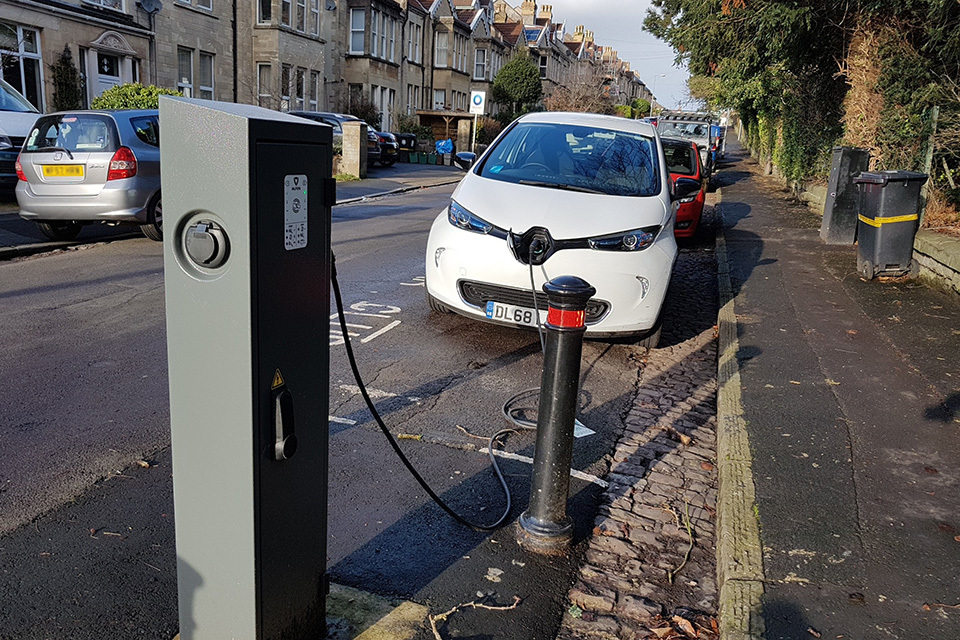
In December 2023 the Department for Transport launched a £70 million pilot scheme to “power up motorway service areas to pave the way for ultra-rapid electric vehicle (EV) chargepoints”, rather lazily using a picture (right) of a car being charged at the roadside.
However, this March the Guardian reported that ministers were considering “diverting money” from the RCF, which had still not paid out any grants.
Reading the latest Guardian story, you get the impression that most experts consider the RCF to be pretty ineffective, with complaints focusing on whether the money should have been spent elsewhere.
Increasing the number of public chargers is seen as crucial to persuading people to switch to electric cars. However, the focus has shifted from rapid chargers, which can allay “range anxiety” on longer journeys, to the slower on-street chargers needed for car owners who do not have private parking spaces.
But here’s the rub:
The Department for Transport said the RCF had never formally been included in budget plans, so the promise was unfunded.
There isn’t any money to divert, like a lot of Tory transport promises.
But what about the March story that said…
Much of the cash allocated to the rapid charging fund (RCF) could be redirected to investments in other charging schemes, or to support the transition to electric vehicles more broadly, although decisions have yet to be made, according to a person close to discussions in government.
And
A government source said that there is no plan to scrap the programme, but added that it needed to be adjusted to reflect the changes in the market.
“We want to make best use of government money,” the person said. “The concept of supporting charging is not going anywhere.”
One lesson from this is never to put any weight on an anonymous source who tells you that there are “no plans” to do something.
And “not going anywhere” is an interesting choice of words for the concept of supporting charging as the government backs away from it.
The need to increase the charges to manage traffic highlights the need for the additional capacity that [Lower Thames Crossing], for which the government confirmed new funding yesterday, will provide.
Translation: we have failed to manage traffic demand so we are building a new road to accommodate it.
What makes the statement worse is that Greenwood explains in great detail the purpose of the charge and its recent history.
To manage demand and protect the crossing’s role as a vital component of the nation’s economic infrastructure, a user charge has been collected at the crossing since 2003. In 2014, the tollbooths were removed to help make journeys smoother and the charge was increased to help manage increased demand. This was the last time that charges were increased for all vehicles.
In the 11 years since, demand at the crossing has grown 7.5%, with the crossing now used by an average of over 150,000 vehicles every day and up to 180,000 vehicles on the busiest days. These traffic levels are well in excess of the crossing’s design capacity, causing delays for drivers using the crossing, congestion and journey disruption to drivers on the M25 and a range of knock-on impacts for local communities.
And then the killer:
The new charges will be significantly lower than if they had increased in line with inflation since the tariff was last fully revised in 2014.
So not only is the government (implicitly) admitting that failing to increase charges at least in line with inflation over the past 11 years means traffic levels “well in excess of the crossing’s design capacity”, but the charges are still not keeping up with inflation.



 Transport Insights
Leave a comment