
The transport secretary watered down National Highways’ plan to reduce deaths and serious injuries on its network, despite telling MPs that the plan set out “a series of safety improvements” that her department had required the company to deliver.
Heidi Alexander also misled MPs on the Transport Committee last April by presenting the plan as complete when it was still in draft form, despite the year that it covered already having begun.
In fact, she subsequently directed National Highways to remove one action from its 2025-26 Safety Action Plan, while the company shortened two others, for reasons that it has declined to explain.
According to the plan, all three actions had the “expected impact” of reducing killed and seriously injured (KSI) casualties at a time when National Highways was expected to miss its official casualty reduction target.
The obvious implication of this is that watering down the plan will have led to more KSI casualties than if it had been implemented in full.

The revelations, which stem from my Freedom of Information (FOI) Act requests and subsequent complaints to the Information Commissioner’s Office (ICO), raise new questions about transparency at the Department for Transport (DfT), National Highways, and its regulator, the Office of Rail and Road (ORR).
I first became aware of the plan following Alexander’s appearance before the Commons Transport Committee on 23 April last year, at a time when National Highways should already have begun to implement it.
Asked by Liberal Democrat MP Steff Aquarone whether she was “minded to make a specific direction” to the company, which was expected to miss its December 2025 KSI reduction target, she replied:
We have been clear with National Highways that it must deliver a series of safety improvements. It has set that out in its safety action plan for 2025‑26.
I then asked the DfT, National Highways and the ORR for the plan under FOI but all refused, claiming that it was exempt from disclosure as it was due to be published as part of National Highways’ delivery plan for the year. A watered down version of the plan was indeed published in July as Annex 7 to the delivery plan.
The ICO has now issued a decision notice on my complaint about the ORR, which discloses that at the time of my FOI request the ORR held various “draft” versions of the safety action plan:
ORR says that these “drafts included the final version” of the Interim Period Delivery Plan. National Highways (NH) submitted this to the Secretary of State for approval prior to publication and delivery.
However, ORR says that in its approval, the Secretary of State removed from the Safety Action Plan 2025-2026 one action that NH had previously proposed.
I have asked the DfT to explain why Alexander did this and am awaiting a response. It has previously denied that the plan was watered down.
As a result of my complaint to the ICO about the DfT’s refusal to disclose the safety action plan, the department has also sent me a version of plan that it held at the date of my request
and contains information that was not ultimately published as part of the finalised action plan.
Comparing this to the version published in July 2025, it can be seen that one action – a “Know your HGV zones” campaign – was removed altogether, while two – the ‘Safe T.R.I.P. Checks’ campaign and the Motorcycle (BikerTek) campaign – had their end dates brought forward from the end of March 2026 to the end of September 2025.
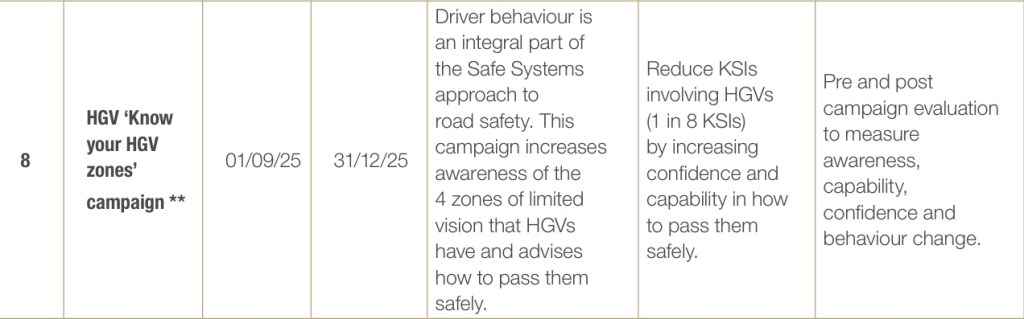
The table setting out the actions has a column setting out the “expected impact” of each. All were expected to “reduce KSIs”.
Not only did Alexander not tell MPs that the plan was in draft at the time Alexander, but she told them that at that time National Highways had already set out a series of safety improvements within it, falsely conveying the idea that it was a finished document.
What makes her statement even more misleading is that, where she suggested that the DfT was pushing National Highways to do more to cut casualties, the reality is that she herself demanded that it do less than it was proposing.
The ICO ruled that the ORR was factually incorrect to state that the draft version of the plan that it held was “the final version”.
This is a huge embarrassment means for regulator as it means that it either did not notice that the plan was subsequently watered down, or misled me and, more importantly, the public by failing to disclose this, again raising questions about its competency and transparency
The regulator claimed in a blog post in October:
we continue to hold National Highways to account for delivering its plans to improve safety for road users
It also claimed:
it is important that the company continues to do all it reasonably can to reduce casualties by as much as possible.
Clearly, by this time it should have known that the company was not doing all it could do and had cut or curtailed a list of actions that it proposed to take.
The ORR has so far declined to comment on or explain this.
The DfT has stated that National Highways did deliver the “Know your HGV zones campaign”, a longstanding campaign to warn drivers of sitting in a lorry driver’s blindspot.
This does not excuse or explain the decision to remove the campaign and it is unclear that the company did anything beyond telling road safety agencies in January that it was running the campaign and inviting them to use existing media assets.
That was later than the original December deadline for the campaign and meant that it was too late to make any impact on road safety during the year to which the company’s casualty reduction target was based.
 Transport Insights
Leave a comment