
Following up on my piece about the impact of the major works at Junction 10 of the M25 on road users, I’d like to return to a story I covered elsewhere in January about National Highways’ efforts to persuade drivers disrupted by roadworks that work is being done, even when it probably isn’t.
The company’s Guidance for using Electronic Boards for Roadworks (EBRW), with the subtitle “Guidance for using ‘customer friendly’ messages through roadworks” is explicit about the need to use information boards for public relations purposes.
In fact, it frames National Highways’ “primary objective” in a way that you may find surprising:
For the rest of RIS2, and moving into RIS3, it is imperative we focus on our primary objective of maintaining and improving our reputation with customers.
Not safety, not decarbonisation, not even improving customers’ journeys, but making them feel like they have had a good journey is the company’s primary objective.
As electronic signage, together with more relatable digital information has been shown to improve journey satisfaction to support this goal, we have tested innovative messages on electronic billboards (EBBs) that will look significantly different from MS4s and other roadside signage. The messages were developed to test the impact of ‘customer friendly’ messaging, specifically to improve customer journey satisfaction when travelling through roadworks. They were also created to explain why roadworks were taking place and to provide information at ‘no visible activity’ sites.
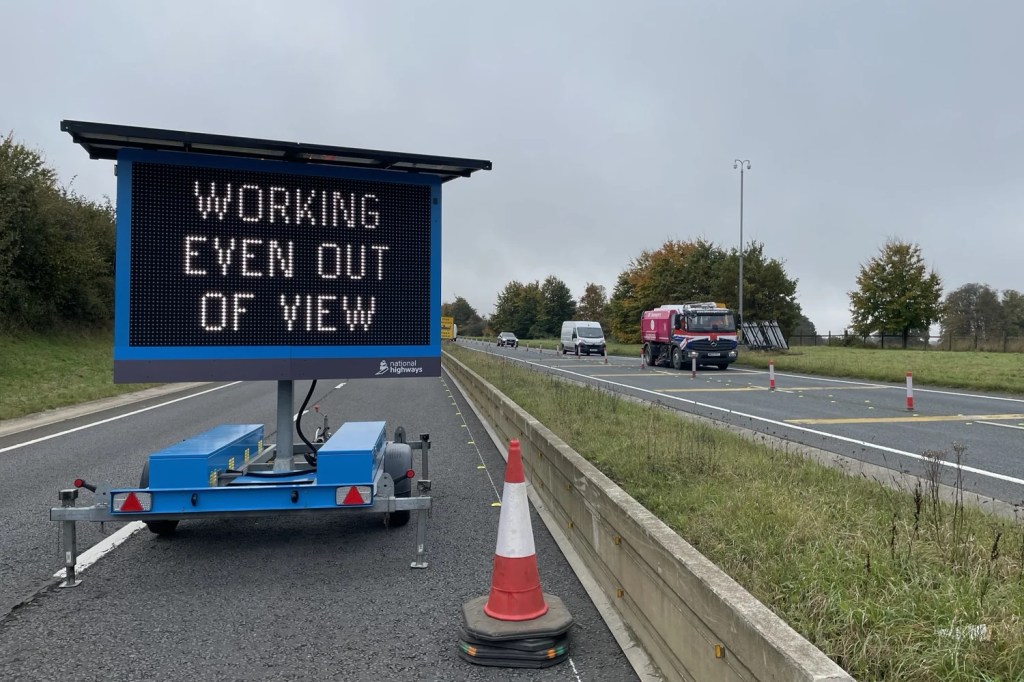
This press release from intelligent transport systems provider SRL states that last October the company provided custom variable message sign equipment on a contraflow section of the A417 Missing Link project, allowing National Highways to communicate “transparently and succinctly” with “messaging” such as “Working even out of view”.
National Highways project manager Nick Nandhra described the new signs as “a significant advancement in our goal to enhance road user experiences”.
Some might call it electronic gaslighting, if that were not a very mixed-up metaphor.
 Transport Insights
Leave a comment